Your search St. Egyden gave 2268 results.
A certain Hermanio has been identified in the dedication of several monuments in different cities in Dacia and even in Rome.

Fresco du Mithraeum de Hawarte, Syria, depicts Mithras' victory over the Sun.
The Mithras of Cabra is the only full preserved Tauroctony sculpture found in Spain yet.
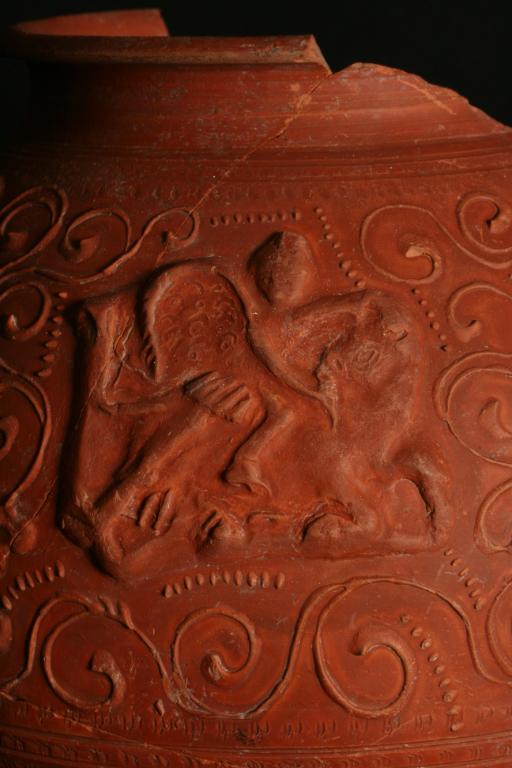
Musée Saint-Raymond, musée d'Archéologie de Toulouse, associate curator of the exhibition Le mystère Mithra, plongée au cœur d'un culte romain.
This altar found in Sentinum bears an inscription from two brothers.
The Mithraeum of Spoleto was found in 1878 by the professor Fabio Gori on behalf of Marquis Filippo Marignoli, owner of the land.
The Mithraeum of Koenigsbrunn is the only one preserved in the ancient Roman province of Rhaetia, current Bavaria.
Mithraeum III in Ptuj was built in two periods: the original walls were made of pebbles, while the extension of a later period was made of brick.
Part of the finds from the fifth Mithraeum of Ptuj is kept in the Hotel Mitra in the modern city.
The Barberini Mithraeum was discovered in 1936 in the garden of the Palazzo Barberini, owned by Conte A. Savorgnan di Brazza.
During the excavations of 1804-1805, a series of monuments dedicated to Mithras and a temple were discovered at ancient Mons Seleucus.
This intaglio with Mithras killing the bull on one side and Kabiros on the other was probably used as a magical amulet.
This intaglio depicting Mithras killing the bull is preserved at the Bibliothèque national de France.
This ancient carnelian intaglio mounted in gold depicts Mithras slaying the bull surrounded by his companions Cautes and Cautopates.
The Mithraeum located in Piazza Dante in Rome was discovered in 1874 along with a series of monuments dedicated by a Pater named Primus.
This fragmentary relief shows Cautopates bordered by three of the six zodiacal signs with which He is associated: Capricorn, Sagittarius and Scorpio.
Mithras Tauroctony on bronze exposed at the Metropolitan Museum of New York.
This monument dedicated to 'Invicto Patrio' was found in Milan in 1869.
