
Altar from the Drave valley between Teurnia and Virunum, Noricum, now reused as a pedestal for a cross, dedicated to Invicto deo Mithrae for the welfare of Marcus Publius Potens by his freedman Ursulus.
Column found at Sankt Peter in Holz, ancient Teurnia in Noricum, dedicated to Cautes by Lucius Albius Atticus and Caius Albius Avitus — probably father and son — making it a rare joint family dedication to a Mithraic torchbearer.
Small marble head from Saifnitz, Noricum, wearing a Phrygian cap; possibly representing Attis or a Mithraic torchbearer.
Marble altar found in flood gravel at Aguntum, Noricum, dedicated to Deo invicto Soli Mithrae collectively by the Aguntenses, making it one of the rare collective dedications to Mithras.
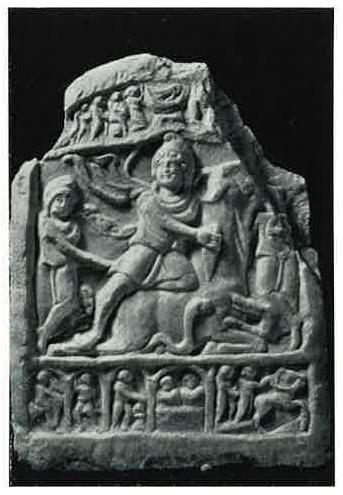
Small limestone tauroctony relief from Enns, ancient Lauriacum in Noricum, found about 100 metres east of the north-east corner of the castra, depicting Mithras killing the bull with dog and serpent and flanking torchbearers.
Carbonised plant remains (4,210 g) from the third room of the Mithraeum at Linz, ancient Lentia, comprising vine, prunes, hedge- and cornelberries, apple pips, walnuts, and millet; interpreted as a ritual food offering to the god.
Several thin silver fragments from the Mithraeum at Linz, ancient Lentia, reconstructed as a votive object surmounted by a crescent or two horns; paralleled in sanctuaries of Jupiter Dolichenus.

Three-fragment terracotta plate from the Mithraeum at Linz, ancient Lentia, with a seven-hole border and a graffito in the centre invoking Iupiter Optimus Maximus; found in the second room of the sanctuary.
Pottery assemblage from the cult room of the Mithraeum at Linz, ancient Lentia, including glazed dishes, three-handled serpent-vases, and related fragments; a vessel type closely associated with Mithraic ritual in the Danubian provinces.
Two-fragment stone altar from the Mithraeum at Linz, ancient Lentia in Noricum, dedicated to Deo Soli invicto Mithrae sacrum by Tiberius Iulius Ursalus, a veteran, for himself and his family.
Two fragments of a larger circular marble relief from the Mithraeum at Linz, ancient Lentia, preserving only the legs of the torchbearers and the outer border, with subsidiary scenes including the rock-birth and an ibex.
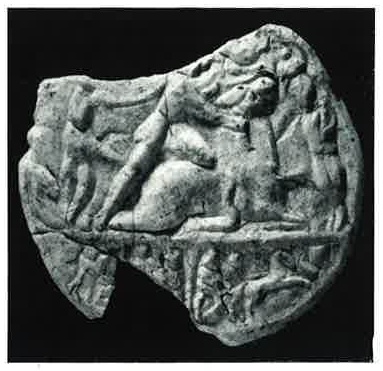
Small circular marble tauroctony relief from the Mithraeum at Linz, ancient Lentia, depicting Mithras killing the bull with dog, serpent, and scorpion, flanked by cross-legged torchbearers with a lion behind Cautopates; the lower section is divided into three subsidiary scenes…
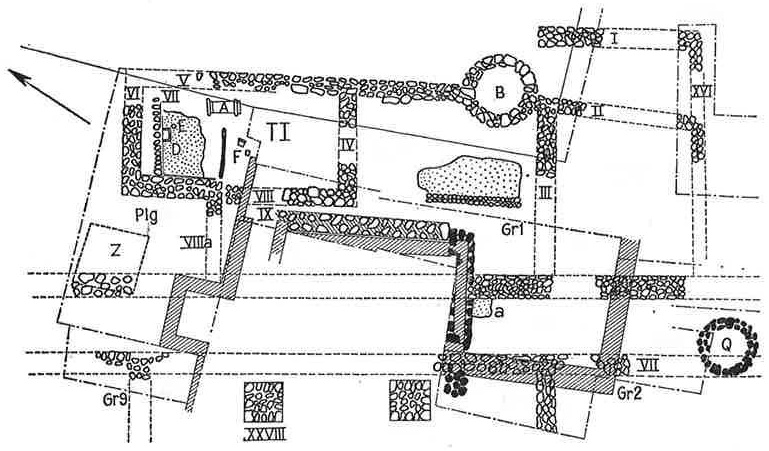
Mithraic sanctuary found in the Tummelplatz at Linz, ancient Lentia in Noricum, constructed within an existing building; the sanctuary yielded marble reliefs, an altar, cult pottery, and a silver votive object.
Inscription from Oberrohr, Noricum, walled into the right of the north porch of the parish church, recording a dedication to Deo invicto Soli.
Altar from Höglwörth, ancient Bedaium in Noricum, dedicated to Deo invicto Mithrae for the welfare of Marcus Lollius Priscus by his freedmen Ianuarius and Lupercus.
Fragments of an altar and an inscription from the Mithraeum at Moosham, Noricum, preserving only the opening of a pro salute dedication; traces of fire are visible.
Small Phrygian-capped head of Mithras from the Mithraeum at Moosham, Noricum, probably belonging to the cult relief.
Altar from the Mithraeum at Moosham, Noricum, dedicated to Deo invicto Mithrae for the welfare of Lucius Albius Atticus; the dedicant's name has been deliberately abraded.
Marble epistylium in three fragments from the Mithraeum at Moosham, Noricum, decorated with a central tree, a flying hind pursued by a dog and an Amazon, a walking lion, and a horseman; bearing an identical inscription on both lateral tabulae.
Small Mithraic sanctuary (8 × 8 m) excavated in 1950–52 on a slope west of Schloss Moosham, Noricum, on the left bank of the river Mur; the finds include a marble epistylium, a Mithras head, and fragmentary altars.
