
Biography
of Gaius Camilius Superatus
- Gaius Camilius Superatus is attested as a member of a Mithraic community (syndexios).
- Attested at Emerita Augusta, Lusitania, Hispania in 2nd half of 2nd century (TNMM 426).
TNMP 10
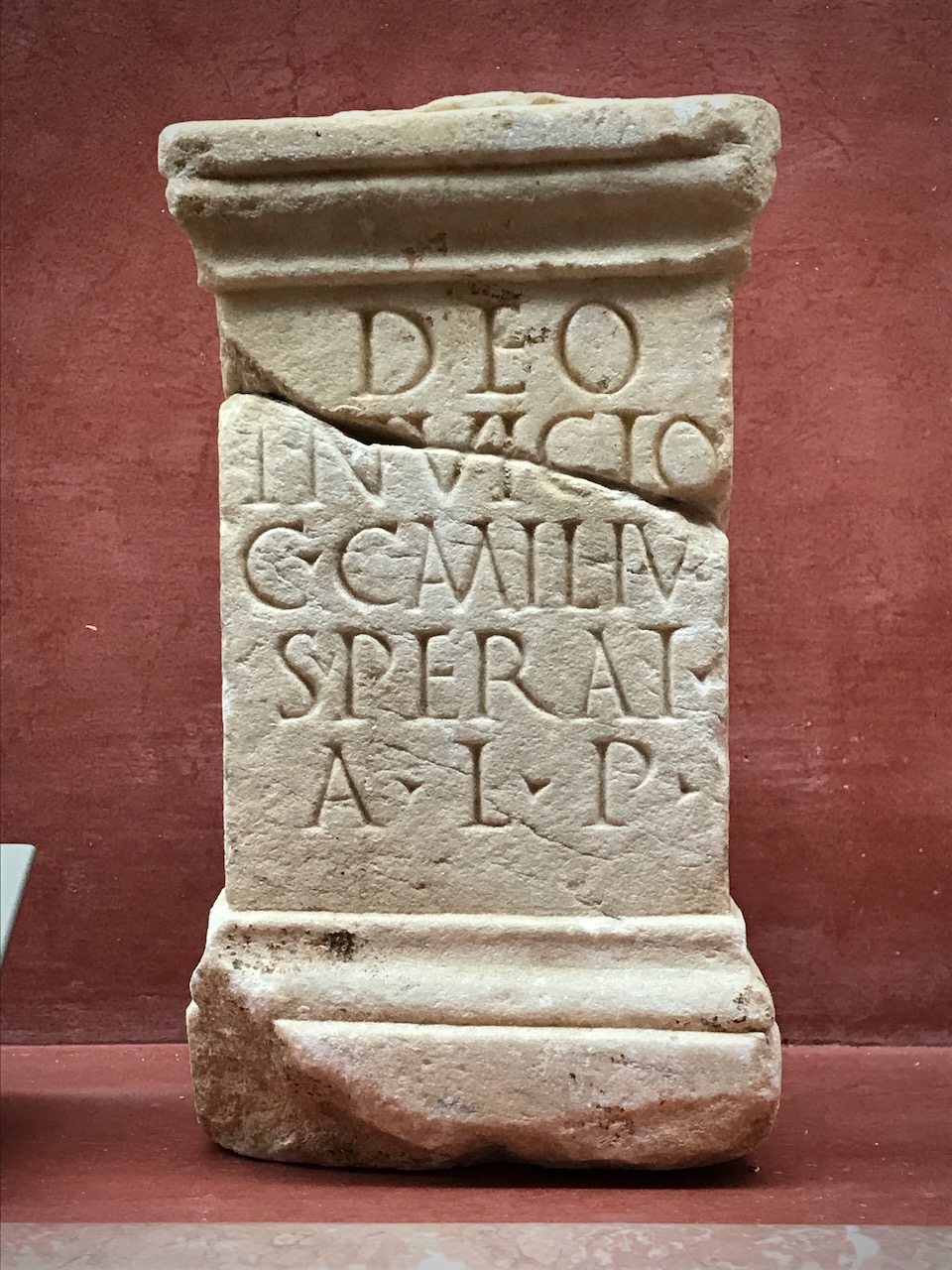
Gaius Camilius Superatus is known from a votive altar (TNMM 426) discovered at the Cerro de San Albín in Emerita Augusta. The inscription records a dedication to the Deus Invictus and is generally dated to the middle decades of the second century CE, contemporaneous with the principal phase of decoration and expansion of the sanctuary (Alvar 2018). Although the text does not explicitly mention Mithras, its archaeological context strongly supports a Mithraic interpretation, and the monument is usually regarded as one of the earliest testimonies to the organised Mithraic community of Emerita.
The dedication places Superatus among the small group of individuals associated with the formative period of Mithraism in Roman Lusitania. Modern scholarship has suggested that the emergence of the community was linked to the activities of figures such as Marcus Valerius Secundus and Gaius Accius Hedychrus, who appear to have played a central role in establishing and financing the cult in the provincial capital. Within this milieu, Superatus may represent one of the earliest known adherents participating in the development of the sanctuary and its ritual life, although his precise status, occupation and relationship to other members remain unknown.
Nothing can be established with certainty regarding his social background. His nomen Camilius is well attested within the Roman world and provides no clear indication of geographical origin. Likewise, there is no convincing evidence linking him to the similarly named Lucius Servilius Superatus known from a lost inscription from Malaca. The differences in nomenclature make such an identification highly speculative and it is generally preferable to treat the two individuals separately (Chalupa 2023).
The altar dedicated by Superatus nevertheless remains an important witness to the consolidation of the Mithraic community of Emerita Augusta during the Antonine period, a phase marked by significant investment in cultic architecture, statuary programmes and votive activity (Alvar 2018).
References
- Aleš Chalupa (2023) Římský kult boha Mithry. Atlas lokalit a katalog nálezů I.
- Alfred Shenington Geden. Altar by Caius Aemilius Superaius of Merida in EDCS.
- Hispania Epigraphica. Altar by Caius Aemilius Superaius of Merida in HE.
- Jaime Alvar Ezquerra (1981) El culto de Mitra en Hispania.
- Mitra en Hispania. Altar by Caius Aemilius Superaius of Merida in MEH.
Attestations
Altar by Caius Aemilius Superaius of Merida
TNMM 426
Small white marble altar made in honour of Mithras found at San Albín, Mérida.
