
Biography
of Venulus
- Venulus, a slave, is attested as a member of a Mithraic community (syndexios) at the Mithraeum I of Ptuj.
- Attested at Poetovio, Pannonia superior, Pannonia (TNMM 1591).
TNMP 319
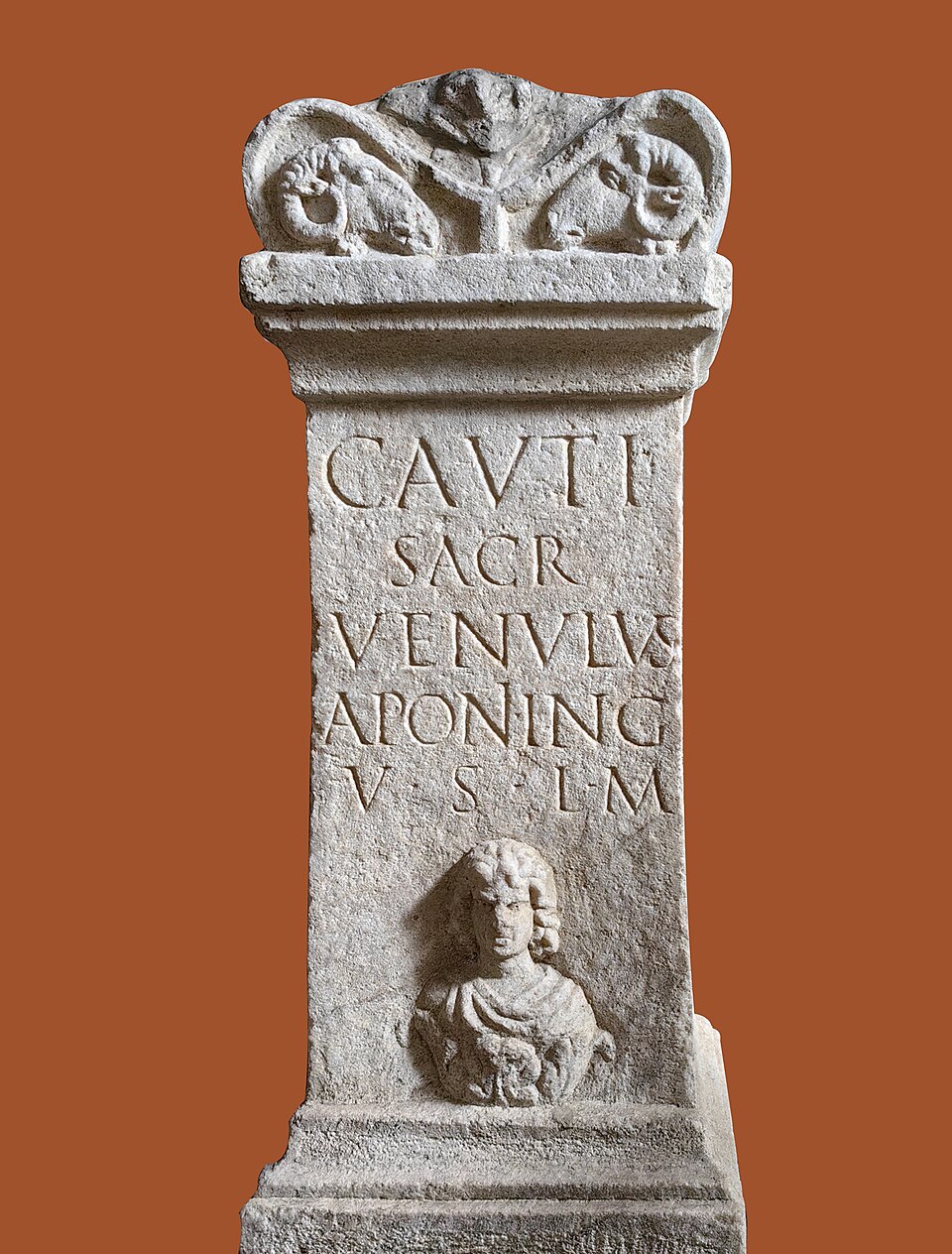
Venulus was an enslaved man belonging to Aponius Ingenuus, known from a marble altar that he dedicated to Cautes in Mithraeum I at Poetovio, modern day Ptuj (TNMM 1591). The inscription identifies him simply as Aponi Ing(enui servus) and records that he willingly and deservedly fulfilled his vow (votum solvit libens merito). No occupation or administrative function is given.
Manfred Clauss (1992) includes Venulus among the numerous enslaved dedicants associated with the earliest phase of Mithraeum I. He observes that enslaved personnel played a particularly prominent role in the sanctuary: most of its early altars were dedicated by slaves, several of whom can be connected with the publicum portorium Illyrici. Unlike many of these men, however, Venulus is not identified as a vilicus, vicarius, scrutator or other official. His owner, Aponius Ingenuus, is likewise not given an office in the inscription. Clauss notes that the nomen Aponius is attested in Italy and southern Gaul and cautions against dating the establishment of the mithraeum to the Hadrianic period solely from the supposedly superior artistic quality of Venulus’ monument.
Françoise Van Haeperen (2024) discusses Venulus together with Cresces, another enslaved dedicant who erected a closely comparable altar to Cautopates. Neither man records a function, and their respective owners, Aponius Ingenuus and Gabinius Antonius, are otherwise unknown. Van Haeperen notes that the unusually careful execution and close similarity of the two altars led earlier scholars, notably Michael Abramić, to propose an origin in an Aquileian workshop and a date as early as the Hadrianic period. Other scholars consequently suggested that they may have belonged to an earlier sanctuary before being transferred to Mithraeum I.
Van Haeperen treats this reconstruction cautiously, but suggests that the two monuments could conceivably preserve evidence for a phase preceding the rebuilding of Mithraeum I associated with Caecina Calpurnius. She also notes that the nomina of the owners of Venulus and Cresces, Aponius and Gabinius, are attested at Aquileia. This raises the possibility of connections with the northern Italian milieu from which some of Poetovio’s early cult personnel or craftsmen may have originated, although neither Venulus’ geographical origin nor that of his owner can be established.
The altar of Venulus is generally dated to the second century e. c.; Ubi Erat Lupa assigns it more specifically to 150–200 e. c. It remains one of the paired dedications to the torchbearers Cautes and Cautopates that form part of the distinctive assemblage of Mithraeum I at Poetovio.
References
- Epigraphic Database Heidelberg (2026) Altar with Cautes bust from Mithraeum I, Ptuj in EDH.
- Epigraphik-Datenbank Clauss / Slaby (2026) Altar with Cautes bust from Mithraeum I, Ptuj in EDCS.
- Françoise Van Haeperen (2024) Mithra en contexte. Les débuts du culte à Poetovio au IIe siècle de notre ère.
- Manfred Clauss (1992) Cultores Mithrae. Die Anhängerschaft des Mithras-Kultes..
- Michael Abramić (1933) Opaske o nekim spomenicima staroga Poetovija.
- Ubi Erat Lupa (2026) Altar with Cautes bust from Mithraeum I, Ptuj in Ubi Erat Lupa.
- Visit Ptuj (2020) Mithras shrines. Mithraeum I and III.
Attestations
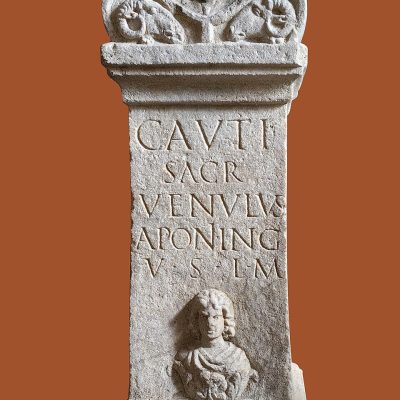
Altar to Cautes by Venulus from Ptuj
TNMM 1591
White marble altar from Mithraeum I at Ptuj, dedicated to Cautes by Venulus and decorated with a bust of the god emerging from foliage.
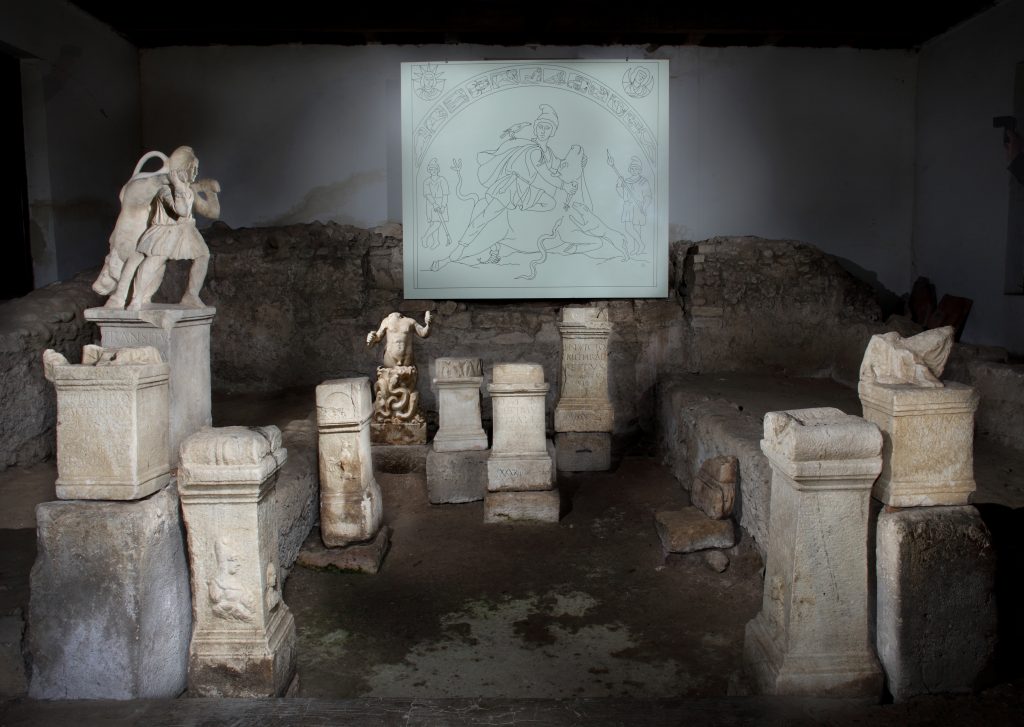
Mithraeum I of Ptuj
TNMM 185
The Mithraeum I of Ptuj contains the foundation, altars, reliefs and cult imagery found in it.
