Your search Anne Le Cam gave 192 results.

Drobeta controlled an important crossing point on the Danube and became one of the major centres of Dacia.
The city of Vienna, modern Vienne, became one of the principal urban centres of Roman Gaul along the Rhône corridor.
Augusta Rauricorum became one of the principal urban centres of the Upper Rhine region.
Alesia became famous as the site of Caesar’s decisive siege during the Gallic Wars.
Aguntum became an important urban centre of Roman Noricum near the eastern Alpine routes.

A fragmentary inscription from Scaleby Castle near Cambeckfort (ancient Petrianae), preserving a partial dedication to Sol Mithras.
Roman settlement of Dacia superior located in the area of present-day Sibiu in Romania. The site became an important urban and military centre, later developed into the medieval city known as Hermannstadt in German and Nagyszeben in Hungarian.
A marble dedication tablet found in the Vigna Curtii Palloni outside the Porta Sant'Agnese near the Praetorian Camp in Rome, recording the construction of a sacrarium dedicated to Sol Invictus by Q. Pompeius Primigenius, pater and sacerdos, under Septimius Severus and Caracalla…
Epigraphic testimony catalogued in the Année Épigraphique and Lugli’s Fontes for ancient Rome.
Small semi-round base found on the Monte Quirinale in Via Mazzarini, from a small Mithraeum, with a dedication to Mithras by T. Camurenus Philadelfus through Nonius Firmus pater.
Marble tauroctony relief fragment from the Byzantine camp at Pontelimonul de sus, ancient Ulmetum in Moesia Inferior, found reused in the masonry; the subject is partly identifiable.
Circular Mithraic relief from Oescus, Moesia Inferior, mentioned by LeRoy Campbell; no further details are available to the author.
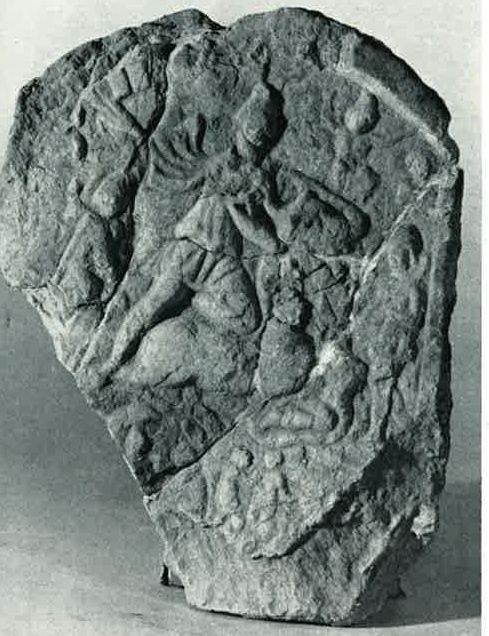
Marble tauroctony relief from the Roman camp at Sucidava, Dacia, found near tower C, depicting the standard bull-slaying with the full iconographic programme.
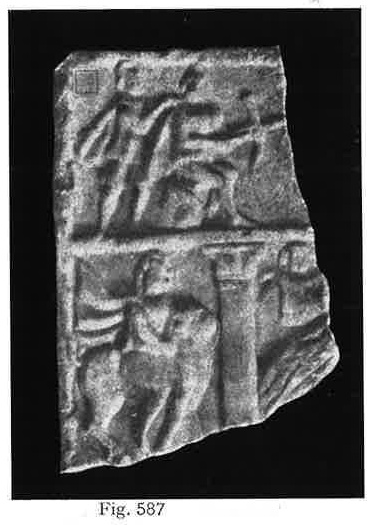
Left upper corner of a white marble tauroctony relief from the Roman camp at Drubeta, Dacia, found in 1896–99, preserving the grotto border and, outside it, Sol in his quadriga with cracking whip.
Mithraic sanctuary found at Sárkeszi near Székesfehérvár, Pannonia Inferior, in a place called Ságvölgyi; yielding altars, tauroctony reliefs, and cult objects.
Trapezium-shaped limestone tauroctony relief from Nagytétény, ancient Campona in Pannonia Inferior, depicting Mithras killing the bull in an arched niche with scorpion, serpent, and torchbearers.
Dark-red clay vase from the refuse pit of the Roman camp at Windisch, ancient Vindonissa, with three handles each encircled by a coiling serpent; a vessel type closely associated with Mithraic ritual.
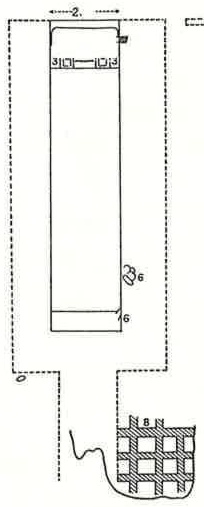
Mithraic sanctuary discovered behind the west part of a Roman cemetery near the camp at Gross-Krotzenburg in 1881, finds destroyed in World War II
A marble statue fragment found at Sentinum (modern Sassoferrato) in ancient Umbria, walled in the atrium of the Palazzo Raccamadoro-Ramelli, showing Mithras tauroctone with dog, serpent and scorpion, one foot pointing towards a torchbearer; the bull's head, tail and Mithras'…
Marble relief with the dressed busts of Sol with five rays, a long-bearded man, and Luna with crescent, found in the camp of the equites singulares near the Scala Santa, now in the Museo Nazionale delle Terme.
