Biography
of Caelius Hilarianus
- Caelius Hilarianus, a senator, is attested as a Pater, with a recorded role as Duodecemvir urbis Romae.
- Attested at Roma, Latium, Italia in 377 (TNMM 620).
TNMP 202
Caelius Hilarianus was a Roman senator (vir clarissimus) active during the second half of the fourth century CE. He is known from an altar dedicated to Magna Mater and Attis Menotyrannus discovered among the inscriptions traditionally associated with the Vatican Phrygianum. The inscription, dated 13 May 377, records an extensive series of priestly functions and constitutes one of the clearest attestations of senatorial participation in Mithraic worship during Late Antiquity (TNMM 620; Griffith 1993; Walsh 2016).
In the inscription, Caelius Hilarianus describes himself as duodecemvir urbis Romae, pater sacrorum and hieroceryx of Mithras, priest of Liber, and priest of Hecate (TNMM 620). His accumulation of priestly offices reflects a broader phenomenon among members of the late Roman aristocracy, several of whom simultaneously held positions in Mithraic, Dionysiac, Hecatean, Isiac, and Metroac cults. Comparable combinations of religious titles are attested for contemporaries such as Ulpius Egnatius Faventinus, Iunius Postumianus, and Alfenius Ceionius Iulianus Kamenius (Griffith 1993; Walsh 2016).
The Mithraic titles borne by Caelius Hilarianus are particularly noteworthy. While the title pater clearly identifies him as a senior member of a Mithraic community, the designation hieroceryx (“sacred herald”) appears repeatedly in fourth-century aristocratic inscriptions and seems to have formed part of the ceremonial vocabulary adopted by these elite circles. Modern scholarship has debated the extent to which such aristocratic devotees represented a continuation of earlier Mithraic communities or a transformed expression of late pagan religiosity. Whatever the interpretation, the inscription demonstrates that Mithraic priesthoods remained prestigious among sections of the Roman senatorial elite as late as 377 CE (Griffith 1993; Clauss 1992; Walsh 2016).
References
- A. B. Griffith (1993) ‘Mithraism in the private and public lives of 4th-c. senators in Rome’. The archaeological evidence for Mithraism in imperial Rome.
- Epigraphik-Datenbank Clauss / Slaby. Altars from the Phrygianum of the Vatican by two clarissimi in EDCS.
- Manfred Clauss (1992) Cultores Mithrae.
Attestations
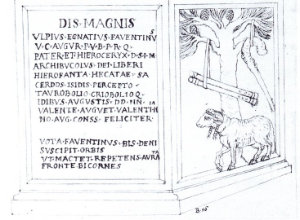
Altars from the Phrygianum of the Vatican by two clarissimi
TNMM 620
Both of them were discovered in 1609 in the foundations of the façade of the church of San Pietro, Rome.
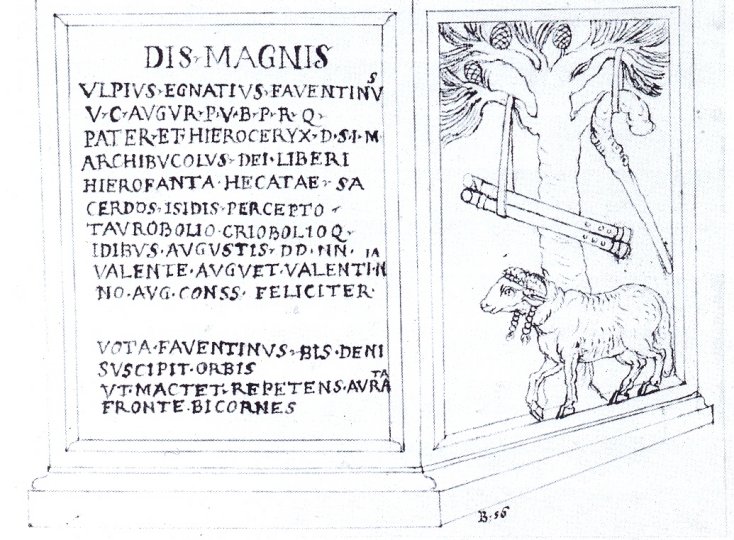
Dis magnis / Ulpius Egnatius Faventinus / v[ir] c[larissimus] augur pub[licus] p[opuli] r[omani] q[uiritium] pater et hieroceryx d[ei] s[olis] i[nvicti] M[ithrae] / archibucolus dei Liberi / hierofanta Hecatae sa/cerdos Isidis percepto / taurobolio criobolioq[ue] / idibus augustis d[ominis] n[ostris] / Valente Aug[usto] V et Valentinia/no Aug[usto] co[n]s[ulibus] feliciter
Vota Faventinus bis deni suscipit orbis / Ut mactet repetens aurata fronte bicornes.
To the great gods. Ulpius Egnatius Faventinus, vir clarissimus, public augur of the Roman people of the Quirites, Father and sacred herald of the god Sol Invictus Mithras, archibucolus of the god Liber, hierophant of Hecate, priest of Isis, having received the taurobolium and criobolium on the Ides of August under our lords Valens Augustus, consul for the fifth time, and Valentinian Augustus as consuls, happily [fulfilled his vows].
Faventinus undertakes the vows of the twice-ten-year cycle, so that, returning once again, he may sacrifice the golden-fronted horned victims.