Your search Castellammare di Stabia gave 2069 results.

Fragmentary marble inscription from Mithraeum II at Ptuj, ancient Poetovio, preserving only the abbreviated dedication to Deo Soli invicto Mithrae.
Inscription from the area of the castellum at Sisak, ancient Siscia, recording that Iucundus, imperial dispensator of Pannonia Superior, built a portico and an aparatorium for Deo invicto Mithrae ex voto.
White marble slab from the Zollfeld at Virunum, Noricum, dedicated to Deo invicto Mithrae by Diadumenus, arcar(ius) of the imperial dispensator Nicolaus for the kingdom of Noricum.
Altar from the Mithraeum at Neuenheim dedicated to Iovi optimo maximo by Candidius Quartus
Two sandstone altar fragments from Mainz, ancient Mogontiacum, with a partially preserved dedication to Deo invicto Mithrae
Sandstone relief fragment from Rückingen with an indistinct standing figure, probably a woman, in an arched niche
Three basalt fragments of a standing figure in jack-boots from Mithraeum III at Heddernheim, ancient Nida, with traces of red paint on the loin-cloth
Two basalt blocks walled into the podium of Mithraeum III at Heddernheim, ancient Nida, which supported decorative sandstone bases
Sandstone relief from Ober-Florstadt featuring two arched niches each containing a naked Dioscurus wearing a shoulder cape and pilum
Inscription dedicated by Caius Paulinius Iustus to the Virtus of the invincible deity within the Mithraic sanctuary.
Small marble relief of Mithras slaying the bull within a wreath decorated with zodiac signs.
Simple inscribed altar dedicated to the invincible deity from Cologne.
Latin dedication to the invincible Mithras reportedly discovered north of ancient Colophon in Lydia.
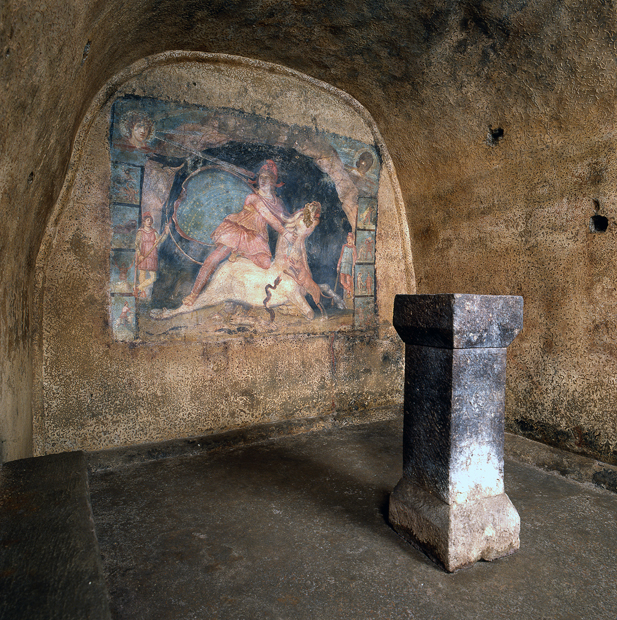
The Marino Mithraeum preserves one of the most elaborate painted cycles of Mithras’ myth, combining the tauroctony, planetary symbolism and scenes from the god’s sacred narrative.
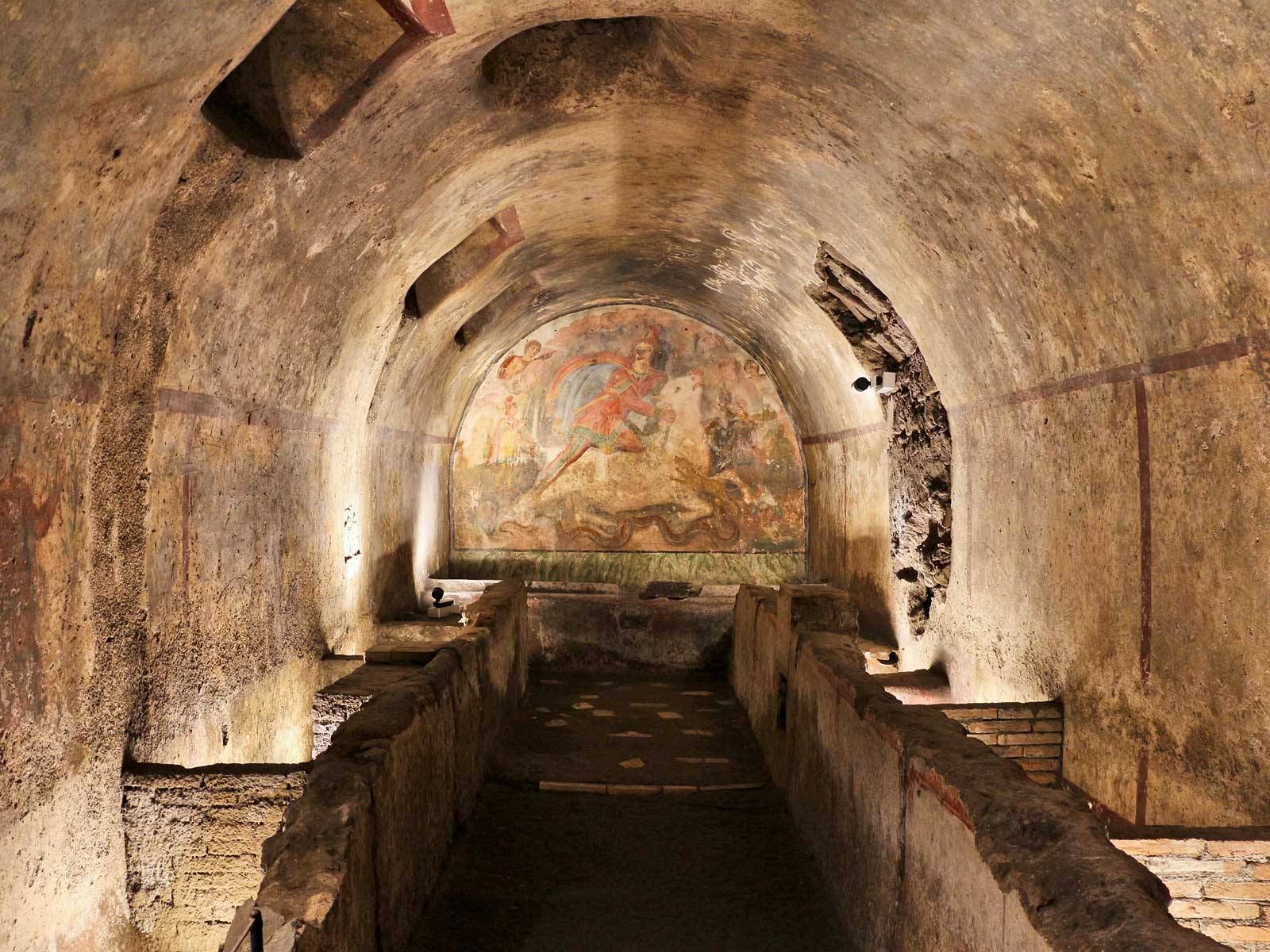
One of Roman Italy’s most important Mithraic sanctuaries, the Mithraeum at S. Maria Capua Vetere preserves a remarkable painted cycle of initiation scenes, offering rare visual evidence for the ritual life of Roman Mithaism.

Diana Veteranorum, today a village called Ain Zana, was an ancient Roman-Berber city in Algeria.
Settlement of prehistoric origin that developed into the Roman Vicus Vetonianus, modern Dieburg, incorporated into the civitas Auderiensium in Germania Superior and attested as an active centre during the Roman period.
Gimmeldingen is a village, part of the town of Neustadt an der Weinstraße, Germany. Its origins, along with the village of Lobloch (which used to be connected), can be traced back to Roman settlements in 325 AD.
Plovdiv is the second-largest city in Bulgaria, standing on the banks of the Maritsa river in the historical region of Thrace, behind the state capital Sofia.
Zerzevan Castle, also known as Samachi Castle, is a ruined Eastern Roman castle, a former important military base, in Diyarbakır Province, southeastern Turkey.
