Your search Roger Jehu Bull gave 454 results.
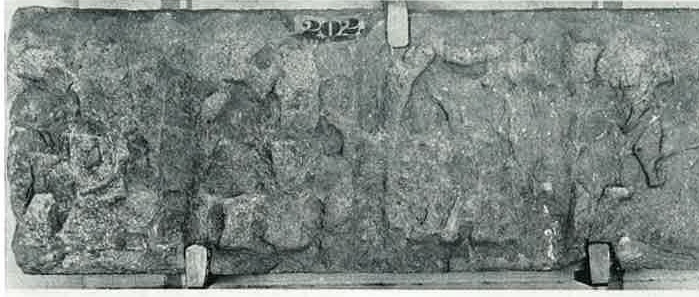
Badly damaged red sandstone relief from Hölzern, Germania Superior, depicting the standard bull-slaying scene; possibly forming part of the border zone of a larger composition.

Grey limestone relief fragment from Rockenhausen found at the Pfingstborn spring, preserving part of the bull-slaying scene
Tuff fragments including a knee, thigh and possible lunar head from a bull-slaying scene.
Marble stele relief with bull-slaying scene and subsidiary Mithraic episodes including the sacred banquet.
Terracotta matrix used to produce vessels decorated with the bull-killing scene of Mithras.
Decorated ceramic vessel showing Mithras slaying the bull together with torchbearers, zodiacal motifs and figures of abundance.
Marble relief showing Mithras slaying the bull inside a vaulted cave accompanied by Sol, Luna and the torchbearers.
Circular marble relief preserving part of the bull, a serpent and zodiacal signs associated with Mithraic iconography.
A marble statue fragment found at Sentinum (modern Sassoferrato) in ancient Umbria, walled in the atrium of the Palazzo Raccamadoro-Ramelli, showing Mithras tauroctone with dog, serpent and scorpion, one foot pointing towards a torchbearer; the bull's head, tail and Mithras'…
Two Mithraic monuments received by the Museo Nazionale delle Terme in Rome in 1896, reportedly from Narni: a small head of Mithras tauroctone in Phrygian cap with traces of red and gilding, and a central relief fragment of Mithras slaying the bull.
A marble tauroctony relief fragment probably from Narni (ancient Narnia) in Umbria, now in the Museo Nazionale delle Terme in Rome, preserving Mithras in Eastern dress as a bullkiller with dog and Cautopates standing cross-legged before the bull; the exact find-spot is uncertain…
A rectangular marble tauroctony relief found in Etruria, once in the Villa Martin at Settignano near Florence, showing Mithras slaying the bull with Cautes and Cautopates in Eastern attire cross-legged on either side and the busts of Sol and Luna in the upper corners;…
A white marble tauroctony statue fragment in the Palazzo Corsini in Florence, possibly from the Florentine area, heavily restored, with the upper body of Mithras and the bull's hind quarter with scorpion preserved but hind-legs lost and the god's head replaced by a petasus…
A white marble tauroctony relief found near a Roman villa on the northern slope of Mount Ciminus near Soriano nel Cimino in Etruria, showing Mithras slaying the bull with dog, serpent and scorpion, the bull's tail ending in three ears of grain, the god's resting leg abnormally small…
A white marble tauroctony statue found in 1925 at the ancient site of Lorium near the eleventh milestone on the Via Aurelia outside Rome, showing Mithras slaying the bull with dog, serpent and scorpion, accompanied by Cautes and Cautopates; now in the Palazzo Doria…
A small tauroctony group once in the collection of the sculptor Antonio d'Este in Rome, depicting Mithras as a bullkiller with the two torchbearers, the entire composition carved from a single piece of stone.
Two tauroctony statues formerly at the Villa del Grande near the Porta Maggiore in Rome, both lacking the upper part of Mithras and the bull's head.
A bluish marble tauroctony relief once in the Villa Ludovisi in Rome, showing Mithras slaying the bull with the raven perched on his cloak holding a heart-shaped fruit, the bull's tail ending in ears of grain, and the dressed busts of Sol and Luna in the upper corners…
A white marble tauroctony relief fragment, in the seventeenth century at the Palazzo Caesiani near the Vatican and later in the Villa Ludovisi in Rome, showing Mithras slaying the bull with dog, serpent and raven, with a cross-legged torchbearer on a base; now lost…
Fragment of a red ware dish from Rome, now in the Akademisches Kunstmuseum at Bonn, with a representation of Mithras as a bull-killer sitting astride the bull with a flying cloak.
