Your search Roger Jehu Bull gave 454 results.

Marble statue of Mithras slaying the bull, with the dog and serpent directing their heads to the wound and the scorpion at the testicles, probably found in Rome and now in the Altes Museum at Berlin; Mithras' head, front part of his arms and cloak, and the bull's muzzle are lost…
Fragment of a small tauroctony relief in the Museo Lateranense, Rome, preserving the bull's head and the upper part of Cautopates pointing his torch downwards with both hands, and the bust of Luna with crescent in the upper corner.
Marble relief from the Villa Wolkonsky showing Mithras slaying the bull, with the serpent creeping over the ground.
Fragment of a small white marble relief showing Mithras slaying the bull with the dog, serpent and scorpion, formerly walled in the inner court of the Palazzo Rondinini (now Palazzo Sanseverino), Corso No. 518.
Relief of bluish marble in the Casino of the Villa Doria Pamphili showing Mithras slaying the bull with the usual animals, cross-legged torchbearers, and Sol in a quadriga and Luna in a biga in the upper corners.
White marble relief from the Casino of the Villa Giustiniani showing Mithras slaying the bull, whose tail ends in ears, with the usual torchbearers, dog, serpent, scorpion and raven, and the busts of Sol and Luna in the upper corners.
Two small fragments of a relief showing Mithras slaying the bull with the two torchbearers in a grotto, with traces of polychrome colouring, dated to the second half of the 2nd century A.D.
Fragments of a marble relief of Mithras as bull-killer from the Caracalla Mithraeum, preserving the knee of the bull's right hind-leg, the bent knee of Mithras, and parts of the serpent, dog, cock and a bust in a tunic.
Fragment of a Greek marble relief found in the Via Borgo Vecchio, preserving only the lower part of Mithras as bull-killer in tunic and flying cloak, with a Cautes bearing an upraised torch behind the bull.
Marble serpent's head with a small hole at the beginning of its neck, belonging to a Mithras bull-killing group or a rock-birth scene, from the Mithraeum at the Palazzo dei Musei, Rome.
Fragments of a marble relief preserving only the lower part, with Mithras slaying the bull, dog and serpent licking blood, a large scorpion, and Cautopates behind the bull pointing his torch downwards, from the Mithraeum of S. Lorenzo in Damaso.
Ancient marble fragments walled into the staircase of the house at Via Boncompagni 101 (Boarding-house Cosmopolita), including a lower part of a Mithras bull-killing group and a fragment of a low-relief with the bullkilling; not traced by Vermaseren.
Relief in plaster, fixed on the wall beside the Mithraic wall-painting (No. 386) in the house of the Nummi Albani on the Quirinal, with traces pointing to a representation of Mithras slaying the bull.
White marble slab showing Mithras as a bull-killer on a rocky base, found in 1928 by the Comtesse de Robillant in a cellar of the Palazzo del Grillo behind the Forum of Augustus; Mithras' head, both arms, and the bull's head and tail are lost.
Two marble fragments of a statue of Mithras as bull-killer, preserving the head in Phrygian cap and right hand with dagger, with traces of red paint, from the Mitreo del Palazzo Imperiale at Ostia.
Fragment of a relief showing Mithras as bull-killer with unusual eagle-headed dagger handle and Sol in a quadriga, from Tivoli (ancient Tibur), known only through an inaccurate engraving by Barbault.
Damaged statue of Mithras as bull-killer on a rectangular base, found in the piazza of the Fountain of Apollo at Cyrene.
Marble head with locks of hair and Phrygian cap, probably depicting Mithras as bull-killer, found under the threshold of the Iseum at Cyrene.

Fragment of a silvered bronze plate from Mithraeum II at Stockstadt depicting Mithras grasping the bull for the kill
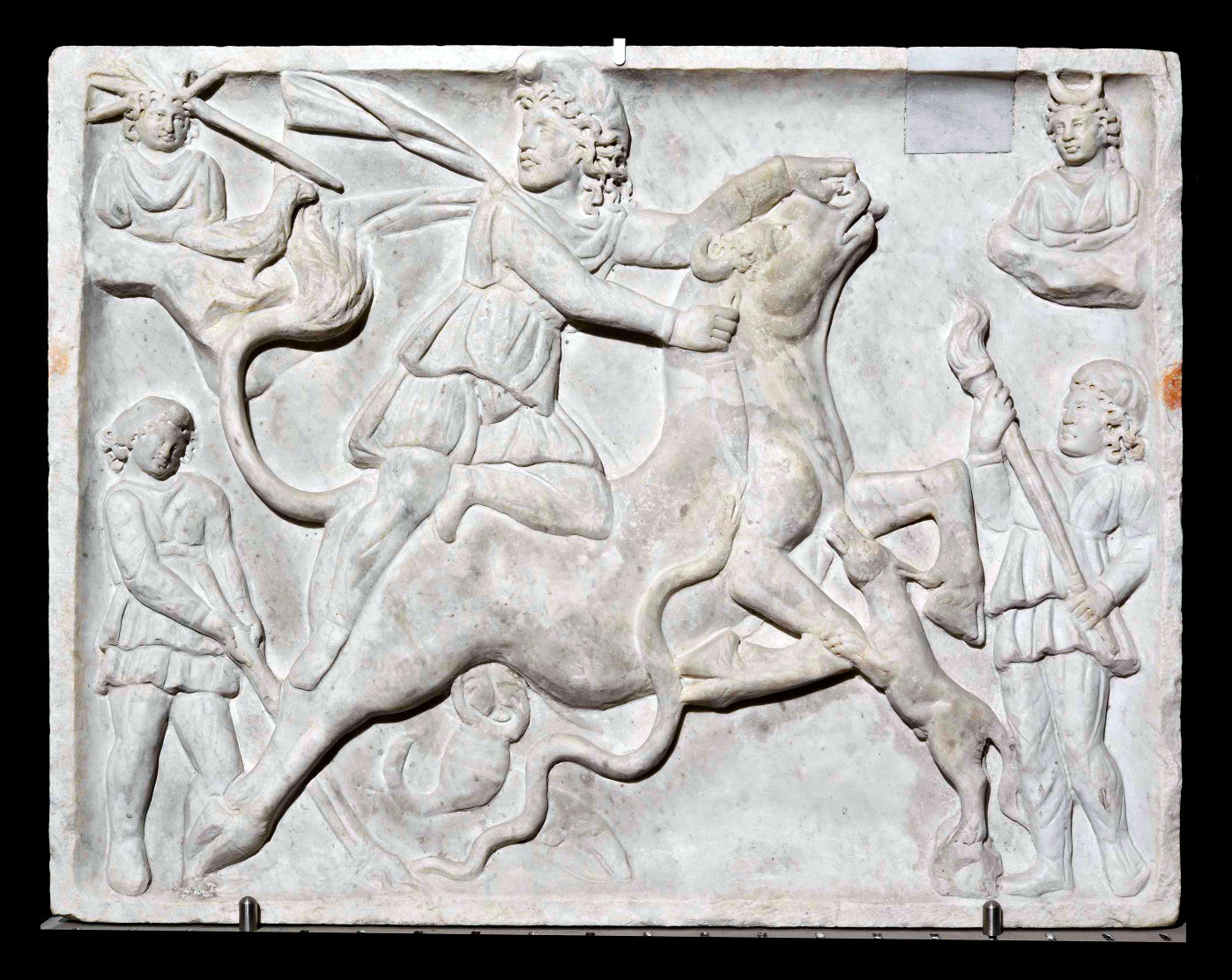
It is not certain that the marble relief of Mithras killing the bull was found on Capri, in the cave of Matromania, where a Mithraeum could have been established.
