Your search Terme di Caracalla gave 2080 results.

Künzing is a municipality in the district of Deggendorf, Bavaria, Germany.
Kalkar is a municipality in the district of Kleve, in North Rhine-Westphalia, Germany.
Brigetio, which became Szőny, was an independent town until 1977, when it was incorporated into Komárom. The Roman legion Legio I Adiutrix was stationed here from 86 AD until the middle of the 5th century.
Argentoratum or Argentorate was the ancient name of Strasbourg. Its name was first mentioned in 12 BC, when it was a Roman military outpost established by Nero Claudius Drusus. The Legio VIII Augusta was stationed there from 90 AD.
The Romans took Arelate from the Ligurians in 123 BC and made it an important city by building a canal towards the Mediterranean. Present-day Arles has preserved many Roman buildings.
Africa Proconsularis formed one of the principal urban and administrative centres of Roman North Africa where Mithraic cults circulated through prosperous civic networks.
Dacia superior formed part of one of the most intensely Mithraic frontier regions of the Roman empire after the conquest of Trajan.
Baetica occupied a prosperous and highly urbanised corner of Roman Hispania where Mithraic cults circulated through Mediterranean exchange networks.

Slave and vilicus in the household of Tiberius Claudius Livianus, linked to the earliest known Mithraic tauroctony.

Member of the Mithraic community of Les Bolards and dedicator of a statue of Cautes.

This supposed Mithraic altar from Soulan in the Pyrenees was later identified as a modern forgery, including both the inscription and the alleged cave context in which it was said to have been discovered.
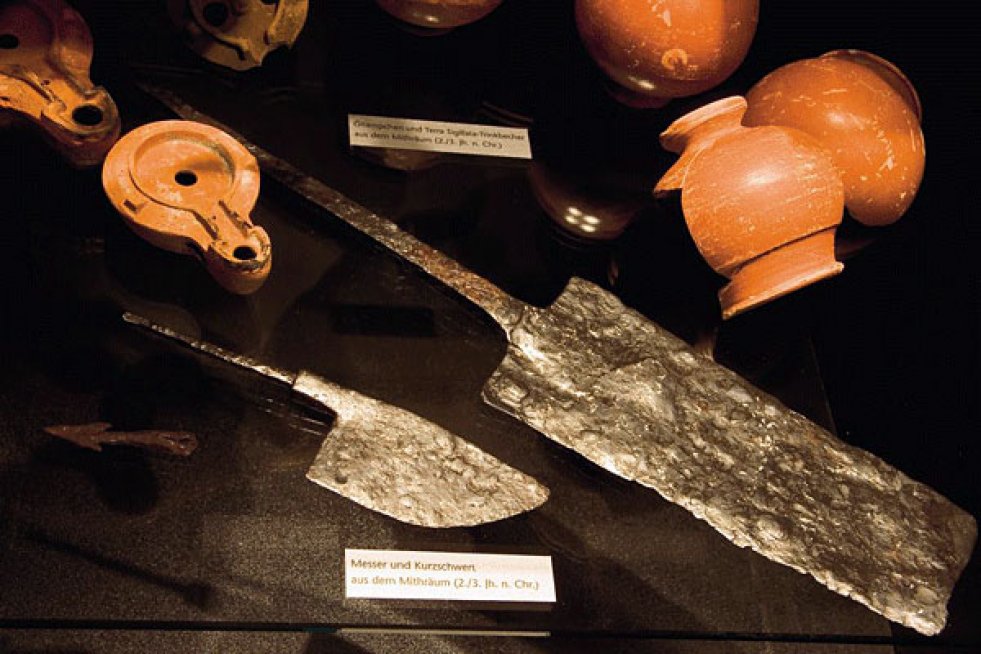
The Mithraeum of Kunzing was an underground building, oriented east-west. The entrance was probably on the east.
Aemilia connected northern and central Italy through prosperous urban centres and major communication routes of the Roman Peninsula.
Britannia superior preserves a substantial body of Mithraic evidence associated with military sites and urban centres of Roman Britain.
Armenia occupied a frontier crossroads between the Roman world, Anatolia and the Iranian cultural sphere.
Liguria linked northern Italy to southern Gaul and the western Mediterranean through coastal and Alpine communication routes.
Venetia connected northern Italy to the Adriatic and Danubian worlds through trade, mobility and imperial communication routes.
Picenum connected the Adriatic coast of central Italy to inland communication routes and the wider networks of the Roman Peninsula.
Samnium occupied a mountainous region of central Italy linked to Rome through military movement and regional urban networks.
Lucania connected inland southern Italy to the Tyrrhenian and Ionian maritime worlds through regional communication networks.
