The corpus from Dacia superior reflects the rapid diffusion of Mithraic cults through military settlements, colonial foundations and mining districts established after the Roman conquest of Dacia. Urban centres and frontier mobility played a central role in the implantation of the cult across the province.
People attested in Dacia superior












Places in Dacia superior
Apulum
Apulum, now within Alba Iulia, was a Roman settlement first mentioned by the mathematician, astrologer and geographer Ptolemy. Its name comes from the Dacian Apoulon.
Cibinium
Roman settlement of Dacia superior located in the area of present-day Sibiu in Romania. The site became an important urban and military centre, later developed into the medieval city known as Hermannstadt in German and Nagyszeben in Hungarian.
Maros Porto
Sighișoara is a municipality on the Târnava Mare River in Mureș County, central Romania.
Ozd
Ózd is a town in Borsod-Abaúj-Zemplén county, Northern Hungary, 40 km from the county seat of Miskolc.
Sarmizegetusa
Colonia Ulpia Traiana Augusta Dacica Sarmizegetusa was the capital and the largest city of Roman Dacia, later named Ulpia Traiana Sarmizegetusa after the former Dacian capital, located some 40 km away. The city was destroyed by the Goths.
Inscriptions from Dacia superior
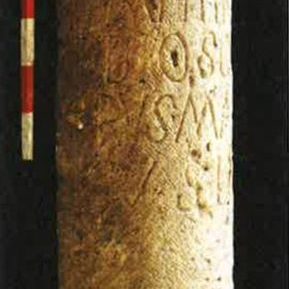
Column of Dioscorus from Alba Iulia
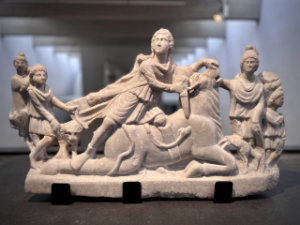
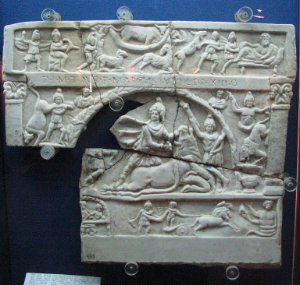
Tauroctony from Aelius Maximus of Turda
Tauroctony relief from Alba Iulia
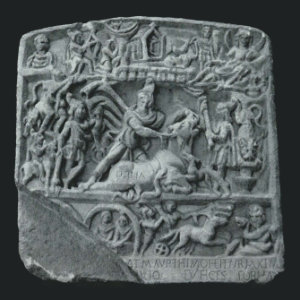
Tauroctony from Euthices from Apulum
Altar of Chrestion from Alba Iulia
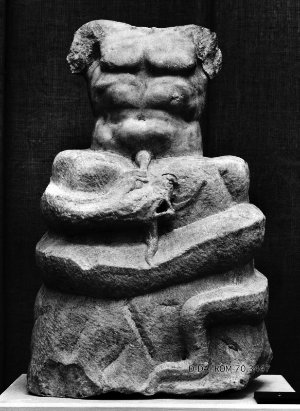
Cautes with bull head of Sarmizegetusa
Altar from Sarmizegetusa by Hermadio
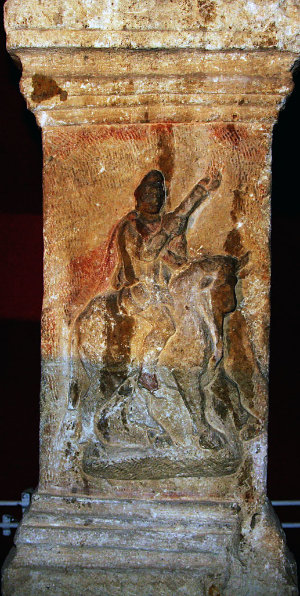
Cautopates of Sarmizegetusa with scorpion
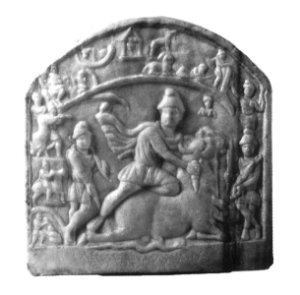
Tauroctony from Aelius Hylas from Doştat
L. Aeli[us] Hylas [vicesimarius] l[ibertus] pr[o] sa[lute] et Horientis [sic] fil[ii] sui et Apuleia[e] eius signum numinis cum absidata / ex voto pos[uit].
Lucius Aelius Hylas, collector of the twentieth tax, freed, for his health, that of his son Horiens and [his wife] Apuleia, following a vow, had the image of the divinity placed with the niche.
Altar of Hermadio from Tibiscum
Column to Nabarze of Protas
Altar of Sextus Syntrophus
References
- Csaba Szabó (2026) Mithras in Roman Dacia. Local Appropriations of a Universal God
- Laurent Bricault & Philippe Roy (2021) Les cultes de Mithra dans l’Empire romain
- Manfred Clauss (1992) Cultores Mithrae. Die Anhängerschaft des Mithras-Kultes.
- Nicolas Amoroso, Laurent Bricault & Richard Veymiers (eds.) (2021) The Mystery of Mithras. Exploring the heart of a Roman cult
