This site uses cookies to offer you a better browsing experience.
Find out more on how we use cookies in our privacy policy.

 
Provincia

Mithras in Britannia superior

Britannia superior preserves a substantial body of Mithraic evidence associated with military sites and urban centres of Roman Britain.

The corpus from Britannia superior reflects the diffusion of Mithraic cults through forts, settlements and communication routes connected to the Roman occupation of Britain. Military mobility and provincial urbanisation played a major role in the spread of the cult across southern Britain.
Mithraic monuments of Britannia superior


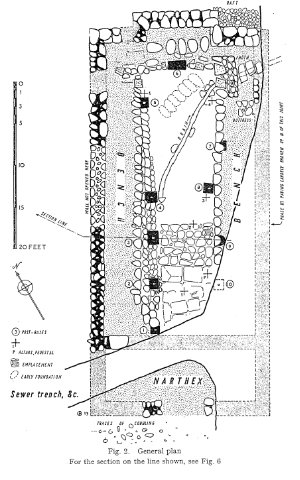
London Mithraeum

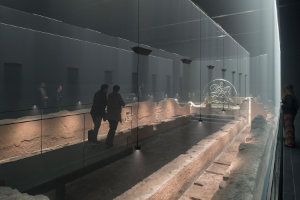
The Mithraeum of London, also known as the Walbrook Mithraeum, was contextualised and relocated to its original site in 2016.

CIMRM 814


Mithraeum of Housesteads

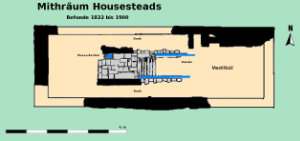
The Housesteads Mithraeum is an underground temple, now burried, discovered in 1822 in a slope of the Chapel Hill, outside of the Roman Fort at the Hadrian's Wall.

CIMRM 852


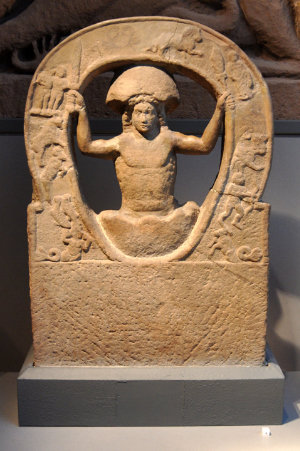
Mithras rock-born from Housesteads

A naked Mithra emerges from the cosmic egg surrounded by the zodiac, as always carrying a torch and a dagger.

CIMRM 860


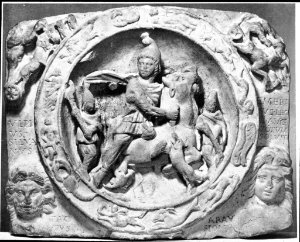
Tauroctonia de Walbrook

The image of Mithras killing the bull, found near Walbrook, is surrounded by a Zoadiac circle.

CIMRM 810


Mithraeum of Caernarfon

The Mithraeum of Caernarfon, in Walles, was built in three phases during the 3rd century, and destroyed at the end of the 4th.

CIMRM 2374


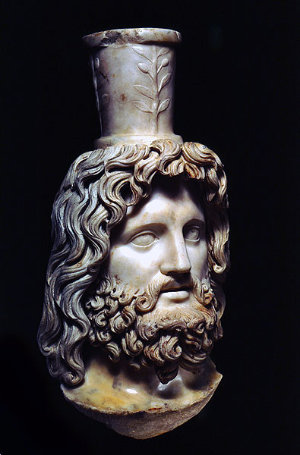
Serapis head of Walbrook

The head of Serapis found at Walbrook, London, is decorated with stylised olive branches.

CIMRM 818


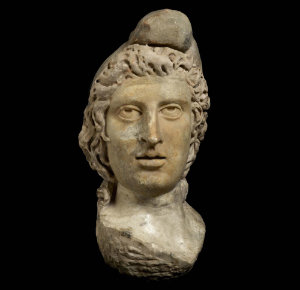
Mithras head of Walbrook

The Mithras's head of Walbrook probable belonged to a life-size scene of the god scarifying the bull.

CIMRM 815


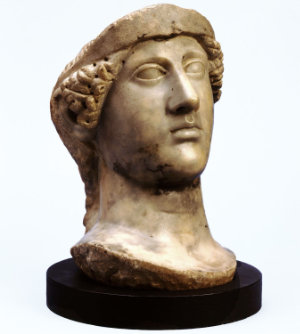
Head of Minerva from London

This head was found at the east end of temple of Mithras in London.


Tabula ansata of Lucius from Bremenium

This inscription commemorates the building of a mithraeum in Bremenium with fellow worshippers of Mithras.

CIMRM 876


Dionysus group marble of London

Marble group of Dionysus accompanied by a Silenus on a donkey, a satyr and a menead.

CIMRM 822


Mithraeum of Burham

To date, there is no evidence that the so-called Mithraeum of Burham was ever used to worship the sun god.

CIMRM 808


Mithraeum of Colchester

One of the rooms in a sustantive masonry building in Hollytrees Meadow was considered to be a Mithreum, a theory that has now been discarded.

CIMRM 829

See all Mithraic monuments in Britannia superior

Places in Britannia superior


Bremenium

Bremenium is an ancient Roman fort located at Rochester, Northumberland, England.


Burham

Burham is a village and civil parish in the borough of Tonbridge and Malling in Kent, England.


Camboglanna

Camboglanna was a Roman fort.


Colenceaster

Colchester KOHL-cheh-stər is a city in Essex, England.


Isca

Isca, variously specified as Isca Augusta or Isca Silurum, was the site of a Roman legionary fortress and settlement or vicus, the remains of which lie beneath parts of the present-day suburban town of Caerleon, Walles.


Londinium

Londinium was the capital of Roman Britain for most of the period of Roman rule. It was originally a settlement founded around 47-50 AD in an uninhabited area.


Segontium

Segontium is a Roman fort on the outskirts of Caernarfon in Gwynedd, North Wales.


Vercovicium / Borcovicus

Housesteads Roman Fort is the remains of an auxiliary fort on Hadrian's Wall, at Housesteads, Northumberland, England, south of Broomlee Lough.


Verulamium

Verulamium was a town in Roman Britain.

Inscriptions from Britannia superior

Tauroctonia de Walbrook

Ulpius Silvanus / factis Arausione / emeritus leg[ionis] II aug[ustae] / votum solvit.
Ulpius Silvanus, veteran of the Legio II Augusta, recruited in Arausio, has fulfilled his vow.

Tabula ansata of Lucius from Bremenium

Deo invicto [[et]] Soli soc[io] / sacrum. Pro salute et / incolumitate imp[eratoris] Caes[aris] / M[arci] Aureli Antonini pii felic[is] / aug[usti] L[ucius] Caecilius Optatus / trib[unus] coh[ortis] I Vardul[lorum] cum con[sa]/craneis votum de [---] / a solo ex[s]truct[un---].
Consecrated to the invincible God and to Sol, his companion, for the welfare and safety of the pious, auspicious and august Caesar Marcus Aurelius Antoninus. Lucius Caecilius Optatus, tribune of the first cohort of Vardulli, with his fellow worshippers, vowed to the god to erect [this building] from the ground up.

Dionysus group marble of London

Hominibus bagis bitam.
Thou givest lift to men.

Inscripton of Justus from Caerleon

[Deo in]victo / [Mi]thrae / ...s Iustus / c[[enturio] leg]ionis II aug[ustae] / [l[ibens]] m[erito] f[ecit].
To the Invincible Mithras, the well-deserving, […]s Justus, […] of the Second Legion Augusta, set this up.

Altar of Castlesteads

De[o] Soli / [Invi]cto / M[ith]r[a]e M[ar]/cus Liciniu[s] / Ripanus praef[ectus] v[otum] s[olvit].
To the Invincible Sun-god Mithras, Marcus Licinius Ripanus, prefect, willingly and deservedly fulfilled his vow.

CIMRM 826

u . . . . / [Bri]tanniae/. . . . [vic]toriam/. . . . am.

References

Back to Top