
Biography
of Gaius Valerius Nicomedes
- Gaius Valerius Nicomedes is attested as a member of a Mithraic community (syndexios) at the Mitreo Fagan.
- Attested in the 190.
- Attested in Ostia, Latium, Italia in 190 (TNMM 116).
TNMP 22
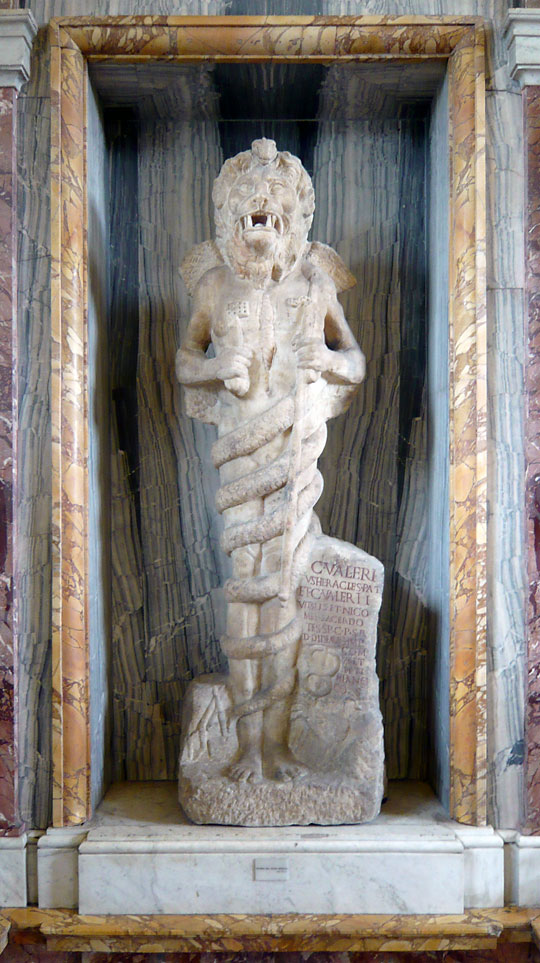
Caius Valerius Nicomedes is attested as a sacerdos of a Mithraic community at Ostia through an inscription engraved on the base of a monumental marble leontocephalic statue dedicated on 13 August 190 CE. The text records that the monument was erected at the expense of three members of the congregation: the pater <b>Caius Valerius Heracles</b> and the priests <b>Caius Valerius Vitalis</b> and Caius Valerius Nicomedes (C. Valerius Heracles pater et C. Valerii Vitalis et Nicomedes sacerdotes sua pecunia posuerunt; TNMM 116; CIL XIV 65; CIMRM 312-313). The inscription places Nicomedes among the known office-holders of the Ostian Mithraic hierarchy and confirms his active participation in financing one of the most elaborate Mithraic monuments discovered in the city (Marchesini 2013, 86-91; Battisti 2020, 154-155; Canciani 2022, no. 146b).
The monument itself is exceptional. Standing 165 cm high, it depicts a lion-headed deity entwined by a serpent and furnished with keys, sceptre, wings, thunderbolts and seasonal symbols. The iconography has generally been interpreted as representing the Mithraic leontocephaline god, often associated in modern scholarship with Time, Fate, Aion or a cosmological principle, although no universal consensus exists regarding the precise identity of the figure (Becatti 1954; CIMRM 313; Bortolin 2012; Canciani 2022). By participating in the dedication of such a costly and symbolically complex monument, Nicomedes appears to have belonged to the inner leadership of the community rather than to its ordinary membership.
Several scholars have noted the significance of the shared nomen Valerius borne by Heracles, Vitalis and Nicomedes. Since all three also carry cognomina commonly encountered among freedmen and individuals of Greek cultural background, it has been suggested that they may have belonged to the same familial, patronal or commercial network, although no inscription explicitly states the nature of their relationship. This remains a plausible but unproven hypothesis. Likewise, the presence on the monument of symbols associated with Vulcan, Attis and Mercury has been interpreted as evidence of the integration of Mithraic worshippers into the broader religious and civic life of Ostia, a context in which Nicomedes evidently operated as one of the community’s recognised priests (Marchesini 2013; Battisti 2020).
References
- Regio I - Mitreo Fagan - Ostia-Antica.org.
- Gisèle Pineau (1995) Frugifer : Une divinité mithraique léontocéphale décrite par Arnobe.
- Arnobius (310) Adversus nationes (Against the Pagans).
Attestations
Leontocephalic deity from the Fagan Mithraeum
TNMM 116
Marble leontocephalic Aion/Arimanus from the now-lost Fagan Mithraeum at Ostia, dedicated in AD 190 by three members of the local Mithraic priesthood.
Mitreo Fagan
TNMM 98
The Fagan Mithraeum, also known as the Mithraeum of Tor Boacciana, yielded remarkable sculptures of lion-headed deities, several of which are now preserved in the Vatican Museums.
