The corpus from Latium is dominated by the exceptional concentration of Mithraic evidence documented in Rome and Ostia. Urban density, imperial administration and intense commercial activity contributed to the extraordinary development of Mithraic cults within the region.
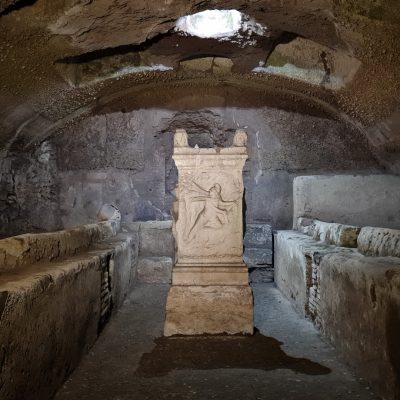
Mithraic monuments of Latium
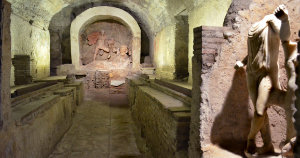
Mitreo di San Clemente
The Mithraeum under the Basilica of San Clemente made part of a notable Roman house.
CIMRM 338
Mitreo di Santa Prisca
The Mithraeum of Santa Prisca houses remarkable frescoes showing the initiates in procession.
CIMRM 476
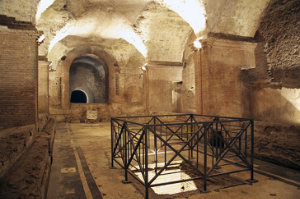
Mithraeum of the Baths of Caracalla
The Mitreo delle terme di Caracalla is one of the largest temples dedicated to Mithras ever found in Rome.
CIMRM 457
Mitreo di Felicissimo
The Mithraeum Felicissimus has a floor mosaic depicting the seven mithraic grades.
CIMRM 299
Mitreo del Circo Massimo
The Mithraeum of the Circus Maximus was discovered in 1931 during work carried out to create a storage area for the scenes and costumes of the Opera House within the Museums of Rome building.
CIMRM 434
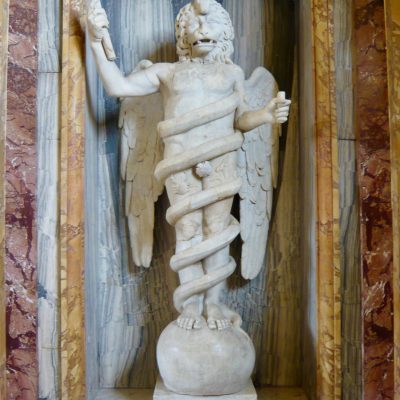
Aion of Villa Albani
White marble statue of Lion-head god of time, formerly in the Villa Albani, nowadays in the Musei Vaticani.
CIMRM 545
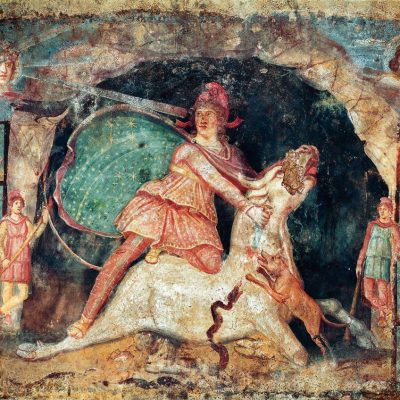
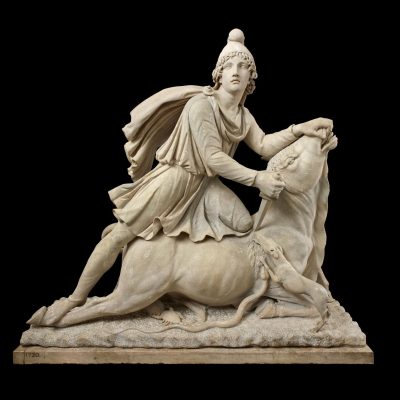
Tauroctony in the British Museum
The sculpture of Mithras slaying the bull was transported from Rome to London by Charles Standish in 1815.
CIMRM 592
Mitreo delle Sette Sfere
The Mithraeum of the Seven Spheres (Sette Sfere) is of great importance for the understanding of the cult, because of its black-and-white mosaics depicting the planets, the zodiac and related elements.
CIMRM 239
Mitreo di Santo Stefano Rotondo
The Mitreo dei Castra Peregrinorum was discovered under the church of Santo Stefano Rotondo in Rome.
Tauroctony from Santo Stefano Rotondo
The relief of Mithras killing the bull of Stefano Rotodon preserves part of his polycromy and depicts two unusual figures: Hesperus and an owl.
Mitreo di Marino
The Mithraeum of Marino presents an unusually elongated structure with depictions from the Severian period.
Brothers active in Latium
Places in Latium
Roma
Archaeological evidence shows that the area around Rome has been inhabited since around 14,000 years ago. Excavations support the theory that Rome grew from pastoral settlements on the Palatine Hill, which was built over the area of the Roman Forum.
Antium
Antium was an ancient coastal settlement in Latium, founded around the 11th century BC. A major stronghold of the Volsci before its conquest by Rome, its territory largely corresponds to modern Anzio and Nettuno.
Lanuvium
Lanuvium (modern Lanuvio) was an ancient city of Latium Vetus, about 32 km southeast of Rome. A member of the Latin League, it was conquered by Rome in 338 BC and remained an active municipium into the Imperial period.
Marino
Marino has been inhabited by Latin tribes since the 1st millennium BC. During the Roman Republic it was a summer resort for Roman patricians who built luxurious villas in the area.
Ostia
Ostia may have been Rome's first colony. According to legend, Ancus Marcius, the fourth king of Rome, destroyed the area and founded the colony. An inscription seems to confirm the foundation of the ancient castrum of Ostia in the 7th century BC.
Stabiae
Stabiae was an ancient city situated near the modern town of Castellammare di Stabia and approximately 4.5 km southwest of Pompeii.
Tarquinia
Tarquinia, formerly Corneto, is an old city in the province of Viterbo, Lazio, Central Italy, known chiefly for its ancient Etruscan tombs in the widespread necropoleis, or cemeteries, for which it was awarded UNESCO World Heritage status. In 1922, i
Tibur
Tivoli is a town and comune in Lazio, central Italy, 30 kilometres north-east of Rome, at the falls of the Aniene river where it issues from the Sabine hills.
Volsinii
Volsinii or Vulsinii, is the name of two ancient cities of Etruria, one situated on the shore of Lacus Volsiniensis, and the other on the Via Clodia, between Clusium and Forum Cassii.
Inscriptions from Latium
Mitreo di Felicissimo
Tauroctony 593
Altar from Mitreo di San Clemente
Procession Fresco from Santa Prisca
Mosaic of the Mitreo di Felicissimo
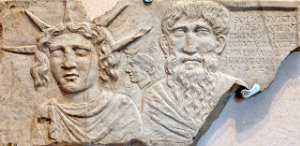
Slab of Sol Invictus
Aion of Mitreo Fagan
Tauroctony from the Mitreo delle terme di Mitra
Tauroctony from the Villa Borghese
To the invincible Sol god Mithras. Caius Aufidius Ianuarius [and Caius Aufidius ---].
Frescoes of lions at Santa Prisca
Nama Hel[io]doro leoni; Nama Gelasio leoni; Nama Phoebo leoni.
Tribute to Heliodoros, Lion; Tribute to Gelasios, Lion; Tribute to Poebus, Lion.
Aion relief of Mitreo Fagan
Tauroctony relief exposed at the Hermitage Museum
References
- A. B. Griffith (1993) Mithraism in the private and public lives of 4th-c. senators in Rome
- Aix-Marseille Université (2025) Lion-headed statue of winged Mithra with snake (Montfaucon, Diarium Italicum, 1702)
- Alain Blomart (1995) Frugifer : Une divinité mithraique léontocéphale décrite par Arnobe
- Alessandro Bedetti (2010) Il Mitreo di Marino. Una scoperta eccezionale alle porte di Roma
- American Institute for Roman Culture (2012) Mithraeum at the Baths of Caracalla
- André Chastagnol (1961) La famille de Caecinia Lolliana grande dame païenne du IV e siècle après J.-C
- Arnobius (310) Adversus nationes (Against the Pagans)
- Attilio Mastrocinque (2017) The Mysteries of Mithras. A different account
- Berlin-Brandenburgische Akademie der Wissenschaften (2023) Mithras tötet den Stier
- BnF (2007) Notice bibliographique du Grand camée de France
- Bricault, Veymers, Amoroso et al. (2021) The Mystery of Mithras. Exploring the heart of a Roman cult
- Bricault; Roy (2021) Les cultes de Mithra dans l'Empire Romain
- Carel Claudius van Essen, Maarten Jozef Vermaseren (1965) The Excavations in the Mithraeum of the Church of Santa Prisca in Rome
- Cassius Dio (229) Historia Romana
- Charles William King (1887) The Gnostics and Their Remains
- Cincinnati Art Museum. Mithraic Relief with Bull
- Elissa Lissi-Carrona (1986) Il Mitreo dei 'Castra Peregrinorum' (S. Stephano Rotondo)
- Flaminio Vacca (1594) Memorie di varie antichità trovate in diversi luoghi della città di Roma
- Francisco Marco Simón (2018) A place with shared meanings: Mithras, Sabazius, and Christianity in the tomb of Vibia
- Franz Cumont (1934) Mithra et l’orphisme
- Franz Cumont (1945) Rapport sur une mission à Rome
- Françoise Van Haeperen (2019) Fana, templa, delubra. Corpus dei luoghi di culto dell'Italia antica
- Gabriela Ingle (2019) A fourth century tomb of the followers of Mithras from the catacomb of ss. Peter and Marcelinus in Rome
- Henri Lavagne (1974) Le mithréum de Marino (Italie)
- Informazioni di servizio (2022) Attività del Parco: il dio Mitra in stucco emerge dagli scavi di Ostia antica
- Jame W Singer - Daily Art Magazine (2021) Masterpiece of the Week: Mithras Slaying the Bull
- Jan Theo Bakker (2017) The City Walls of Ancient Ostia
- Laurens Dragstra (2023) The 10 highlights of… the Museo Nazionale Romano (Baths of Diocletianus)
- Laurent Bricault (2023) Recueil des Inscriptions concernant les Cultes Isiaques (RICIS)
- Lloyd G. Patterson (2009) God in Early Christian Thought
- Luciano Lazzaro (1993) Esclaves et affranchis en Belgique et Germanies romaines d’après les sources épigraphiques
- Maarten Jozef Vermaseren (1963) Mithras, the Secret God
- Maarten Jozef Vermaseren (1982) Mithriaca III. The Mithraeum at Marino
- Maarten Jozef Vermaseren (1978) Mithriaca IV. Le Monument d'Ottaviano Zeno et le culte de Mithra sur le Célius
- Musei Vaticani. Profane museum
- Musei d'Italia (2023) Ara
- Musée du Louvre (2023) candélabre
- Musée du Louvre (2023) groupe statuaire
- Musée du Louvre (2023) relief
- Official site. Parrocchia di Santa Prisca all'Aventino
- Ostia Antica (2020) Regio I - Insula III - Mitreo del Caseggiato di Diana (I,III,3-4)
- Ostia Antica (2020) Regio V - Insula VI - Mitreo dei Serpenti (V,VI,6)
- Ostia-Antic (2020) Regio V - Insula IX - Mitreo di Felicissimus (V,IX,1)
- Ostia-Antica.org (2021) Regio I - Insula III - Mitreo di Menandro (I,III,5)
- Ostia-Antica.org (2020) Regio I - Insula X - Tempio Collegiale and Mitreo di Fructosus (I,X,4)
- Ostia-Antica.org (2020) Regio I - Mitreo del Palazzo Imperiale
- Ostia-Antica.org (2022) Regio II - Insula I - Mitreo Aldobrandini (II,I,2) and Torre sul Tevere (II,I,3)
- Ostia-Antica.org (2020) Regio III - Insula I - Domus and Mitreo delle Pareti Dipinte (III,I,6)
- Ostia-Antica.org (2020) Regio III - Insula XVII - Caseggiato del Mitreo della Planta Pedis (III,XVII,2) and Mitreo
- Ostia-Antica.org (2020) Regio IV - Insula II - Mitreo degli Animali (IV,II,11)
- Ostia-antica.org (2020) Regio II - Insula II - Mitreo presso Porta Romana (II,II,5)
- Ostia-antica.org. Regio II - Insula VIII - Mitreo delle Sette Sfere (II,VIII,6)
- Raffaella (2018) Roma: i sotterranei e il Mitreo di S.Prisca - I Viaggi di Raffaella
- Roger Beck (2017) If So, How? Representing “Coming Back to Life” in the Mysteries of Mithras
- Roger Beck (1976) Interpreting the Ponza Zodiac
- Roger Pearse (2015) CIMRM 349 - Mithraeum of Piazza Dante. Esquiline, Rome, Italy
- Roger Pearse (2014) CIMRM Supplement - Mithraeum. S.Stephano Rotondo / Castra Peregrinorum, Rome
- Tertullian.org. CIMRM Supplement - Tauroctony. Cincinnati, USA
- The Walters Art Museum (2022) Cautopates with Signs of the Zodiac
- The Walters Art Museum (2022) Votive Altar to Mithras
- Ugo Onorati (2014) Il mitreo di Marino
- VAN HAEPEREN, Françoise (2019) Fana, templa, delubra. Corpus dei luoghi di culto dell'Italia antica
- Vittoria Canciani (2022) Archaeological Evidence of the Cult of Mithras in Ancient Italy
- jthb (2022) Domus dei Capitelli di Stucco (V,VII,4-5) (House of the Stuccoed Capitals)
- British Museum
- CIMRM Supplement - Mithraeum in the 'Domus del Mitreo', Tarquinia, Italy
- Electronic Journal of Mithraic Studies
- Funerary ara of Vettius Agorius Praetextatus and Aconia Fabia Paulina — Musei Capitolini
- Grave inscription of Vettius Agorius Praetextatus and his wife Paulina — Alte Welt
- Le gemme antiche figurate di Leonardo Agostini ... Parte seconda
- Mithras slaying the bull, ca. 140–160 A.D. – Princeton University Art Museum
- Mitreo del Circo Massimo — Sovrintendenza Capitolina
- Regio I - Insula XVII - Mitreo delle Terme del Mitra (I,XVII,2) - Ostia-antica.org
- Regio I - Mitreo Fagan - Ostia-Antica.org
- Regio IV - Insula IX - Caupona del Dio Pan e Mitreo dei Marmi Colorati (IV,IX,5) - Ostia-Antica.org
- Relief représentant Mithra, dieu iranien du Soleil, sacrifiant le taureau
- Tarquinia (VT). Domus cosiddetta
- https://collections.louvre.fr/en/ark:/53355/cl010275230