

Biography
of Gaius Lucretius Mnester
- Gaius Lucretius Mnester is attested as a member of a Mithraic community (syndexios), with a recorded role as summagister anni primi.
- Attested in the 2nd – 3rd century.
- Attested at Roma, Latium, Italia in 171 – 230 (TNMM 785).
TNMP 66
Gaius Lucretius Mnester was a member of a Mithraic community in Rome, known from a marble altar that he dedicated to Deus Invictus Mithras together with Marcus Aemilius Philetus. The two men describe themselves as summagistri anni primi M. Aemili Chrysanti and state that they provided the dedication at their own expense (TNMM 785; CIMRM 517; CIL VI 734; ILS 4218).
The expression summagistri anni primi is difficult to interpret. The inscription associates Mnester and Philetus directly with Marcus Aemilius Chrysanthus, who is identified as magister anni primi in two other inscriptions from Rome (TNMM 479; CIMRM 519; CIL VI 717; TNMM 463; CIMRM 518; CIL VI 556). Their title therefore appears to indicate a subordinate or assisting position in relation to Chrysanthus, although the precise functions of both magister and summagister remain uncertain.
Campos (2026) interprets the inscription as evidence for a temporary period of supervision over newcomers to the Mithraic community. This interpretation, however, goes beyond what the inscription itself establishes. As Clauss (1992) already observed in discussing Chrysanthus, the function of the magister anni primi cannot be securely determined.
References
- Israel Campos Méndez (2026) Mitra. Un dios entre Oriente y Occidente.
- Epigraphik-Datenbank Clauss / Slaby. Altar from Rome by Mnester and Philetus in EDCS.
- Evelyn Schraudolph (1993) Römische Götterweihungen mit Reliefschmuck aus Italien. Altäre, Basen und Reliefs.
- Manfred Clauss (1992) Cultores Mithrae. Die Anhängerschaft des Mithras-Kultes..
Attestations
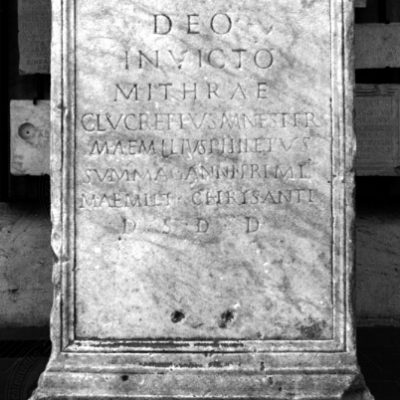
Altar from Rome by Mnester and Philetus
TNMM 785
This marble altar was found ’in the street called di Branco’, behind the palace of the Cardinal of Bologna, in Rome.
