Your search Al. N. Oikonomides gave 3559 results.
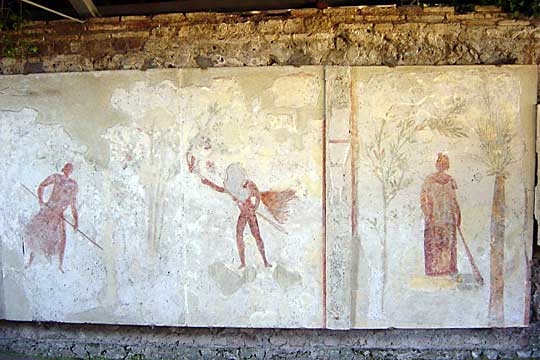
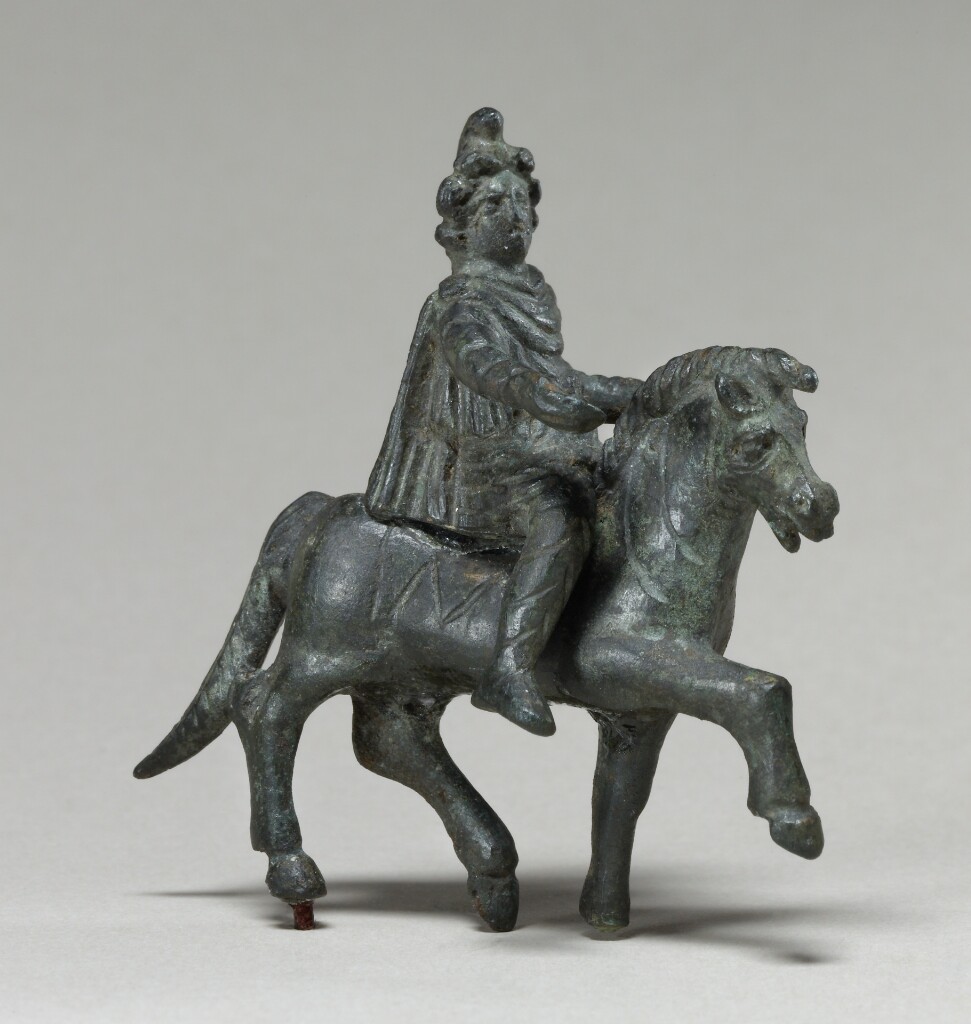
Pair of bronze torchbearer statuettes in Oriental dress from the Cabinet des Médailles, originally belonging to the same sculptural group.
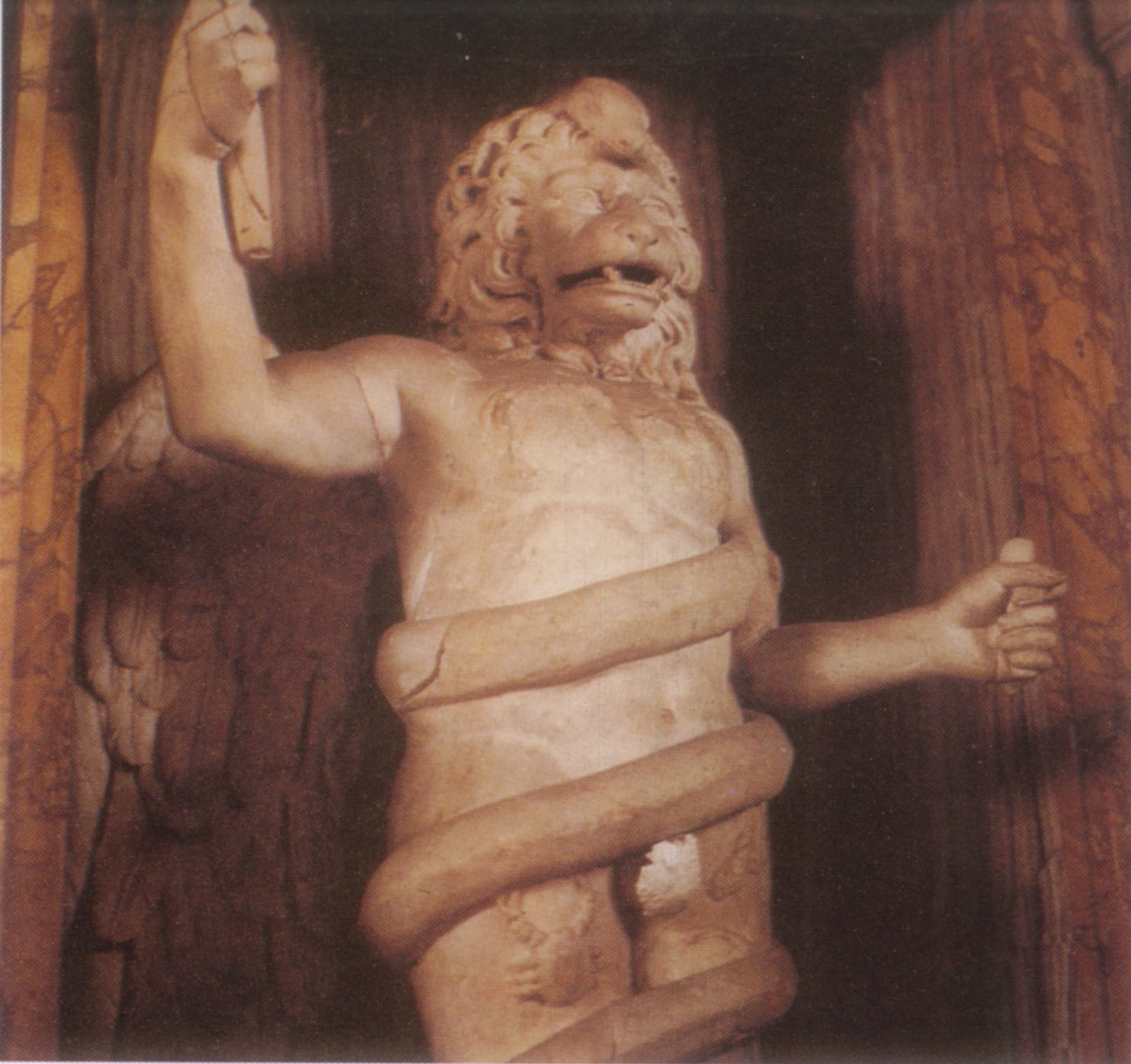
Oval jasper gem in the Cairo Museum depicting Mithras slaying the bull with Sol, Luna, a leontocephalic figure and seven stars.
Yellow jasper fragment of unknown provenance, formerly in the Museo Borgiano, with a tauroctony on the obverse and a Mithraic figure on the reverse.
A small stone pedestal and the fallen statue of a seated Mother-goddess from the Mithraeum at Procolitia (modern Carrawburgh), depicting a figure of ungainly proportions enfolding in her arms a basket resting on her knees, found in the corner behind the screen at the east end of the temple…
Marble tauroctony relief fragment from an unknown provenance, preserving part of Mithras's body, his right arm and dagger, and his left arm grasping the bull by the nostrils.
Arched white marble tauroctony relief of unknown provenance, depicting the standard bull-slaying in the usual attitude with dog and serpent.
Marble tauroctony relief fragment from Dacia, preserved in Bucharest, with only Mithras's head and part of his flying cloak visible; above this a water-miracle scene and above that the bull in a small boat.
Luguvallium was a Roman settlement and fort in northern Britannia, today Carlisle.
Pautalia became an important urban and thermal centre in the southwestern Balkans.
The hill fort of Epiacum, known today as Whitley Castle, occupied a strategic upland position south of Hadrian’s Wall.
Almus occupied a strategic position on the southern bank of the Danube in western Moesia.
San Valentino in Abruzzo Citeriore is a mountain hill town in the province of Pescara, part of the Abruzzo region in central Italy.
Palestrina is a modern Italian city and comune with a population of about 22,000, in Lazio, about 35 kilometres east of Rome.
A marble relief found in 1851 built into the adjoining hall of White Friars at Chester (ancient Deva), now in the Grosvenor Museum, depicting a standing dressed figure with a sheep-hook in his left hand and possibly a downward-pointing torch in his right…
A small stone statue found at Chester (ancient Deva) in 1853 built into a cellar wall in White Friars, still seen by Stukeley in 1725 but now lost, depicting a standing torchbearer in Eastern attire and cross-legged, holding a torch downwards with both hands…
Wall remnants found deep underground at San Zeno near Trento, possibly indicating a Mithraeum, discovered alongside Roman coins, lost bronze figures and a small gold disc decorated with an ear of corn or a sword.
A limestone low-relief tauroctony fragment found in 1869 near the entrance of the valley of San Zeno di Romedio in the Trentino, now in the Museum at Trento, showing a primitive Mithras bullkiller with Cautes upraised, the bust of Luna and an inscription on the lower border…
A coarse-grained yellowish-white marble tauroctony relief fragment found walled in at San Zeno am Nonsberg in the Trentino in 1911, now in the Museum Ferdinandeum at Innsbruck, showing part of Mithras slaying the bull and Cautes raising a flaming torch.
A brief inscription reading "Deo Invicto Mithrae", found in the ruins of the Castello di Tuenno near San Zeno at the entry to the Tovel valley in Trentino, alongside the decorated relief No. 723.
An altar with a praefericulum on the right side and a patera on the left, found at the Mithraeum at Borcovicium (modern Housesteads) in 1822, recording a vow fulfilled to Sol Invictus Mithras Saecularis by Litorius Pacatianus, beneficiarius consulis, for himself and his family…