Your search Apt gave 103 results.
Relief of Heracles/Hercules capturing the Golden Hind of Artemis.
Small limestone stele, discovered at Apt in 1903. It depicts a standing torchbearer in the conventional Mithraic posture and dress, accompanied by a cock placed at his feet.
Apt is a commune in the Vaucluse department in the Provence-Alpes-Côte d'Azur region in southeastern France.

Roman emperor from 253 to 260, he was taken captive by Shapur I of Persia. He was thus the first emperor to be captured as a prisoner of war.
In Plutarch’s Life of Alexander, the grieving Darius binds the eunuch Tireus by the light of Mithras to reveal the truth about his captive wife Statira, a solemn appeal that leads to unexpected praise for Alexander’s honor and restraint.
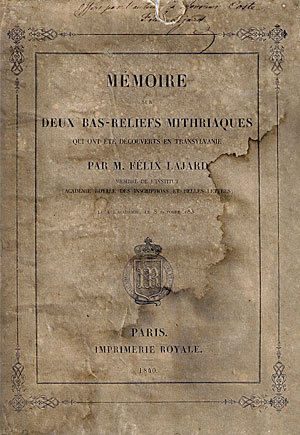
In 1852, Károly Pap, a naval captain, unearthed several Mithraic monuments in his garden at Marospartos, including this altar.
Danube region can be traced back to the legions that fought under his command in Armenia.
Emperor Caracalla ordered one of Rome’s largest temples to the god Mithras to be built in the baths bearing his name.
Hermadio's inscriptions have been found in Dacian Tibiscum and Sarmizegetusa, as well as in Rome.
Hector erected an altar to Mithras in Emerita Augusta by means of a ‘divine vision’.
The Mithraeum of Santa Prisca houses remarkable frescoes showing the initiates in procession.
A selection of texts gathered by Ernesto Milá that reinterprets Mithraism as an initiatory, solar, and heroic cult. It includes the so-called Great Magical Papyrus of Paris, translated and commented by Julius Evola and the Ur Group.
At Rome’s twilight, amid political upheaval and Christian ascendancy, Vettius Agorius Praetextatus embodied pagan intellect, virtue, and authority across senatorial, military, and mystical spheres.
By reading Orphic theology together with Eleusinian ritual practice, the mysteries emerge as a structured mystagogy of transformation: a disciplined passage from forgetfulness (Lethe) to knowledge (aletheia), from mortality to participation in the divine.
This article revisits the Mithraeum of S. Maria Capua Vetere, one of the most complete and artistically refined Mithraic sanctuaries in the Campanian region, situating it within its archaeological, iconographic, and ritual-historical contexts.