Your search Franz-Valéry-Marie Cumont gave 236 results.
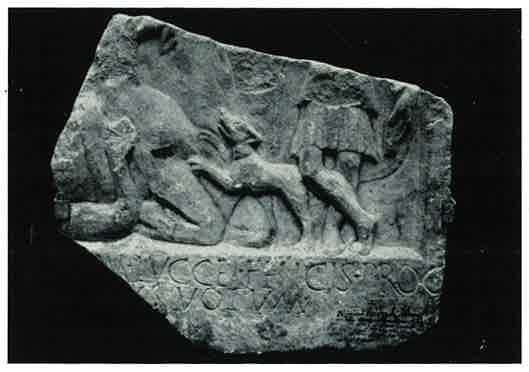
Marble tauroctony relief from Sarmizegetusa, Dacia, found at Zám and subsequently in various private collections; depicting the standard bull-slaying.

Fragments of a bluish marble tauroctony from the Mithraeum at Sarmizegetusa, Dacia, possibly related to the preceding piece, preserving remnants of a bull.
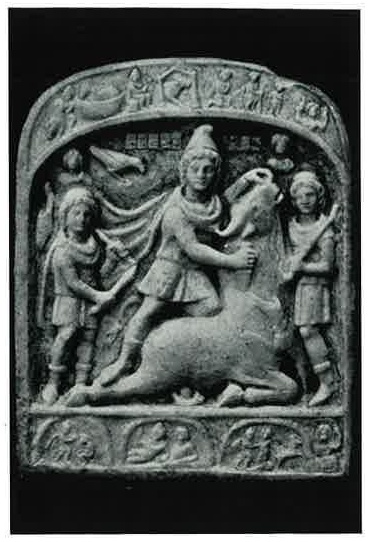
White marble tauroctony relief found in the river Mureș at Vintu de Jos near Apulum, Dacia, around 1859, depicting the bull-slaying with the full iconographic programme.
Author's observation that several inscriptions from Apulum, Dacia (CIL III 1096, 1095, 1154, 1002) may belong to a sanctuary of Diana rather than to a Mithraeum.
White marble tauroctony relief from Apulum, Dacia, depicting Mithras killing the bull in a grotto with dog and serpent; formerly in a private collection in Budapest.
Slab from near the Cathedral at Alba Julia, Apulum in Dacia, found in 1725, dedicated to Deo invicto Mithrae by a legionary legate.
Fragment of a relief from Brigetio, Pannonia Superior, preserving the central tauroctony scene surrounded by a laurel wreath.
Altar from Brigetio, Pannonia Superior, dedicated to Mithrae by Donnius.
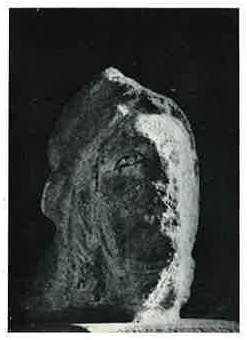
Two sandstone fragments from Mithraeum III at Carnuntum, Pannonia Superior, belonging to a torchbearer statue probably of Cautes, comprising a Phrygian-capped head with painted eyes and a body fragment; the statues probably stood at the beginning of the benches…
Inscription from Mithraeum III at Carnuntum, Pannonia Superior, recording that Titus Flavius Viator built or founded something for Deo invicto; the verb condi fecit is interpreted as referring to the construction of the sanctuary.
Red sandstone base from the Mithraeum at Neuenheim with representations of deities on each of its four sides
Square bronze plate from Mithraeum III at Heddernheim, ancient Nida, probably a cult tessera bearing barely legible engraved letters
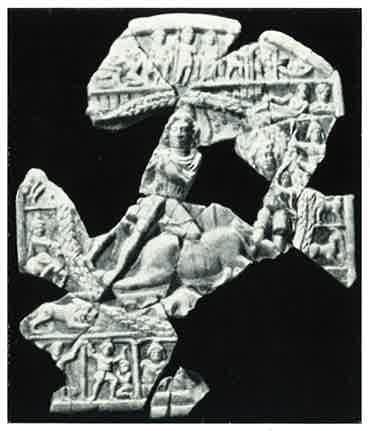
Fragments of a white marble arched tauroctony from Mithraeum III at Heddernheim, ancient Nida, showing Mithras killing the bull in a leaf wreath
Three basalt fragments of a standing figure in jack-boots from Mithraeum III at Heddernheim, ancient Nida, with traces of red paint on the loin-cloth

Fragment of a statuette on a sandstone base found in Mithraeum III at Heddernheim, ancient Nida, formerly in the Häberlin collection
Two basalt blocks walled into the podium of Mithraeum III at Heddernheim, ancient Nida, which supported decorative sandstone bases
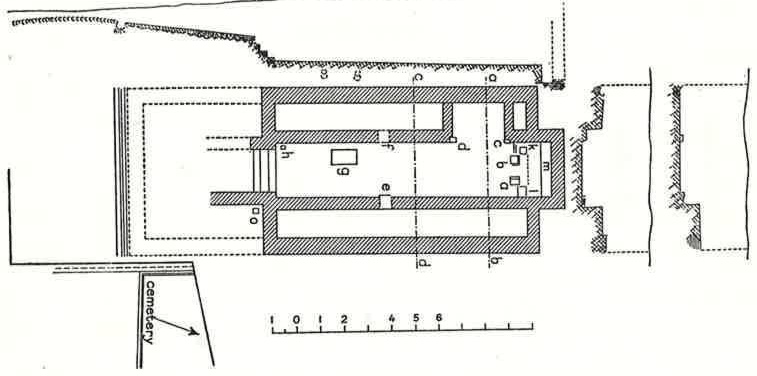
Third Mithraic sanctuary found north-west of the cemetery at Heddernheim, ancient Nida, in 1887 and fully excavated by G. Wolff in 1890
Tall sandstone column base from Mithraeum I at Heddernheim, ancient Nida, with an inscription set between two columns, possibly naming Mithras
Inscribed altar from the Friedberg Mithraeum erected by the beneficiarius consularis Caius Paulinius Iustus.
Imported limestone relief fragments showing the Mithraic torchbearers beside the podia of the sanctuary.
