Your search San Gemini gave 586 results.

Sandstone haut-relief from Mithraeum I at Carnuntum, Pannonia Superior, depicting Cautopates cross-legged; head, feet, and left arm are lost; possibly belonging to the great tauroctony relief.
Fourth Mithraic sanctuary discovered at Ptuj, ancient Poetovio, at Zgornji Breg in 1937; the sanctuary (c.14 × 7 m) is oriented west–east with the standard corridor and bench division, an altar before the cult niche, and a water-basin in the pronaos.
Marble fragments of draped arms and legs from Mithraeum II at Ptuj, ancient Poetovio, belonging to unidentified cult statues within the sanctuary.
Small circular marble basin from Mithraeum II at Ptuj, ancient Poetovio, probably used for libations or purification within the sanctuary.
Fragment of a marble relief from Mithraeum II at Ptuj, ancient Poetovio, preserving a woman's head adorned with a wreath; probably a secondary deity from the sanctuary's sculptural programme.
Upper portion of a marble plate from Mithraeum II at Ptuj, ancient Poetovio, decorated with a central stem flanked by leaf motifs and a small twig — a purely decorative element from the sanctuary.
Large marble water-basin on a column from Mithraeum II at Ptuj, ancient Poetovio, decorated with a central rosette; it probably stood near the entrance of the sanctuary.
Inscription from Mithraeum I at Ptuj, ancient Poetovio, set up by Primitivos, contrascrip of the imperial procurator Caius Antonius Rufus, in memory of Hyacinthus — probably the founder of the sanctuary.
Deposit of twenty-three coins from the Mithraeum at Schachadorf, Noricum, spanning from Claudius II to Valentinianus II and providing a terminus for the sanctuary's use.
Small rectangular Mithraic sanctuary (spelaeum 8.00 m long) found in 1935–36 in a gravel terrace at Schachadorf near Wartberg an der Krems, Noricum; the building is divided into a pronaos and an inner cult room, and shows traces of fire destruction.
Upper portion of a sandstone statue from Strasbourg, ancient Argentoratum, showing a head surmounted by a serpent's head; the fragment probably belonged to an Aion.
Sandstone relief fragment from the Mithraeum at Gimmeldingen preserving the upper bodies of two standing deities: a bearded male, possibly Vulcanus, and a helmeted Minerva with lance.
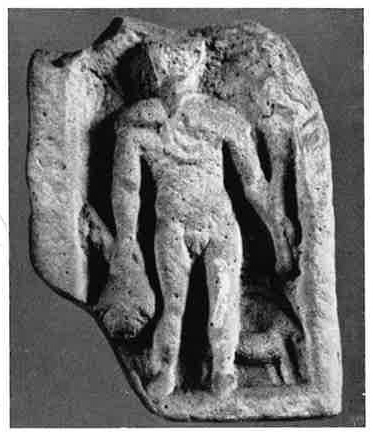
Sandstone relief from the Mithraeum at Gimmeldingen depicting a standing Mercury with caduceus and purse, accompanied by a ram and a cock; the head and upper caduceus are damaged.
Lower portion of a sandstone relief from the Mithraeum at Gimmeldingen, preserving a cross-legged torchbearer in a long cloak, probably Cautes.
Sandstone altar fragment from the Mithraeum at Neuenheim dedicated by Sentionius Tertinus
Red sandstone base from the Mithraeum at Neuenheim with representations of deities on each of its four sides
Small red sandstone statuette of a lying lion from Wiesbaden, ancient Aquae Mattiacae, with snout and hindquarters broken off
Sandstone relief from Wiesbaden, ancient Aquae Mattiacae, found in a subterranean room in 1858, depicting Cautopates in Oriental dress holding a downward torch
Sandstone votive altar with traces of red paint from Wiesbaden, ancient Aquae Mattiacae, erected during the reign of Macrinus with permission of Varonius Lupulus
Votive sandstone altar from Wiesbaden, ancient Aquae Mattiacae, dedicated to Deo Soli invicto by Caius Silvinius Maternus, in honour of the Domus Divina
