Your search Tal hal Hariri / Es-Sâlihiyeh / As Salhiyah gave 3725 results.

Fragment of a Mithras relief from Bumbești-Gorj, Dacia, bearing a partially preserved dedication to Deo Soli invicto Mithrae.
Base of bluish marble formerly in the Villa Giustiniani near Porta Flaminia and now in the Vatican Musea, Cortile della Pigna, with a round pedestal encircled by a bearded crested serpent biting its own tail, probably supporting a statue of Aion.
Two small fragments of a relief showing Mithras slaying the bull with the two torchbearers in a grotto, with traces of polychrome colouring, dated to the second half of the 2nd century A.D.
White limestone fragment from the Mithraeum at Biljanovac, Moesia Superior, preserving the upper part of Mithras as bull-slayer in a sleeveless tunic.
Stone lamp installation, vessels and bronze chain links associated with ritual activity inside the Mithraeum of Vindobala.
Marble slab fragment from Steklen, ancient Novae in Moesia Inferior, depicting Mithras and Sol in a two-horse chariot with the bust of Oceanus above.
Small white marble relief from Kostolac, ancient Viminacium in Moesia Superior, depicting the sacred repast of Mithras and Sol: two reclining figures behind a three-legged table (tripod), in an arched niche.
Right portion of a limestone Cautes relief from Kostolac, ancient Viminacium in Moesia Superior, depicting Cautes standing on an elevation in Oriental dress — not cross-legged — with a semicircle above him, probably Sol's nimbus.
Fragment of a limestone tauroctony relief from Székesfehérvár, Pannonia Inferior, preserving only the border of the grotto in which Mithras kills the bull; the greater part of the god and bull are lost.

Limestone tauroctony relief from the Mithraeum at Sárkeszi, Pannonia Inferior, depicting Mithras killing the bull with a broad belt, dog, serpent, raven, and torchbearers; the grotto is indicated by rough soil.
Sassanian-period frescoes discovered at Susa whose possible Mithraic interpretation remains uncertain.

Ancient region of the Crimean Peninsula associated with the Greek colonies and Roman presence in Taurica.
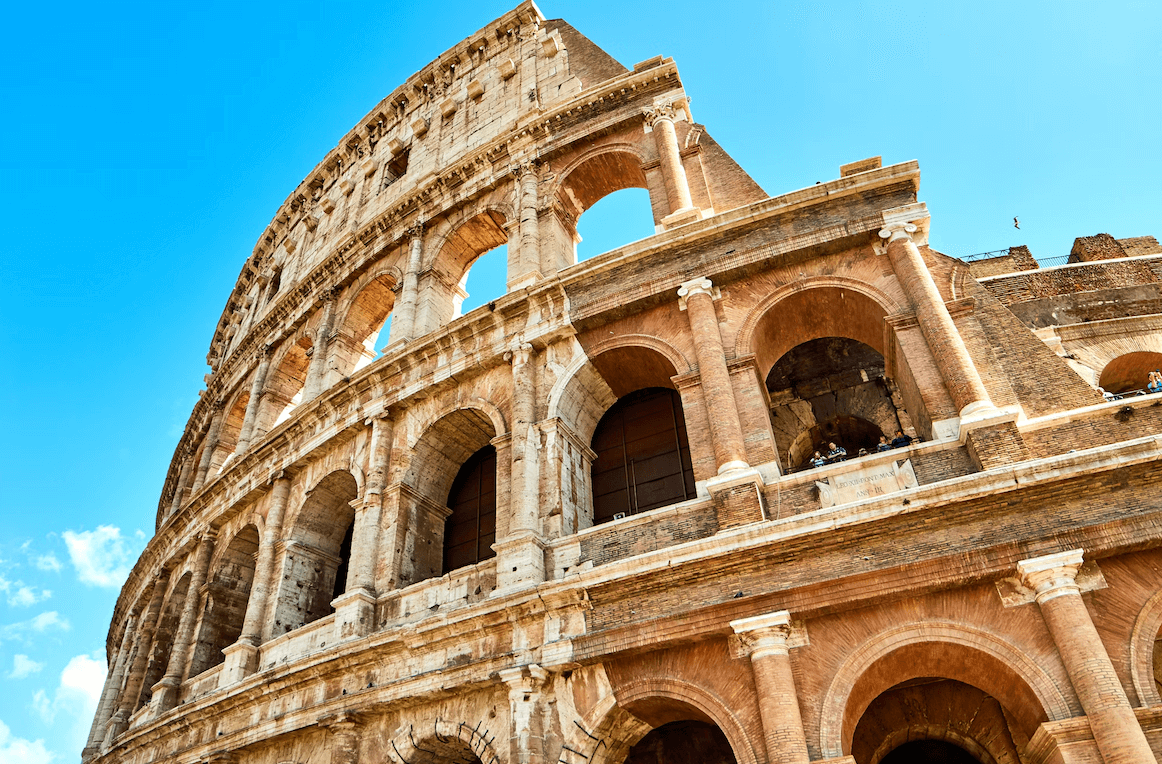
Roman Italia preserves a central and exceptionally influential corpus within the development of Mithraic cults.
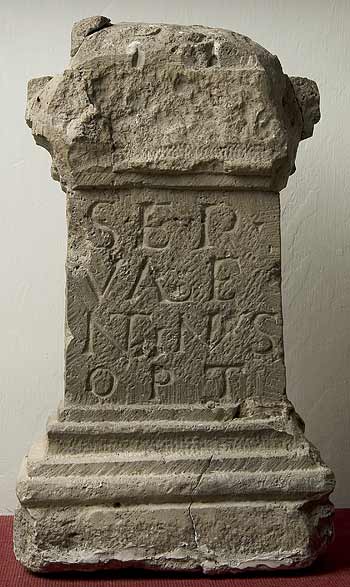
Limestone altar dedicated to Cautes by the Roman optio Septimius Valentinus, discovered in the Mithraeum of Sárkeszi in Pannonia Inferior.
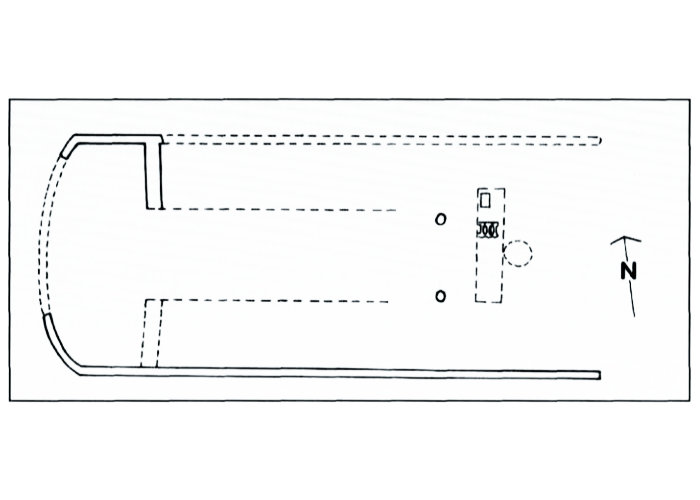
One of the largest known Mithraea in Pannonia, the sanctuary of Sárkeszi stood near the Roman road linking Herculia and Aquincum.
The Bad Ischl area has been inhabited since the time of the prehistoric Hallstatt culture. Documentary evidence of the settlement dates back to 1262, when it was referred to as Iselen.
Mauretania Caesariensis connected western North Africa to Mediterranean trade routes and the provincial networks of the Roman empire.
Mesopotamia formed part of the eastern frontier zone where Roman military expansion encountered long-established Mesopotamian traditions.
Syria-Palestina occupied a complex religious landscape shaped by imperial administration, pilgrimage and eastern Mediterranean mobility.
Asia formed one of the most urbanised and interconnected provinces of the eastern Roman world where Mithraic cults circulated widely.
