Your search Tal hal Hariri / Es-Sâlihiyeh / As Salhiyah gave 3730 results.

Two marble reliefs of the same height from Brigetio, Pannonia Superior, each depicting a cross-legged torchbearer in Oriental dress — Cautes and Cautopates — holding their torches.
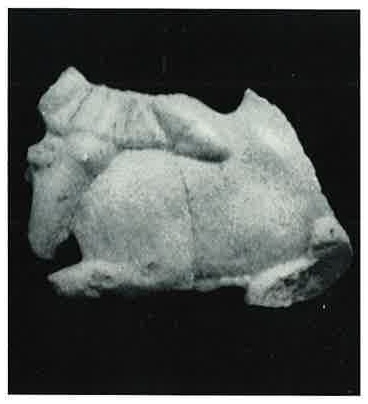
White marble tauroctony relief fragment from Carnuntum, Pannonia Superior, preserving the bull and the lower part of Mithras's tunic.
Two sandstone fragments from Mithraeum III at Carnuntum, Pannonia Superior, comprising a base with one leg and a downward torch, and a Phrygian-capped head of Cautopates; probably stood at the beginning of the benches alongside the Cautes statue.
Marble plate from Stix-Neusiedl, Pannonia Superior, dedicated to Deo invicto Mithrae by Vitalis and Silvanus; traces of red colour are preserved in the lettering.
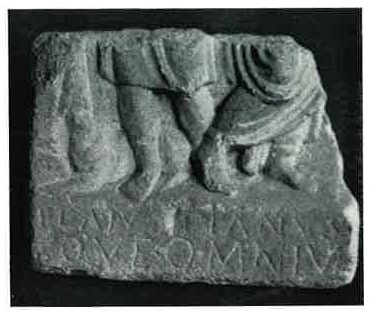
Marble relief fragment from Mithraeum III at Ptuj, ancient Poetovio, preserving part of Mithras's flying cloak and the scorpion below the bull.
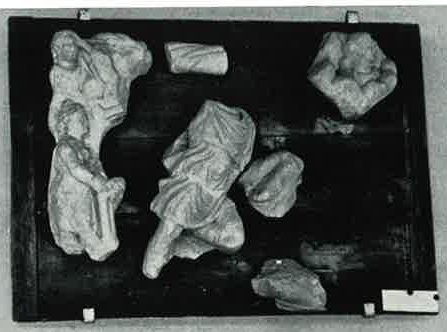
Marble tauroctony relief from Mithraeum III at Ptuj, ancient Poetovio, preserving Mithras killing the bull — head and most of the flying cloak lost — flanked by Cautopates holding the torch downward.
Three marble cornice fragments from Mithraeum III at Ptuj, ancient Poetovio, bearing an inscription recording that the monument was elevated in the manner of Sol, in honour of Cautes and Cautopates.
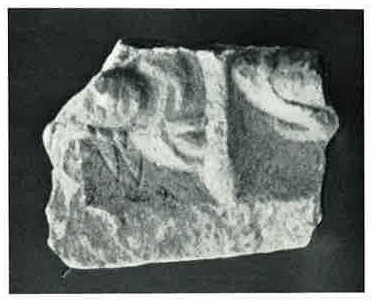
Left upper corner of a marble relief from Mithraeum II at Ptuj, ancient Poetovio, with the dressed bust of Sol in radiate crown above a horizontal rim, beneath which the head of a torchbearer, probably Cautopates.
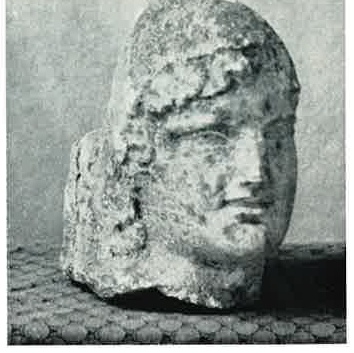
Small marble head from Mithraeum II at Ptuj, ancient Poetovio, depicting a smiling Mithras in Phrygian cap with a profiled reverse — one of the most expressive Mithraic heads from the Danubian provinces.
Marble relief from Mithraeum II at Ptuj, ancient Poetovio, depicting standing Jupiter with sceptre and thunderbolt beside standing Hercules with the Hesperides' fruit and club — a divine pair with Mithraic associations.

Left portion of a marble tauroctony relief from Mithraeum II at Ptuj, ancient Poetovio, preserving the bust of Sol and below it standing Cautopates with a downward torch, together with the bull's hind-leg and Mithras's right leg.
Fragmentary inscription from Mithraeum II at Ptuj, ancient Poetovio, recording a dedication to Deo invicto Mithrae by Titus Flavius Restutus, IIIIvir Augustalis of the Colonia Poetovionis.
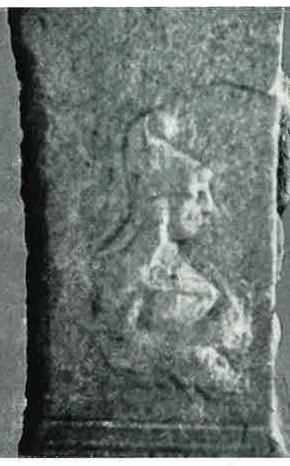
White marble altar from Mithraeum I at Ptuj, ancient Poetovio, decorated below the inscription with the dressed bust of Cautopates, a palm between two ram's heads above, and busts of Mithras on both lateral faces.
Small bronze bust of Sol with five rays found at Strasbourg, ancient Argentoratum, during construction works in the 1860s–70s; associated with the Mithraic assemblage from the city.
Upper portion of a sandstone statue from Strasbourg, ancient Argentoratum, showing a head surmounted by a serpent's head; the fragment probably belonged to an Aion.
Rocky base from the Mithraeum at Neuenheim probably originally supporting a representation of Mithras' rock-birth
Red sandstone base from the Mithraeum at Neuenheim with representations of deities on each of its four sides
Small red sandstone statuette of a lying lion from Wiesbaden, ancient Aquae Mattiacae, with snout and hindquarters broken off
Sandstone votive altar with traces of red paint from Wiesbaden, ancient Aquae Mattiacae, erected during the reign of Macrinus with permission of Varonius Lupulus
Votive sandstone altar from Wiesbaden, ancient Aquae Mattiacae, dedicated to Deo Soli invicto by Caius Silvinius Maternus, in honour of the Domus Divina
