Mithras, the invincible god
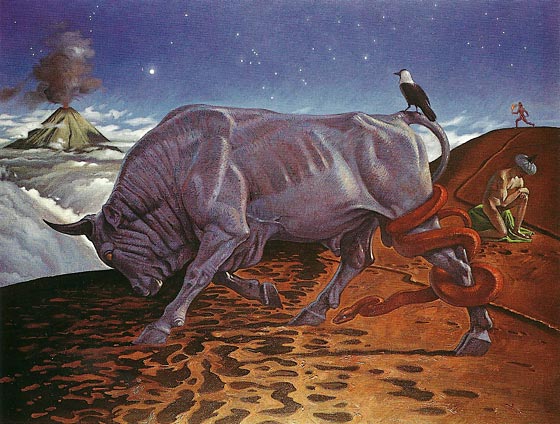
Prima dei Bagliori
Massimo Livadiotti
A myth carved in stone
We do not know the story of Mithras from a surviving sacred book. Almost everything that can be said about his myth has to be reconstructed from images, inscriptions and the archaeological context of the mithraea.
The richest evidence comes from complex reliefs, particularly those found in the Rhine and Danube provinces. Around the central image of Mithras killing the bull, these monuments show episodes such as his birth from the rock, the miracle of water, the pursuit and capture of the bull, his encounters with Sol, the divine banquet and his journey in the solar chariot.
Together, these scenes preserve substantial parts of a sacred narrative, but their arrangement is not uniform. Some episodes appear frequently, others only occasionally, and their connections are not always clear. The account below follows a conventional modern reconstruction, drawing on Manfred Clauss’ presentation of the myth and on studies of the relationship between Mithraic images and ritual.
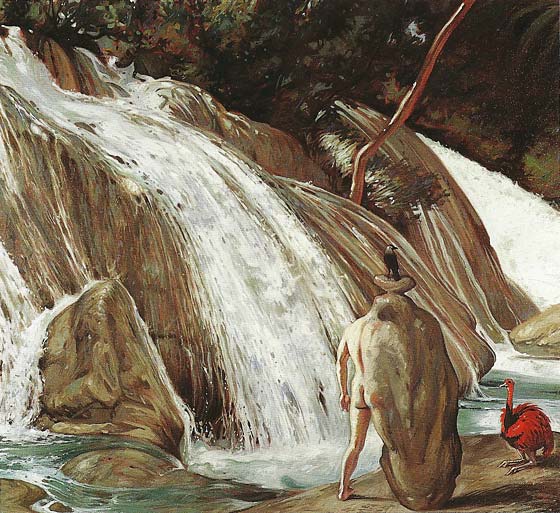
La Natività
Massimo Livadiotti
The rock-born god
Mithras enters the world in an extraordinary way: he is born from a rock. The petrogenesis, or rock-birth, is one of the most characteristic images of Roman Mithraism. Mithras normally emerges naked as a young god, already wearing his Phrygian cap. His arms are raised and he usually holds a torch and a dagger or sword.
The rock itself was honoured as Petra Genetrix, the “rock that gives birth”. In the first mithraeum at Poetovio, modern Ptuj, a dedication by Felix addresses Petrae Genetrici. Its final words, ex viso, record that the offering followed a vision. The surviving monument combines the inscription with a carved rock, above which a separately attached figure of Mithras once stood. The act of worship and the image of the birth were brought together in the same object.
Some representations include Cautes and Cautopates, the two torchbearers who accompany Mithras elsewhere in the myth. At the third mithraeum of Ptuj, they appear to assist the god as he emerges. Serpents may also coil around the rock, connecting the scene with an animal familiar from the tauroctony.
The torch associates the birth with light, while the weapon anticipates the god’s later encounter with the bull. Other versions give the scene a more explicitly cosmic setting, surrounding the emerging Mithras with zodiacal signs or showing him with a globe. His birth could thus be presented as an event whose significance extended to the world as a whole.
The often repeated date of 25 December is not securely attested as a Mithraic birthday festival. It derives from an association with the Roman celebration of Natalis Invicti, rather than from direct evidence for the calendar of the mysteries.
The miracle of water
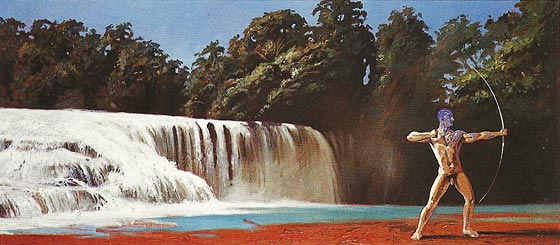
Mithras
Massimo Livadiotti
Another recurring episode shows Mithras seated or kneeling before a rock, aiming his bow towards it. Water springs from the stone, while nearby figures kneel or extend their hands. Conventionally known as the water miracle, the scene presents the god as the source of water essential to life.
A painted verse from the Mithraeum of Santa Prisca in Rome has often been connected with this episode:
Fons concluse petris, geminos qui aluisti nectare fratres…
“Spring enclosed in the rocks, you who nourished the twin brothers with nectar…”
The verse brings together stone, a spring and two brothers, an association that recalls the figures accompanying Mithras in several representations of the miracle. These companions are often identified as Cautes and Cautopates. The proposed connection is persuasive, although the verse does not name the brothers or describe the shooting of an arrow.
A decorated vessel from Mainz provides a further perspective on the episode. One of its scenes shows a seated figure in a Phrygian cap drawing a bow towards a smaller, naked figure, accompanied by a third participant. Roger Beck interprets the scene as an initiation in which the Father of the community assumes the role of Mithras. His action reproduces the god’s archery in the water miracle, bringing an episode of the myth into the experience of the initiate.
This interpretation gives the scene a significance beyond the provision of water. The deed of the god becomes a model for an action performed within the sanctuary, connecting divine narrative and human ritual.
Mithras and the bull
The bull is the central animal of Mithras’ myth, and complex reliefs sometimes preserve several episodes leading towards its sacrifice. It may first appear alone or grazing. Mithras is then shown seizing it, clinging to it as it runs, or riding on its back. Other scenes show him carrying the animal across his shoulders.
The relief from Neuenheim, near Heidelberg, brings several of these moments together. A grazing bull is followed by scenes of Mithras carrying it, being dragged along by it and carrying it again. Read as a sequence, the images suggest a capture followed by renewed resistance before the animal is finally subdued.
The image of Mithras carrying the bull is often called the transitus. The animal’s body lies across his shoulders, its legs held in front of him. The motif recalls other ancient images of figures carrying animals, but here it belongs to the struggle that precedes the central sacrifice.
Porphyry, writing in the third century CE, also associates Mithras with the bull. In On the Cave of the Nymphs, he describes the god as borne on the bull of Venus and places him at the celestial equator. The passage interprets Mithraic imagery through the relationships between planets, zodiacal signs and the generation of life. It provides an ancient cosmic reading of the image, shaped by Porphyry’s philosophical interests.
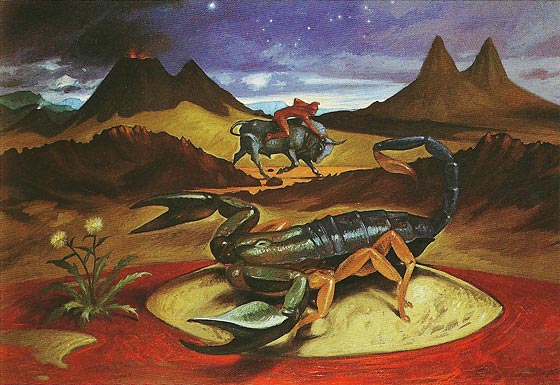
Lo Scorpione
Massimo Livadiotti
The sacrifice of the bull
At the centre of Mithraic iconography stands the tauroctony: Mithras killing the bull. The image occupied the focal position in the mithraeum and appears throughout the Roman world. Whatever differences existed between individual communities, this was the defining image of their god.
Mithras presses a knee against the bull’s back, pulls its head upwards and drives a dagger into its neck or shoulder. His own face is usually turned away, often towards Sol or the raven in the upper part of the scene.
Around the dying bull appears a distinctive group of animals. A dog reaches towards the wound, a serpent approaches the animal and a scorpion grips its genitals. A raven is frequently present, while Cautes and Cautopates stand on either side, the former with his torch raised and the latter with his torch lowered. Sol and Luna commonly occupy the upper corners of the composition.
Vegetal imagery connects the killing with the production of life. Most famously, the bull’s tail may end in ears of wheat. This detail has been central to interpretations of the sacrifice as an act that creates or renews the world. Scholars have differed over whether the scene represents an original creation, the renewal of nature, or the ordering of an existing cosmos.
The celestial elements are equally prominent. Zodiac signs sometimes surround the scene, and several of its animals have counterparts among the constellations. Astral interpretations examine how these figures, the Sun and Moon, and the position of Mithras might form a coherent account of the heavens. They disagree, however, over the precise correspondences and the event or process being represented.
The tauroctony combines these associations in a single, carefully organised image. Its composition brings together the violent death of the bull, the appearance of grain and the surrounding celestial world. The debate concerns how these elements were understood together and what the sacrifice accomplished for the god’s followers.
Mithras and Sol
Sol, the Sun god, occupies a central place in Mithras’ story. Their relationship is expressed differently in inscriptions and narrative images. Dedications can invoke Sol Invictus Mithras, identifying Mithras with the unconquered Sun, while reliefs and paintings show the two gods facing one another, sharing a meal or travelling together.
One unusual episode shows Sol kneeling before Mithras. Mithras touches his head or raises an object above him. The scene is traditionally described as the submission of Sol, although it has also been interpreted as the conferral of an honour or as an initiation.
The object in Mithras’ raised hand cannot always be identified. Different examples have been interpreted as a cap, a drinking horn or a portion of meat. The familiar explanation that Mithras places a Phrygian cap on Sol’s head therefore applies to a particular reading of the evidence, rather than to every representation of the encounter.
Other monuments show the gods joining their right hands in dexiosis, sometimes across an altar. In Greek and Roman visual language, this gesture expressed agreement, loyalty or the establishment of a bond. It is generally understood here as an alliance between Mithras and Sol.
These encounters give different forms to the gods’ relationship: submission or recognition in one scene, mutual commitment in another, and shared celebration at the banquet. Their sequence is reconstructed from the monuments; it is not necessary to assume that every encounter followed the killing of the bull.
The banquet of Mithras and Sol
Mithras and Sol recline together at a sacred meal, often upon the hide of the slaughtered bull. The connection with the sacrifice is particularly strong because several monuments place the two scenes on opposite sides of the same relief. The animal has been killed; its hide now covers the couch on which the gods feast.
The relief from Fiano Romano, in the Louvre collection, preserves this arrangement. Its two faces show the sacrifice and the banquet, attended by Cautes and Cautopates, and the stone could turn on its base. The monument allowed the two closely connected episodes to be presented in succession.
Other banquet scenes include attendants whose appearance recalls the ritual grades of the Mithraic communities. Here the relationship between myth and ritual becomes particularly close. The long raised benches of the mithraeum provided places for worshippers to recline at communal meals, giving the human gathering a setting comparable to the feast of the gods.
Beck reads the banquet imagery at Santa Prisca and on the relief from Konjic in terms of this correspondence. The Pater, or Father, and the Heliodromus, or Sun-Runner, represent Mithras and Sol, while other members serve them according to their grades. In this interpretation, the ritual meal gives participants roles within the divine story.
The banquet offers one of the clearest surviving connections between Mithraic myth and religious practice. The community gathered around a shared meal whose divine model was displayed among the images of the sanctuary.
The ascent
Mithras joins Sol in the solar chariot. In some representations he is already aboard; in others, the scene captures the moment when Sol helps him into the vehicle. The Sun god holds the reins and a whip as the two prepare to travel or depart together.
The episode is conventionally described as the ascent of Mithras and placed at the end of modern reconstructions of the story. Oceanus appears in association with it on some monuments, extending the setting of the journey beyond the immediate world of the cave and the sacrifice.
Its connection with ideas about the soul’s passage through the cosmos is a matter of interpretation. The celestial journey nevertheless belongs to a wider field of Mithraic imagery in which planets, zodiacal signs and the structure of the heavens occupy a prominent place. With Mithras beside Sol in the chariot, the gods’ association takes the form of a journey through that celestial world.
One myth, many images
The surviving monuments preserve the outline of a story with distinctive episodes and recurring companions. Mithras emerges from the rock, brings water from stone, struggles with the bull and kills it. His encounters with Sol include a solemn agreement, a shared banquet and a journey in the solar chariot.
Within this familiar repertoire, individual monuments make different choices. The elaborate reliefs of the Rhine and Danube regions surround the sacrifice with numerous episodes; smaller works may concentrate on the birth, the bull-carrying or the banquet. Their differences belong to the history of the cult as much as their shared subjects do.
For the members of the Mithraic mysteries, these images formed part of the setting in which they worshipped. They occupied the walls and cult monuments of the mithraeum, accompanied communal meals and gave visible form to the deeds of the god they called Mithras Invictus.
References
- Roger Beck (2000) Ritual, Myth, Doctrine, and Initiation in the Mysteries of Mithras: New Evidence from a Cult Vessel
- Roger Beck (2007) The Religion of the Mithras Cult in the Roman Empire. Mysteries of the Unconquered Sun
- Manfred Clauss (1990) The Roman cult of Mithras
- Maarten Vermaseren (1956 – 1960) Corpus Inscriptionum et Monumentorum Religionis Mithriacae
- Carel Claudius van Essen & Maarten Vermaseren (1965) The Excavations in the Mithraeum of the Church of Santa Prisca in Rome
- Attilio Mastrocinque (2017) The Mysteries of Mithras. A Different Account
- Richard Gordon (1980) Panelled Complications
- (2021) The Mystery of Mithras: Exploring the heart of a Roman cult
- (2024) On the Cave of the Nymphs
