The many lives of Mithras
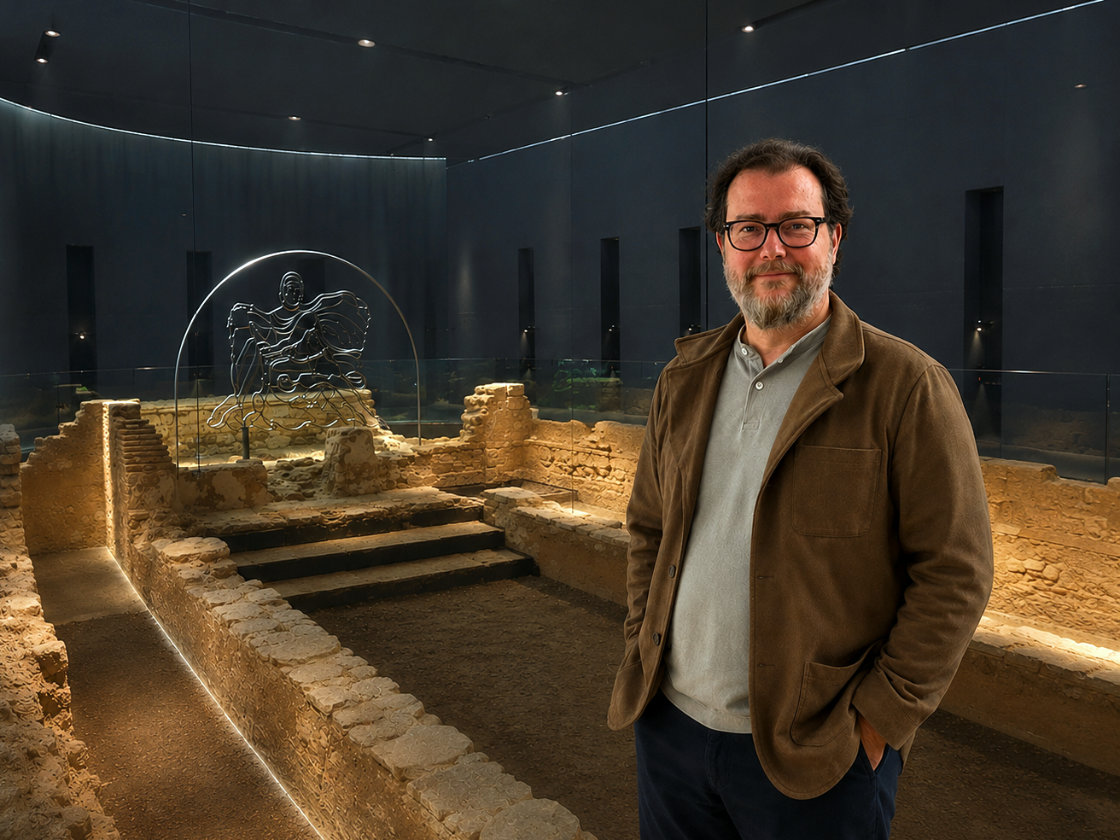
Israel Campos at the London Mithraeum.
Israel Campos
Israel Campos Méndez is one of Spain’s leading specialists in the study of Mithras and his cult. He is Professor of Ancient History at the University of Las Palmas de Gran Canaria and has spent more than two decades devoting an important part of his research to the origins of the Mithraic cult and to the controversial relationship between the Mitra/Mithra venerated in the Indo-Iranian traditions and the Roman mystery cult.
He is the author of several monographs and numerous studies on the subject. He has also helped organise the Jornadas Mitraicas at the Archaeological Museum of Cabra and has collaborated as a historical adviser with the Museum of London. He has just published his latest essay, Mitra, un dios entre Oriente y Occidente, a new synthesis that brings together much of his research and invites us to reconsider what we know about the evolution of Mithras and his background, from the Indo-Iranian traditions to the farthest reaches of the Roman Empire.
Israel, how are gods born?
It is a question that those of us who study the history of religions sometimes forget to ask. We take it for granted that the gods are simply there, and we begin to reconstruct things from the evidence. But the main question, “how are gods born?”, is not always one we ask ourselves.
When I began writing my new essay, I told myself that I could not start in the usual way, by talking about the earliest testimonies. Gods are creations of human societies, and the question we must ask in order to understand their function and the place they occupy in the societies through which they pass is why they are born.
In this case, Mithras is born in order to respond, from a religious and cultural point of view, to what seems to lie behind his own name. In Sanskrit, in Avestan and in other Indo-Iranian languages, Mitra seems to evoke the idea of pact and friendship. I believe that Mitra is born, like many other gods, in response to a social purpose: so that a divinity may watch over relationships between people, and likewise over pacts, agreements and the given word. Gods are born, and in this case Mitra is born, to respond to our needs of coexistence.
And now, then, what is the first testimony we know of concerning Mithras?
Curiously, the first written text in which the appearance of Mitra in the sources is usually situated is not linked to the Persian world, to the Iranian world, or even to the Vedic sphere. Although his cult may well go back to earlier times, Mitra first appears in a peace treaty found in present-day Turkey, in the context of the Hittite Empire, around 1380–1350 BCE.
There Mitra appears alongside other gods from the Indo-Iranian or Aryan context, linked to a pact, to a peace treaty. And, curiously, from the very first moment Mitra already appears fulfilling the role I have just mentioned: that of a god who watches over a treaty, over a pact.
That function will always be his leitmotif. It is always there as one of Mitra’s defining features, regardless of the other attributes that will be given to him over the course of history: a god who guarantees social order.
The problem with this first reference is that only the name of Mitra appears, alongside a large number of Mitannian and Hittite divinities, and nothing more. It is difficult to draw further conclusions about the cult he may have had. To learn anything more, one has to go to India or Persia.
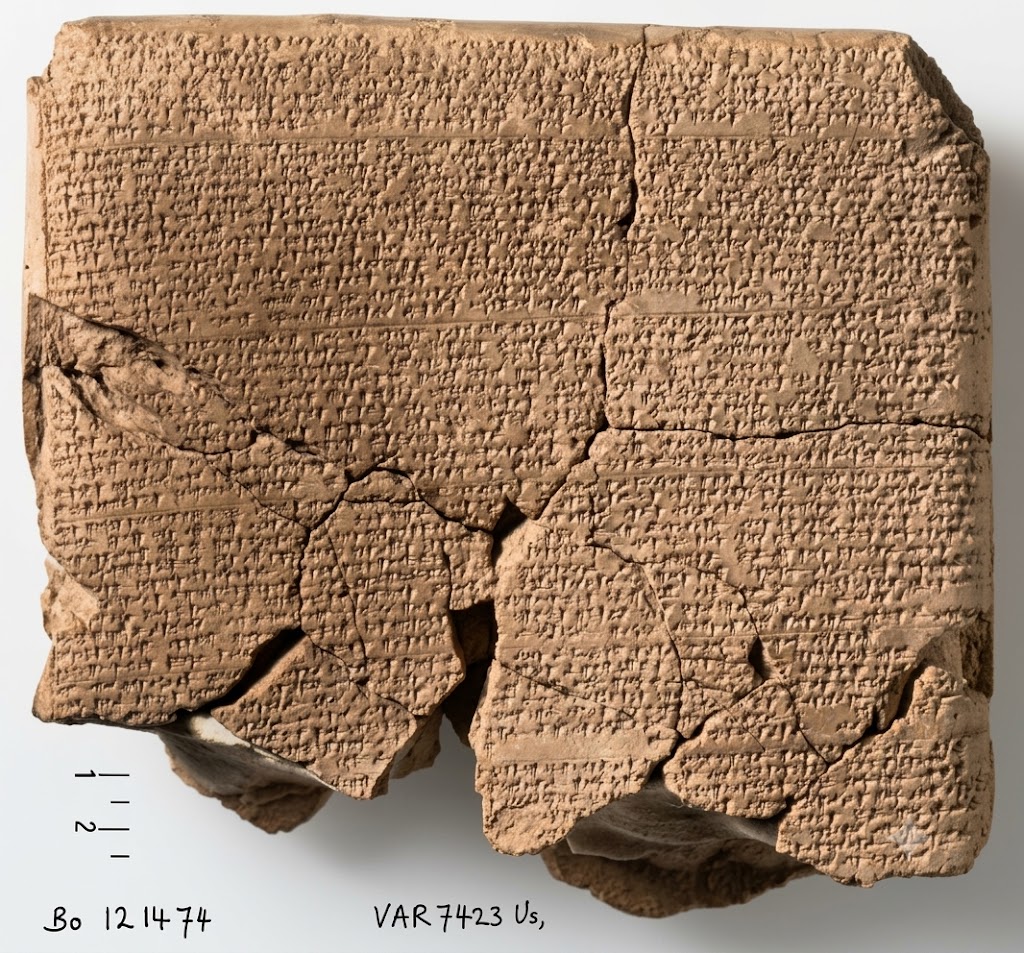
Treaty between Šuppiluliuma I and Šattiwaza of Mitanni.
Israel Campos
We are talking about the treaty between Šuppiluliuma and Mattiwaza. Could you give us a little more context?
It comes from Mitanni, a kingdom that lasted some two or three hundred years and arose basically in what is now Syria and northern Mesopotamia. It was a kingdom located between the Hittite Empire, which lay mainly in Asia Minor, and Egypt.
It is an interesting kingdom because it was led to a large extent by a population of Aryan origin, that is, by a population connected to the Indo-Iranian root. It is probably for that reason that those gods — Mitra, Varuna, Indra — who are foreign to the Hittite pantheon as a whole, and also to the Mitannian one, appear represented in that treaty.
Mitanni is therefore a kind of exception in relation to what we later know of Mitra in Persia and India. Curiously, the earliest Mithraic testimony we know of is closer to the Mediterranean than to the plains of Central Asia.
This text is roughly contemporary with the Rigveda, the oldest sacred text of the Vedic tradition, in which Mitra appears for the first time in the Indian subcontinent. What does the Vedic tradition tell us about Mitra?
It is an interesting subject. The Mitanni treaty, around 1380 BCE, appears as an exception that has no further correlation. Mitra is not mentioned again in the Mitannian context. The next written references to Mitra appear in a territory thousands of kilometres away from Mitanni: the Indus Valley.
There, towards the end of that period, around 1200 BCE, the Vedic culture emerges as the result of the arrival in the Indus Valley of populations of “Indo-European” origin, although this term is now under discussion. In this context a civilisation of Indo-Iranian roots will arise, in which Mitra is reflected much more clearly, especially in numerous religious hymns.
The Vedic books are principally collections of religious hymns. In many of them, especially in the Rigveda, Mitra is mentioned frequently. There is even a hymn dedicated exclusively to him.
Through those written references in Sanskrit, it is possible to reconstruct rather more of Mitra’s meaning, and to understand what role he may have played in a pantheon as complex as the Vedic one. It is a pantheon with an enormous number of gods, some with a far more important role, such as Varuna, Indra and many others.
In that context, Mitra appears with functions similar to those we had seen in Mitanni. He is mentioned as a god of pacts and cosmic order, that is, as a divinity who ensures that the functioning of social relations is guaranteed. He is a god of friendship. In fact, the word Mitra is often translated as “friendship” in Sanskrit.
But that friendship, I believe, refers rather to the maintenance of relations between people: a friendship of pact, comradeship or fellowship. There we have a Mitra with functions far more evident than those we knew from Mitanni.
This is still closely connected with functions that we will later see in the Roman cult, such as the comradeship and friendship you mention. But, in addition, in the Vedic context Mitra has an almost fusional relationship with Varuna. Mitra-Varuna is often spoken of as a single entity. What does this involve?
It is difficult to translate this into our Western religious mindset, because our models of thought tend to identify divinities as individuals or particular elements, each with their own specific functions and attributes. Even in Christianity itself, it is complicated to explain the Trinity.
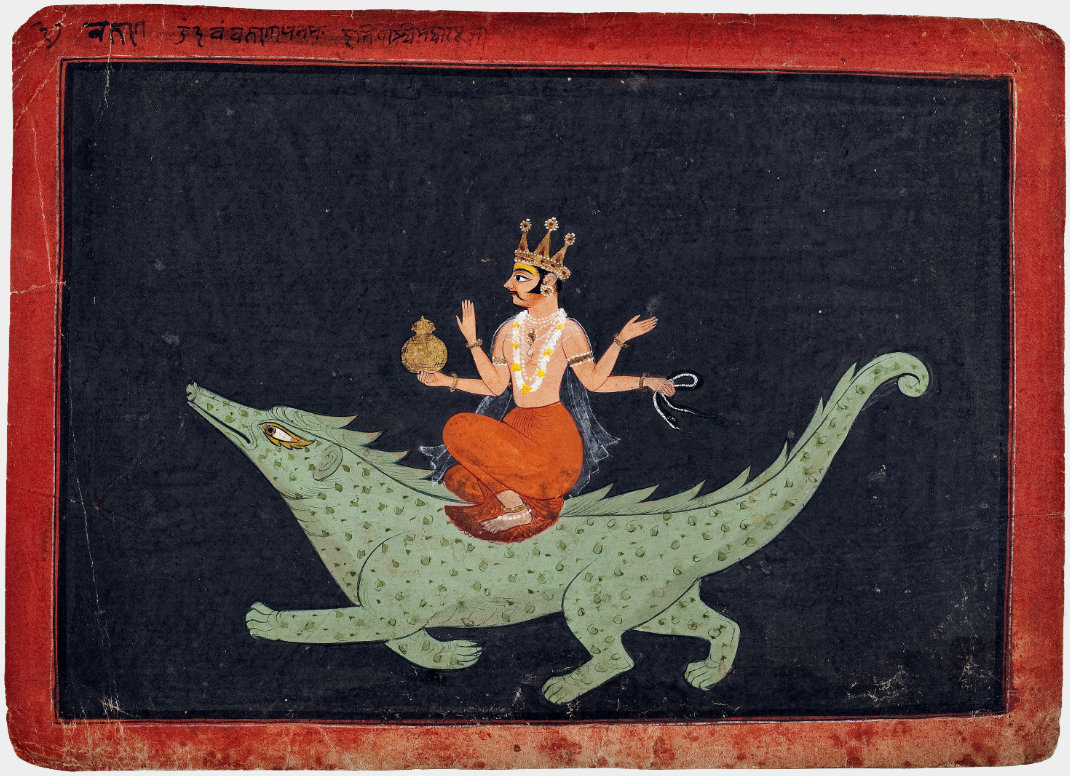
Varuna, Bundi, Rajasthan, India. Gift of the Felix and Helen Juda Foundation.
Public domain
Mitra is the god who protects the activities carried out during the day. Varuna would be the divinity who protects, cares for or watches over everything that happens during darkness. Since night and day are inseparable, in the sense that they form a continuity that permanently succeeds itself, their roles are understood in that way. There are then other ideas in relation to that function of cosmic order I mentioned earlier. Mitra and Varuna are the guarantors that society functions, one might say. That is where the issue of the inseparability of the two elements lies.
The curious thing is that, through the rest of the Vedic texts, we know that Varuna also has functions of his own. Varuna is one of the principal divinities of the Vedic cult. One cannot speak of a chief god, because it is a much more complex pantheon, but Varuna performs functions as father of the gods. When Mitra is brought into the picture, researchers encounter difficulties in explaining all its consequences.
Following the chronological thread, Mithra reappears centuries later in the Avesta, the main corpus of sacred texts of Zoroastrianism. But what do we know about Mithra in the Iranian world before Zarathustra?
We know little about this pre-Zoroastrian or pre-Avestan Mithra, because we are once again dependent on written sources. If before we were in the Indus Valley, now the camera shifts towards what would be present-day Iran, ancient Persia.
It should be remembered that the Avestan texts belong to an oral tradition that, at a certain point, was put into writing. In fact, for quite some time there was resistance to doing so. For many of them this may have happened from the first millennium onwards, and even in the Achaemenid period.
These Avestan texts preserve what is considered to be the reform of traditional Iranian religion carried out by Zarathustra. New elements appear there, such as the role assumed by Ahura Mazdā, who becomes the principal divinity of the Zoroastrian cult or Mazdaism.
From these texts, inferences can also be made about what earlier cults were like. It seems that Mithra, the pre-Zoroastrian or pre-Avestan Mithra, was already an important divinity. There are references to festivals celebrated before Zoroastrianism, such as Mihragān, and the idea is that Mithra must have had a certain prominence among Iranian populations.
These populations, moreover, still lived in a dispersed manner. The role of Cyrus II was to unite the Iranian tribes into a single kingdom; from there Persia would emerge, and Persia would become an empire.
In that context, Mithra takes on functions very similar to those we had seen in the Vedic world: a close god, a god who sponsors the day, who watches over social relations, the pact, agreements and treaties. That role will be repositioned once the Zoroastrian reform is accepted. The Avestan Mithra will assume much of what he had already represented. That is to say, the Mithra we see in the Avesta is very probably a continuation of the earlier Mithra, although he will later acquire a political role within the interests of the Achaemenid dynasty.
This reminds me of what you were saying earlier about Varuna and Mitra. You said that Varuna could be regarded as a superior deity, almost like a father of the gods, like Jupiter in the Roman context, while Mitra was subordinate and at the same time formed a binomial relationship with him. Does something similar occur in the Iranian context?
There is an important debate in the study of ancient Iranian religion: whether Ahura Mazdā corresponds to Varuna. In many other cases there is a kind of continuity, or at least it is possible to identify gods who appear in the Vedic world and remain present in the Avestan world. One has to bear in mind that we are talking about India and Iran, but also about a series of correspondences.
For a long time it was thought that the Zoroastrian Ahura Mazdā was an equivalent of Varuna. Today that idea has been abandoned, because Ahura Mazdā is granted his own personality without the need to understand him as a Persian adaptation of Varuna. But there are roles of principal gods: Ahura Mazdā and the Ameša Spenta, who are in some way his main associates, and then the other gods, who exercise their own functions.
Curiously, in relation to the Zoroastrian reform, what is usually suggested is that perhaps at first this reform had a more radical phase. To make it understandable, one might think of it a little as a kind of counter-reformation: there was a traditional religion, and Zarathustra led a different way of practising that religion.
At first, in the more radical period, the other gods are excluded and only Ahura Mazdā and the Ameša Spenta remain. Later, once the reform is accepted and the population gradually adopts it, the traditional gods that had been set aside are recovered and begin to gain or regain ground. It is in that sense that we could situate Mithra.
Mithra does not appear in the earliest Avestan texts, the Yasna. But, curiously, later on, in the other poetic texts, he begins to appear. That means that there may have been a phase of radicalism in which the other gods had no place. Not that they were persecuted, but they had no place. Afterwards, when Zoroastrianism becomes institutionalised, previous religious forms gradually regain a place.
With all due caution, early Christianity is very radical: there is only God and the figure of Jesus. In High Medieval Christianity, all the saints begin to appear. What are all those saints? Very often, they are the old gods that existed in Roman pagan religion.
What remains of Mitra/Mithras today in Iran and India?
The history of the Zoroastrian community is interesting. Today the Zoroastrian cult is not very numerous. Little remains of Vedic religion in that sense, because Vedism evolves into Brahmanical religion, and Brahmanical religion begins to prioritise a series of gods, such as Viṣṇu and others. Those traditional gods disappear in Hinduism, although there are elements that can be traced, especially in India in the fourth and fifth centuries CE, where references to Mithra appear in a Buddhist context. But it is a difficult field to follow.
Today, Zoroastrian communities are scattered throughout almost the whole world. When the Islamic conquest of Iran took place in the seventh century, many Zoroastrian communities that survived there held out for a time, until they began to be persecuted and eventually fled to India. Most Zoroastrian communities, during the second part of the Middle Ages and the Early Modern period, were based in northern India.
In the twentieth century they spread to many places. There are important communities in England, obviously because of the British colonial legacy, and also in Canada and other countries. That Zoroastrian cult is maintained in accordance with the Avestan texts, although without any great public relevance.
If we keep moving forward, we inevitably come to Alexander the Great and the conquest of the Achaemenid Empire, when much of the territory underwent Hellenisation. What happens to Mithra in this context?
As I mentioned earlier, during the early Iranian period Mithra seems to be a divinity whom we cannot trace in much detail. The Mithra we know best in that Persian period is the Mithra who also exercises a recognised political role during the Achaemenid dynasty. From the fifth century BCE onwards, especially with Artaxerxes I and Artaxerxes II, propagandistic inscriptions begin to appear in palaces, in Persepolis and elsewhere, where Mithra is presented as a divinity who, together with Ahura Mazdā and the goddess Anāhitā, protects the royal family.
In addition, there are many theophoric names, that is, names of people that evoke Mithra. We find evidence of names such as Mithradates or Mithridates, and of a vast number of public figures whose names include an evocation of Mithra. These are testimonies that Mithra had an important public role during the Achaemenid period.
With the conquest of the Persian Empire, with the arrival of Alexander the Great and the formation of the Hellenistic kingdoms, the Seleucid Empire and then the fragmentation of Asia Minor into a large number of small kingdoms, as well as Ptolemaic Egypt, the trail of the cult of Mithra is somewhat lost.
At least initially, there is no clear link with the Macedonian or Greco-Macedonian rulers who will be present throughout the Asian region. The Avestan cult of Mithra would surely have continued, because Avestan religion was not explicitly persecuted by the new Greek rulers. We know that there was a Greek-speaking minority that governed, but that did not persecute those customs.
Curiously, it is in the territory of Asia Minor that we can begin to find the survival of testimonial traces linked to Mithra. Especially from the second century BCE onwards, a process begins of fusion or mixture between elements of the traditional Iranian Mithra, as we know him from the Avesta, and forms of Hellenistic religiosity.
We have testimonies in the kingdom of Commagene, in the kingdom of Pontus, in Bithynia and in other small kingdoms of Asia Minor. The testimonies relating to Mithra already show a process of syncretism with elements of Greek influence. In some cases Mithra continues to appear named in his own right, with elements halfway between the two traditions. But in other cases a process of syncretism between Mithra and Apollo, for example, has been identified.
That syncretism is probably what is usually called a translation into the Greek world of what Mithra was for the Greeks. Mithra is a solar god, with luminous elements, a protective god present in everyday life. Looking for gods with whom to compare him, Apollo was the best choice.
On Mount Nemrut Dağı, in Commagene, in present-day Turkey, we see precisely an iconography of Mithra quite similar to what we will later find in the properly Roman cult, don’t we?
The sanctuary or hierothesion of Nemrut Dağı, on a hill in central Turkey, was conceived as a kind of sacred place of the rulers of the dynasty of the kingdom of Commagene. This was an Irano-Greek or Greco-Iranian dynasty, that is, a fusion between a ruling dynasty of Greek origin and elements of Iranian tradition. And it is there, in this place, that an iconographic representation of Mithra appears for the first time.
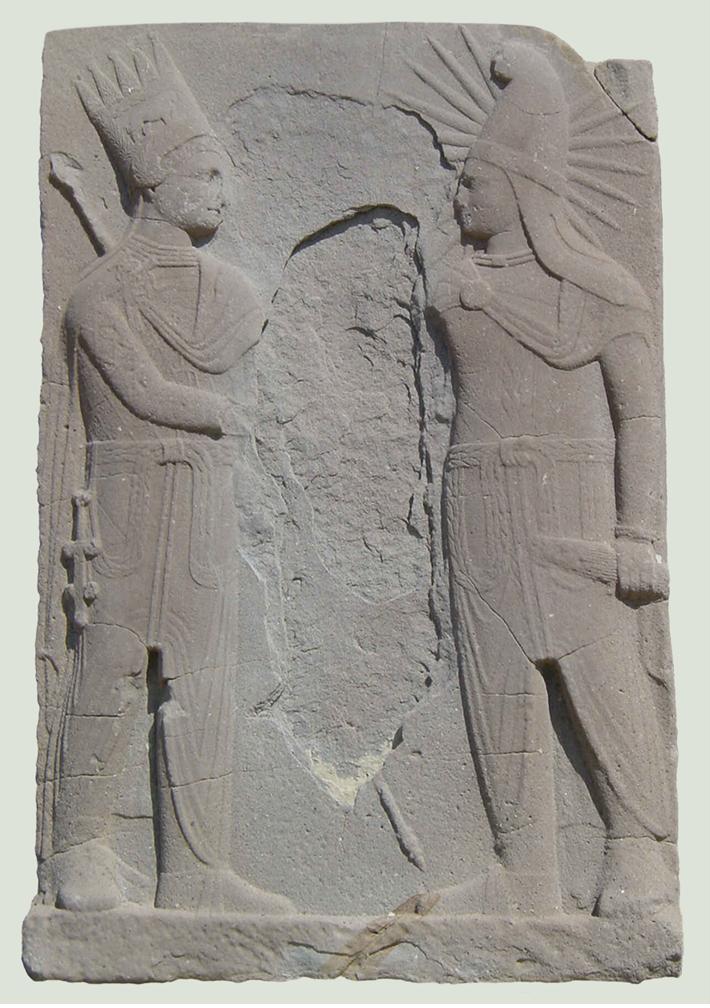
Antiochus I Theos and Apollo-Mithras-Helios-Hermes from Nemrut Dağı.
Herman Brijder
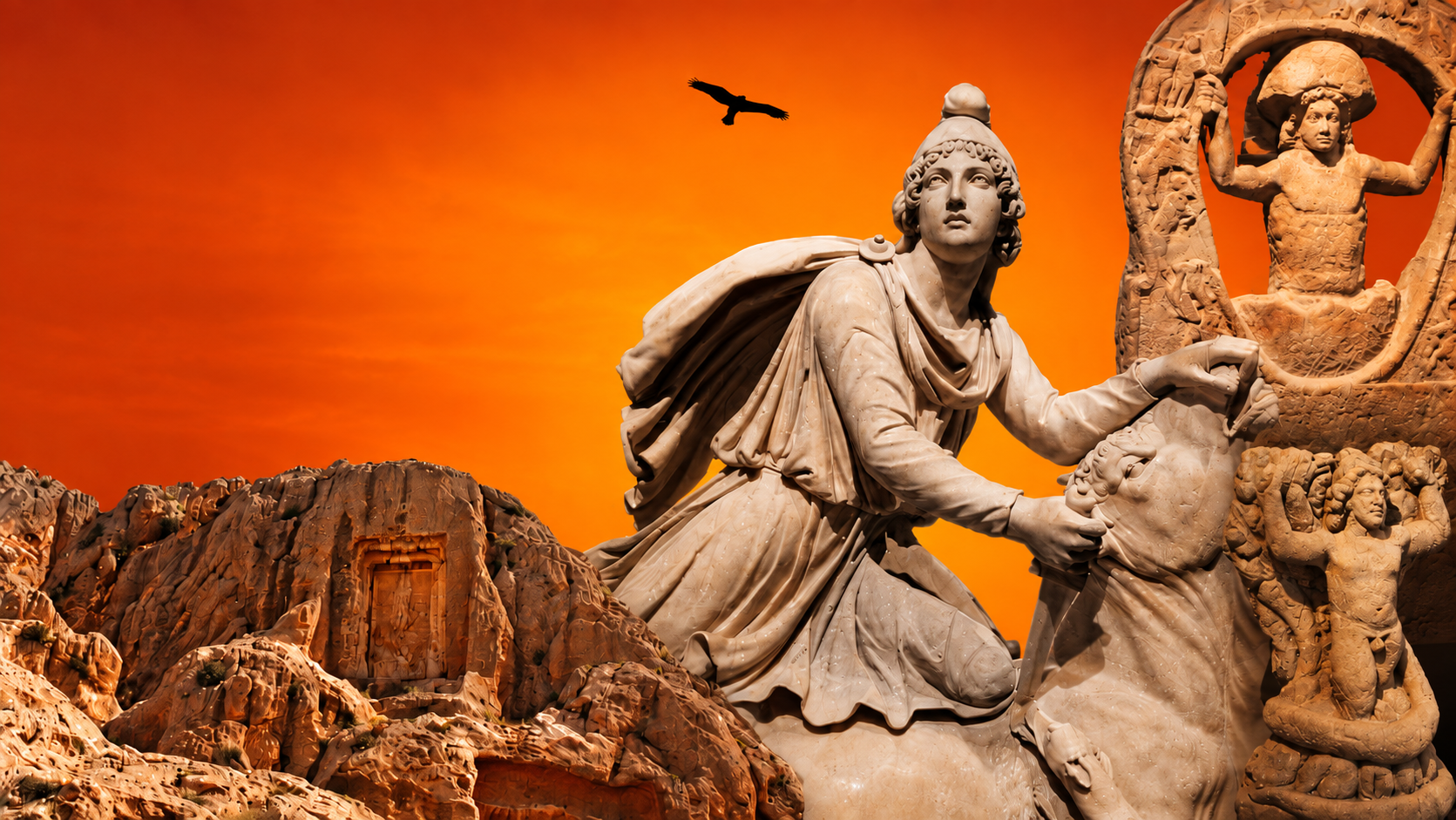
In the written text he is identified with Apollo. He appears as Mithra-Apollo, and that written reference is very interesting. But iconographically it is the first time we see Mithra dressed as we will later recognise him in the Roman world, “in the Persian manner”, as the Greeks would say, with trousers, with anaxyrides, with a chiton or long shirt, and with the characteristic Phrygian cap, the “Smurf hat”, as everyone knows it (laughs).
That is the first time we can identify Mithra iconographically. We do not know whether this had been done earlier in Persia, because we have no evidence. And, curiously, that iconographic canon of Mithra, which appears for the first time in Asia Minor, will be the one transferred to the Roman world, but also the one that remains present in the Persian world.
I mentioned earlier that Mithra had an important role in the Persian Achaemenid dynasty. When Persia re-emerges as an empire, first under the Arsacids and then under the Sasanians, Mithra will continue to carry significant weight in Sasanian Persia. In Sasanian religious iconography, Mithra will appear dressed in a way similar to what we have seen in Commagene.
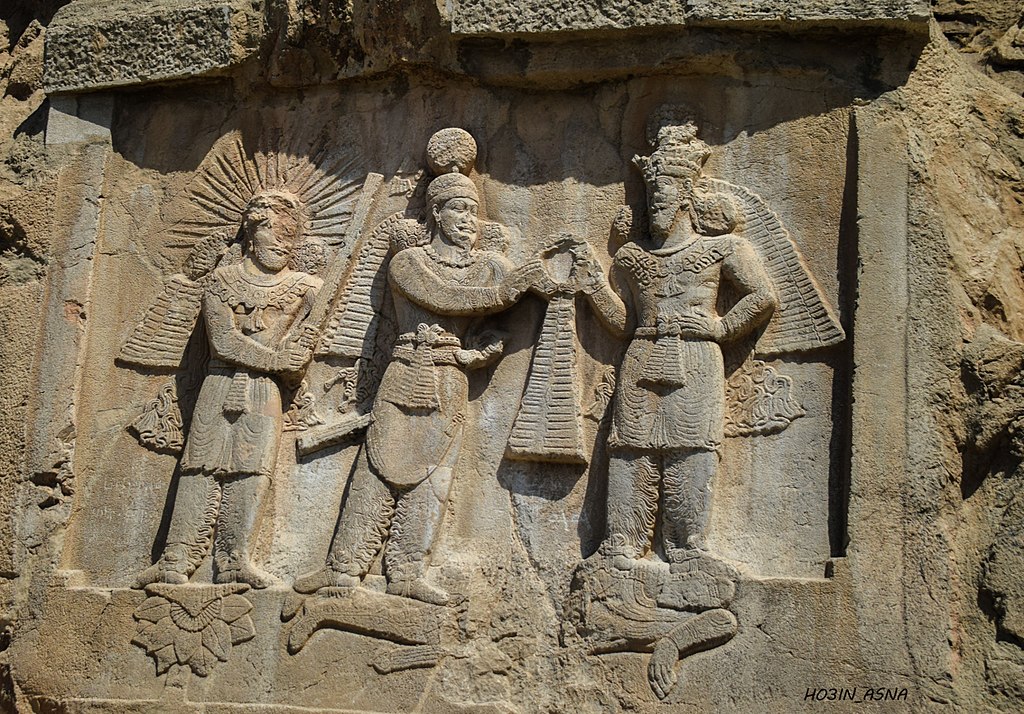
Mihr, Shapur II and Ardashit II at Tāq-e Bostān
Ho3in1988
Do gods travel?
By themselves, yes. And if people take them along, all the better. I don’t know whether you have seen the series American Gods, which is about the gods who live in the United States and shows how they got there. Their greatest concern is that the last person who believes in them should not die, because gods die when the last person who believed in them stops believing.
Gods travel with the people who believe in them. Unless you are Roman and the Romans carry out the evocatio directly, saying: “we take the god of such-and-such a people and bring him ourselves”, and then set up their own cult.
But in general, gods travel with the people who worship them. In the case of Mithras, we have seen that he moves from one place to another with those who believe in him. How Mithras enters Rome is an interesting question because it has not been possible to answer it with precise testimony. But it is clear that Asia Minor must have been the bridge by which the cult of Mithras reached Rome, whether directly or not — because that is another question — from the Iranian sphere.
According to Franz Cumont, the father of modern Mithraic studies, Roman Mithraism was a direct evolution of Iranian religion, a hypothesis that is now discarded in those terms. Since then, academic debate has oscillated between those who defend a greater continuity with Indo-Iranian traditions and those who consider Mithraism to be an essentially Roman creation developed in the religious context of the Empire. Do you think the reaction against Cumont has led part of contemporary historiography to minimise Mithras’ eastern heritage excessively? Where would you place your own interpretation within this debate?
Cumont was a highly authoritative figure because, among other things, he published the first catalogue bringing together all the epigraphic, literary and archaeological documentation known about Mithras at the end of the nineteenth century. He put forward a series of hypotheses. He was the first to reconstruct the cult, the ritual and the beliefs, with all the limitations that existed at the time, but he was also the first to propose a more or less solid hypothesis about how the cult of Mithras reached Rome.
What he argued was that the cult of Mithras, or Roman mystery Mithraism, was in fact a Roman form of the Iranian cult of Mithra brought, around the first century CE, by what he calls the Hellenised Magi. The Magi, to put it simply, are the official priests of the Avestan religion. According to Cumont, at a certain point, these people, four or five individuals with a profound knowledge of the Avestan cult of Mithra, arrived in the Roman world, in the midst of the regime change towards the Early Empire, and spread a particular form of the cult of Mithras.
That was the theory accepted for much of the twentieth century, until the 1970s, and some people have continued to uphold it. Today, however, it is argued that many of the elements that characterise Roman mystery Mithraism have more components belonging to the religious context that developed in Rome from the end of the first century BCE and during the first centuries of the Common Era, elements shared with the mystery cults of Isis, Cybele, Dionysus or Jupiter Dolichenus. It would be difficult for all this to fit with something that came directly from the East.
That first led Richard Gordon, then Roger Beck and John Hinnells, writing in the 1970s, to question Cumont’s hypothesis. In addition, a crucial element was introduced for understanding Mithraism. Cumont said that what was represented in the tauroctony, the scene of Mithras killing the bull, was a naturalistic element, symbolising the permanent regeneration of nature. The death of the bull represented the continuous cycle of vitality, spring, winter, and so on.
In the 1970s and 1980s, by contrast, it was proposed that behind the representation of the tauroctony there were elements of cosmological representation. What was being done was an evocation of a kind of astral cult. And all those elements of astral cult would not have an Iranian origin, but would rather belong to the Roman context.
As for my own position, I recognise that initially — in fact, my thesis was on the cult of Mithras in the East — I was very much in favour of investigating correlations. And in reality there are correlations between elements we know from the cult of Mithras in the East, as you have been pointing out, and elements that appear in the cult of Mithras in Rome.
The problem is demonstrating direct connections. When Rome adopts Mithras, when a Mithraic cult is formed in Rome, someone would have needed to possess such profound knowledge of the whole Avestan tradition that it is difficult simply to accept. In some respects there may be obvious connections, such as the representation of Mithras dressed in the Persian manner. But in other cases elements may have been adopted deliberately in order to give the cult a kind of exoticism.
I raise this because that is where I began to review my own positions. For example, when we analyse the presence of words of Persian origin such as nama or nabarze, we find that they are all late. They appear in inscriptions from almost the third century onwards. If they are Persian words, why are they not present earlier? One then asks whether someone introduced them consciously, or whether they existed before but have left no testimonies.
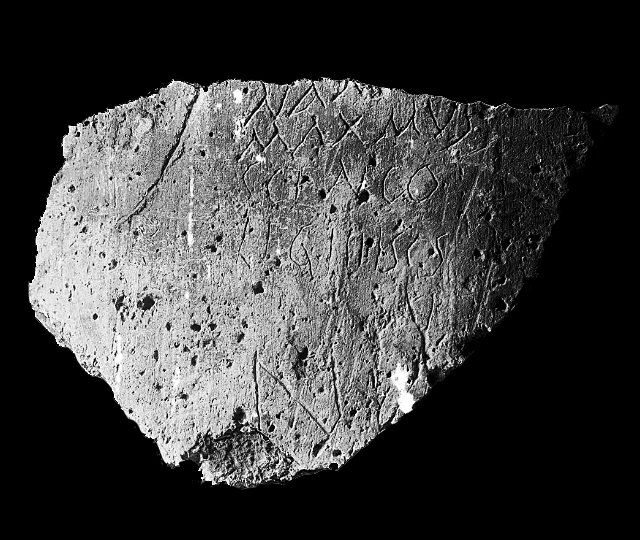
Engraved column by Maximus of Dura Europos, including the persian term ‘nama’.
The New Mithraeum / Laurent Bricault (CC BY-SA)
I would like us to analyse some of those correspondences. Let us begin with the term “mithraeum”. The first mention in Greek, mithraion, dates from the third century BCE. We find it in some papyri from Memphis, in Egypt. We suppose that it designates a temple of Mithra, but of the Iranian cult. Curiously, centuries later, in that same city, we find a Roman mithraeum. What does this papyrus tell us about the presence of an organised cult of Mithra in Ptolemaic Egypt? Could there have been some kind of continuity between that Iranian mithraion and the later Roman mithraeum?
It is complicated, like almost everything. First, because that mithraion that appears in isolation in a third-century papyrus is probably connected with the Iranian form of the cult of Mithra. Nor is it especially surprising that it appears in Egypt. We forget that Egypt, for some two hundred years, was a Persian satrapy and that there would therefore have been people of Persian origin settled there. That population could have been the patron or sponsor of local forms of the cult of Mithra.
The main problem with the word mithraion and with “mithraeum” is that the Romans themselves will never use the word mithraeum. The word mithraeum, as you said, is in fact recovered with Cumont in the nineteenth and twentieth centuries to refer to the Mithraic place of worship. The word the Romans used to refer to the place where they performed the cult was spelaeum, meaning cave. They speak of the spelaeum or the antrum, or else they use the more generic term templum without any qualms when the place is established.
Establishing a direct connection is difficult. That has long been the effort: to try to establish direct lines. But it is much more complicated. We are probably unaware of many intermediate points.
Let us now move into the properly Roman context. The first to mention Mithras in this sphere is Statius, in the Thebaid, where he evokes Mithraic rites celebrated in a Persian cave. Later, Plutarch writes that the Cilician pirates practised “strange sacrifices on Olympus” and celebrated certain “secret mysteries directed to Mithras”. These pirates are important because they have been proposed as one of the possible origins of the Roman Mithraic cult. However, there is a gap of a little over a century between the arrival of the pirates in the Italian peninsula and the first evidence of the properly Roman cult. Do we know anything about those strange sacrifices and those secret mysteries? Do you think they could form part of the origins of the Roman cult, or should we rule that out?
The question of the Cilician pirates was also taken for a long time as an alternative to the theory of the Hellenised Magi. In addition, Plutarch, in his treatise On Isis and Osiris, provides quite a lot of information about Mithra/Mithras. He was, after all, a priest of Apollo and had knowledge of the traditions that existed at that time.
The problem with that information about the pirates is, first, that we would be situating ourselves around 60 BCE, while the first evidence of differentiated Mithraic elements is the poem by Statius that you mention, around 90 CE. There are almost 150 years, or at least 120 or 130 years, between one thing and the other, and in between there is no reference relating to Mithras in Roman territory.
Moreover, the characteristics of Plutarch’s references to the cult of Mithras are closer to Iranian forms. In the Avestan texts, the hymn to Mithra repeatedly says that Mithras must be worshipped on the heights, that one must go to the mountain and seek him there. The word “mystery” is misleading, because we read mystery and think that it refers to the mysteries, but in reality it may simply indicate that he does not know how that cult is being carried out.
What is accepted today is that this text by Plutarch and the reference to the Cilician pirates probably belong to another tradition. We have pirates maintaining a cult of Iranian tradition in the area of Asia Minor, as we know from what has already been said about Commagene and other places, and then those pirates are captured and dispersed throughout Italy. Once dispersed, they were probably sold as slaves. If they were captured by Pompey, it is very difficult to imagine that slaves would have been able to promote a cult or organise it independently, even if they believed in it privately.
It is difficult to make the leap from there to such a complex structure, with philosophical contents such as those that seem to define Roman Mithraism. That direct connection between one thing and the other is difficult.
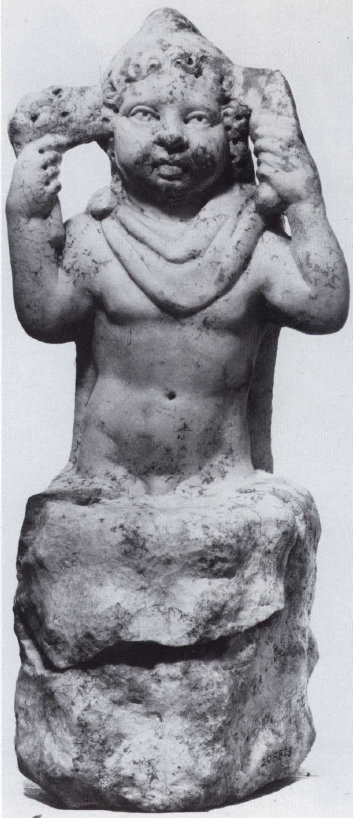
Second Petrogeny of Santo Stefano Rotondo
Tertullian.org
You said earlier that we have preserved no sacred text from the Roman cult of Mithras, nor first-hand descriptions of its rituals or of what was done in its temples. We have only references by ancient authors, in many cases Christians who openly criticise the Mithraic cult or exaggerate some of its features. Fortunately, we have a large archaeological catalogue of monuments and sculptures, among which the birth of Mithras from a rock stands out. Where does this iconography come from, and what might it mean?
That is one of the controversial issues with regard to the question hovering over this whole conversation: Mithras’ links with the East. It must be explained that much of the myth of Mithras is known to us through iconography. As we say, we have no written texts. What we have is a great deal of iconographic evidence: the tauroctony, the presence of the other gods or divinities that appear alongside Mithras, and a series of scenes representing episodes or events.
There are no accounts directly linked to this episode. It is interpreted as it is interpreted: Mithras is a divinity born by spontaneous generation from a rock. Attempts have been made to find mythological or legendary parallels in the Armenian tradition. Roman Armenia, or Irano-Roman Armenia, has literary elements linked in some cases to episodes involving Mithras. There one hears of an earlier divinity who spills his semen onto a rock, and from there Mithras, or a son of Mithras, would emerge. But that Armenian legendary account raises problems.
In other cases, scholars have tried to find a link with the Avestan texts, where Mithra appears associated with a mountain. That rock would evoke the sacred mountain of the Iranian world. It could be something of that kind, or it could form part of those elements that survived in the Roman Mithraic tradition and evoke the Iranian world. It could also be that someone sought specific information about that tradition. Or, simply, it may be something that points to a purely Hellenistic-Roman tradition, in which we already have other gods who emerge spontaneously from elements of nature. It is difficult to draw a firm conclusion.
Something similar occurs with the central image of the cult of Mithras, the so-called tauroctony or sacrifice of the bull. In the Avesta, as far as we know, Mithra does not sacrifice any bull, but there is a primordial bull whose death plays a fundamental role. What can you tell us about this passage?
The sacrifice of the bull in the Roman Mithraic world is a very interesting element because of the significance of the scene itself. There has been enormous debate over whether it has a cosmogonic, naturalistic or astrological meaning.
The question of whether this is connected with the Iranian world has also been much debated. For a long time, when attempts were made to force those links, a direct connection was seen between the Mithraic bull sacrifice and certain passages of the Avesta where it is said that at the end of time, in the Avestan apocalypse, Saoshyant, a kind of Zoroastrian messiah, would come and sacrifice the primordial bull. From the blood shed by that primordial bull, the whole of creation would be regenerated.
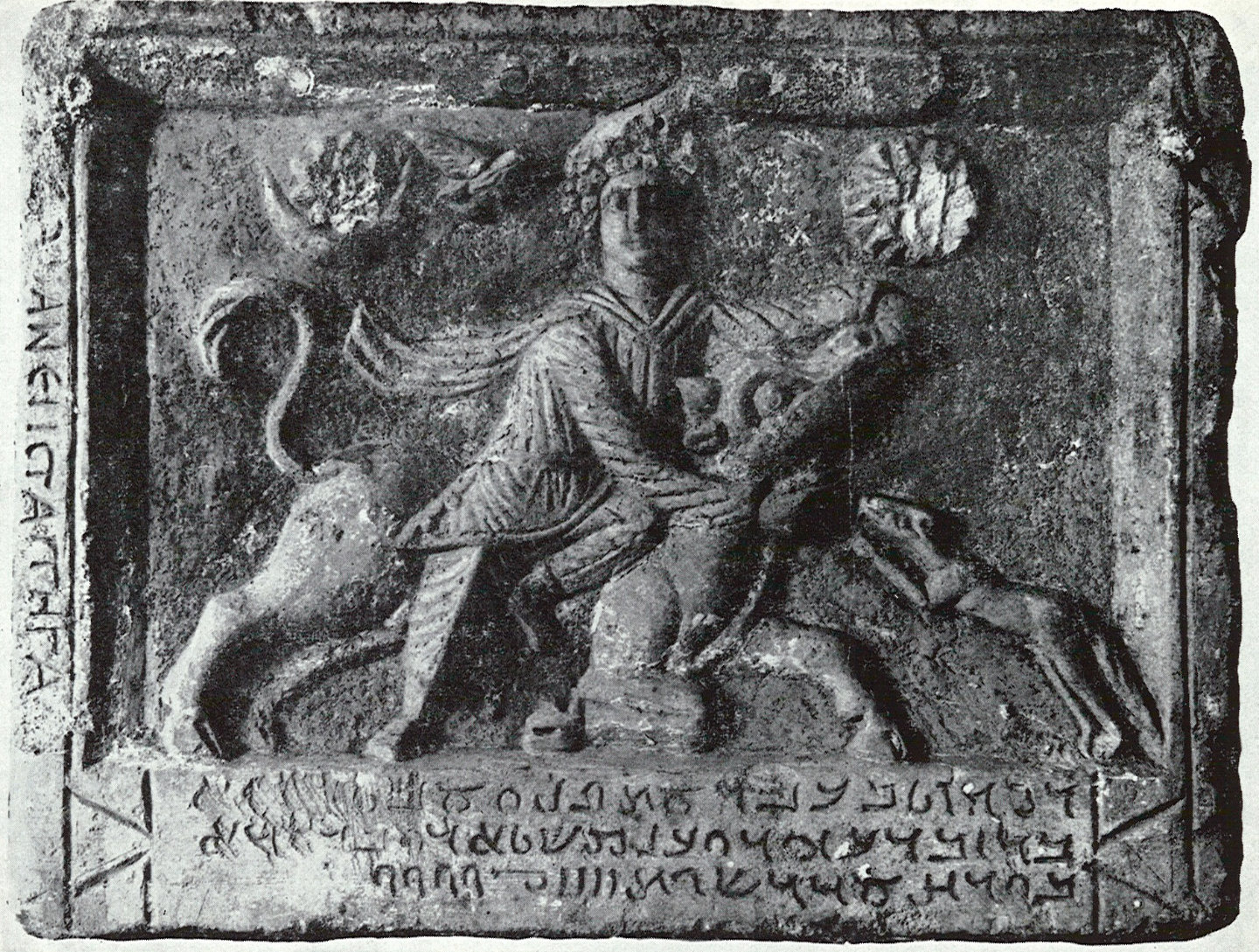
First tauroctony from Dura Europos
CIMRM
Many people thought, and it is obviously not unreasonable to see the parallel, that there could be an equivalence between the Mithraic bull sacrifice and the bull sacrificed by Saoshyant. The problem is that Saoshyant is not Mithra in the Avestan world. The identification is therefore somewhat forced in order to say that the Roman Mithras assumes the role of Saoshyant. And if one has to force the arguments so much, perhaps the matter was not so clear.
It cannot therefore be stated that this sacred bull of Mithraism is the sacred bull of the Avesta. Nor is it entirely necessary, because the sacrifice of the bull in the Roman context also has its own meanings, whether we view it from a naturalistic point of view, that is, the blood of the bull as a regenerative element, or from an astrological point of view, in which the bull represents the constellation Taurus in a context related to the precession of the equinoxes.
Another recurring motif is an enigmatic figure with the head of a lion and a serpent coiled around his human body. What do we know about this divinity, whom we usually call the lion-headed god?
It is an interesting subject and I think it is still unresolved, although there are people who think otherwise. Within Mithraic places of worship, there is a very particular structure: they are a kind of hall intended mainly for a communal meal, with benches along the sides, always presided over by the figure of the tauroctony in the main apse.
But in many mithraea other representations of divinities have been found. Cautes and Cautopates appear, two gods considered to be a kind of twin paredroi of Mithras, and then a divinity with very curious characteristics: a god with a lion’s head and a human body, who also sometimes appears with wings, with a key in his hand and a serpent coiled around his body. These are symbolically very interesting elements.
The problem is that most of these images appeared without any inscription linked to them that would allow us to identify their name or function. Hence the name lion-headed god. How do we call this divinity? Well, “the one with the lion’s head”, and we do not complicate matters any further.
For a long time, interpretations were made in relation to the symbolic elements of time. It was thought that it might be Cronus, Aion or gods connected with the passage of time. At the same time, epigraphic inscriptions appeared in some mithraea, not many, perhaps five or six, in which the signum Arimanium is mentioned. That is, they refer to someone having paid for a statue of the god Arimanius. And there the problem arises: who is this god Arimanius for whom we have no image? Because those inscriptions are not associated with any sculpture.
Until, at the beginning of the twentieth century, a figure with characteristics similar to those of the lion-headed god, but without a head, was found in York, ancient Eboracum, in northern England. In the inscription below there is a mention of Arimanius.
.jpg)
Aion from York frontal view
Carole Raddato
From that point, the reconstruction was made: we now have the missing piece. This headless figure, but with a text mentioning Arimanius, corresponds to the god Arimanius. Therefore, the lion-headed god is the god Arimanius. In that way a name was given to the image.
The new problem was: who is this god Arimanius? What is a god Arimanius doing in the Mithraic cult? References were sought and it was seen that the god opposed to Ahura Mazdā in Zoroastrianism is Ahriman. The question then arises: is there in Mithraism a cult of the Zoroastrian demon? What is a cult of the negative god who symbolises darkness, evil and destruction doing within Roman Mithraism?
All sorts of explanations were proposed in an attempt to save Mithraism’s honour, because it seemed strange. Today there are several issues. In the final part of the book I suggest that I have certain doubts as to whether the York inscription can be used to establish that identification between the god Arimanius and the lion-headed god.
I think we still do not know the real name of the lion-headed god. He may be evoking elements of time, because that is quite plausible. In any case, I believe that the references to the god Arimanius that appear in Roman inscriptions do not refer to the evil god of the Zoroastrian world, but to another god called Airyaman, who also appears in the Avesta and is a companion of Mithra. He assists him in his daily functions, among other things in judging souls on their passage to the next life.
It is an open line of enquiry, but I think it is more understandable that, if there is a cult of a divinity that may evoke something of the Iranian world, it should not be a negative divinity, but one with positive characteristics. Why there is a cult of Airyaman in Mithraism is another matter.
In recent years, much research has tended to privilege local contexts and concrete experiences of Roman Mithraism, rather than the search for an origin beyond the borders of the Empire. What do you think of this approach?
New archaeological methods, especially microarchaeology, the archaeology of details, have made it possible to extract far more information from each excavated archaeological site. This applies both to sites that had already been excavated and to which new technologies are now being applied, and to the new mithraea that have appeared in recent years. All this has made it possible to revise earlier ideas.
It has made it possible to understand the internal functioning of each community much better. And by better understanding the internal functioning of each community, it has been possible to revise large theories that often worked by generalisation. It was assumed that what was done in one mithraeum was identical in all the others.
In reality, if we have said that there are no written texts of Mithraism, it is because there was probably no official catechism either. Each community was clear about the fundamental characteristics of how the cult of Mithras should be performed, but then functioned with considerable autonomy.
There was no Mithraic hierarchy, no Mithraic pope whom all the others had to recognise. Each community was quite autonomous. That is why I think it is interesting to understand the functioning of each mithraeum in its immediate surroundings and in its context: mithraea in public buildings, in private houses or in villas, and what their relationship was with their environment.
This allows for a much broader understanding. At the same time, theories such as Cumont’s, already questioned, have been revised, as have others based on the tendency to generalise and to fit the Mithraic mysteries into a general idea of the mysteries of Isis, Cybele, Bacchus, and so on.
I think we are moving towards an understanding of the specificities of Mithraism: its internal functioning, its relationship with society, how those outside knew what was happening inside. This is an important question. The Mithraic mystery was always spoken of as if nothing was known from the outside, but I am convinced that the mithraeum was embedded in an environment where people would have had far more knowledge than we imagine.
Academic debate and new generations are contributing much more detailed information about the particularities of the cult. This allows us to avoid operating on the assumption that everything functioned in the same way.
To finish, could you tell us what you are working on now and whether, in the Mithraic field, there is anything in particular you would like to explore in greater depth?
In the Mithraic field — because one always has several matters in hand at once — I still need to write up and document in greater detail the question of the deus Arimanius and the lion-headed god. I want to give structure to the proposal I make: that I believe this is not the negative Ahriman, but Airyaman.
I also have in mind to work on the whole question of iconographic evolution and its relationships, now using the new tools of artificial intelligence, which make it possible to establish patterns of variation in images. Before, that would have meant months and months of work. My idea is to establish those iconographic evolutions in the patterns that repeat and those that do not in the representation, for example, of the tauroctony.
I think it is a subject that was touched on in its time even in relation to origins, with the influence that the representation of the victorious Nike has as a canon for the creation of that image. I am keen to get to work on it using new technologies, because I think it could be something new and significant for the advancement of Mithraic knowledge.





Comments
BTW, ayahuasceros report the two most frequently seen in animals in their vision quests are.....felines and snakes.
Remarkable work, indeed! I have two modest reflexions to suggest:
The Greeks of the 4th century BC celebrated the liberation of slaves by wearing a Phrygian cap. This came from the peoples of the Black Sea who did not practice slavery. So, the Phrygian cap predates the cult of Mithras.
Does the god Arimanius have a connection with Armenia, which came under Roman control in 74-63 BC? This is the region of the cult of Mithras, as shown by the bas-relief of Antiochus of Nemrut Dagi. However, Jesus Christ spoke "Aramaic," one of the languages spoken in this region. If we accept that the Gospels are texts of Mystery, would this allude to the cult of Arimanius from which Jesus would have originated?
I did a modest research on the migration of the soul in the cult of Mithras:
The catacomb of St. Marcellinus and Peter in Rome: Orpheus, Mithras or Jesus
Best regards
Dr D.Persoons