
Biography
of Alfenius Ceionius Iulianus Kamenius
- Alfenius Ceionius Iulianus Kamenius, a senator, is attested as a Pater, with a recorded role as Senator.
- Attested in 19 July 374.
- Attested at Roma, Latium, Italia in 19 July 374 (TNMM 1058).
- Attested at Roma, Latium, Italia in 370 – 380 (TNMM 1059).
- Attested at Numidia, Africa in 385 (TNMM 910).
- Died at Antium, Latium, Italia in 385 (TNMM 910).
TNMP 283
Alfenius Ceionius Iulianus Kamenius was a late Roman senator, priest and provincial governor active during the second half of the fourth century CE. He is attested in several inscriptions from Rome and Antium which present him as one of the clearest examples of the aristocratic pagan milieu associated with the late Roman mystery cults.
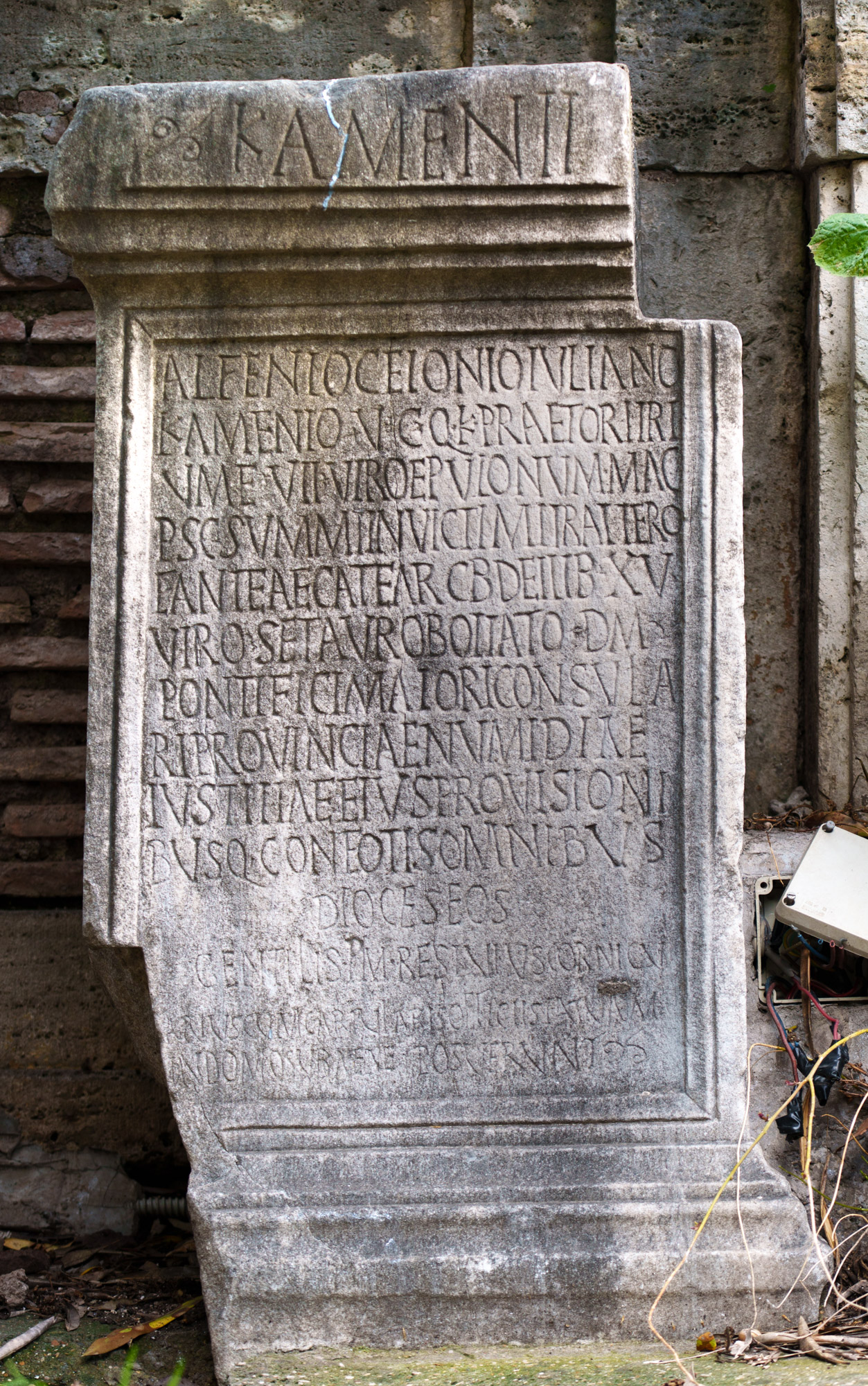
Kamenius held a distinguished political and religious cursus. His inscriptions describe him as vir clarissimus, quaestor candidatus, praetor triumphalis, septemvir epulonum, quindecimvir sacris faciundis, pontifex maior and consularis provinciae Numidiae. A statue base erected by members of his provincial administration records that a bronze statue was dedicated to him in his own house in Rome in recognition of his justice and administration in Numidia (TNMM 1059 = CIL VI 1675 = CIMRM 516 = LSA-1392). Another related base was discovered in the same area near the Palazzo Barberini on the Quirinal hill (LSA-1569).
His religious titles are especially notable. Kamenius is described as pater sacrorum summi Invicti Mithrae, hierophant of Hecate, archibucolus of Liber and recipient of the taurobolium of Magna Mater. An altar discovered beneath Saint Peter’s Square in 1949 and dated to 19 July 374 CE records the dedication of an altar to Magna Mater and Attis Menotyrannus after the completion of the taurobolium and criobolium rites (TNMM 1058 = CIMRM 515 = AE 1953, 238). The monument is generally associated with the Vatican Phrygianum.
Kamenius also appears connected with the aristocratic religious networks of late fourth-century Rome centred around figures such as Vettius Agorius Praetextatus and Ulpius Egnatius Faventinus. Modern scholarship has frequently cited his inscriptions as evidence for the convergence of Mithraic, Dionysiac, Hecatean and Phrygian priesthoods within the Roman senatorial elite during the final decades of public paganism in Rome.
His funerary inscription from Antium indicates that he died in the late fourth century CE (TNMM 910 = CIMRM 206).
References
- Pierre de Labriolle (2021) La Réaction païenne.
- A. B. Griffith (1993) ‘Mithraism in the private and public lives of 4th-c. senators in Rome’. The archaeological evidence for Mithraism in imperial Rome.
- Epigraphik-Datenbank Clauss / Slaby. Statue Base of Alfenius Ceionius Iulianus Kamenius in EDCS.
- Epigraphik-Datenbank Clauss / Slaby. Funerary inscription of Alfenius Ceionius Iulianus Kamenius in EDCS.
- Francesco Massa (2016) Liber et les autres : un réseau mystérique chez les païens de la fin du IVe siècle.
- Ubi Erat Lupa. Statue Base of Alfenius Ceionius Iulianus Kamenius in Ubi Erat Lupa.
Attestations

Altar of Alfenius Ceionius Iulianus Kamenius
TNMM 1058
Marble altar dedicated at the Vatican Phrygianum in Rome by the Mithraic pater Alfenius Ceionius Iulianus Kamenius in 374 CE.
Funerary inscription of Alfenius Ceionius Iulianus Kamenius
TNMM 910
Late Roman funerary inscription from Antium commemorating the senator, governor of Numidia and Mithraic pater Alfenius Ceionius Iulianus Kamenius.
Virtutem meritis et honoribus emicuisti,
Ornamentum ingens generis magnique senatus.
Sed raptus propere liquisti, sancte Kameni,
Aeternos fletus obiens iuvenalibus annis.
Te dulcis coniunx lacrimis noctesque diesque
Cum parvis deflet natis, solacia vitae
Amisisse dolens casto viduata cubili;
Quae tamen extremum munus, solacia luctus,
Omnibus obsequiis ornat decoratque sepulcrum.
Alfenio Ceionio Iuliano Kamenio v(iro) c(larissimo) quaestori candidato / pretori triumfali, VII viro epulonum, patri sacrorum summi / invicti Mitre, hierofante Aecatae, archibucolo dei Liberi, XV viro / s(acris) f(aciundis), tauroboliato deum Matris, pontifici maiori, consulari / Numidiae et vicario Africae qui vixit annos XLII m(enses) VI d(ies) XIII. / Rec(essit) II nonas septembr(es) d(omino) n(ostro) Archadio et Fl(avio) Bautone / v(iro) c(larissimo) cons(ulibus).
you shone forth through virtue, merit, and honours,
a great ornament to your lineage and to the noble Senate.
Yet, taken too soon, holy Kamenius,
you left behind eternal mourning, dying in the years of youth.
Your devoted wife, in tears night and day,
together with your little children, mourns you,
grieving that she has lost the consolation of her life,
widowed from a chaste marriage bed;
and yet, as a final duty and solace in grief,
she honours and adorns your tomb with every devotion.
To Alfenius Ceionius Iulianus Kamenius, clarissimus, quaestor candidatus, triumphal praetor, member of the college of the septemviri epulones, father of the sacred rites of the supreme unconquered Mitra, hierophant of Hecate, archibucolus of the god Liber, member of the quindecimviri sacris faciundis, tauroboliate of the Magna Mater, pontifex maior, governor of Numidia and vicarius of Africa, who lived 42 years, 6 months and 13 days. He died on the 4th of September during the consulship of Arcadius Augustus and Flavius Bauto, vir clarissimus (385 CE).
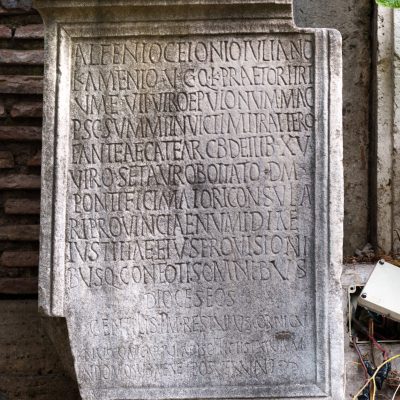
Statue Base of Alfenius Ceionius Iulianus Kamenius
TNMM 1059
Honorific marble statue base dedicated to the senator and Mithraic pater Alfenius Ceionius Iulianus Kamenius by members of his provincial administration.
