Material from Noricum illustrates the circulation of Mithraic practices through frontier mobility, regional trade and provincial administration. The province preserves evidence connected to settlements and communication corridors linking Italy, Pannonia and the central European provinces.

Mithraic monuments of Noricum
Mithraeum of Virunum
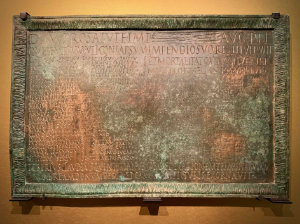
A bronze plaque records the existence of a mithraeum at Virunum that collapsed and was rebuilt by members of the community.
Plaque with the list of worshippers of Virunum
The bronze bears the dedication of a restoration of a Mithraeum carried out in 183.
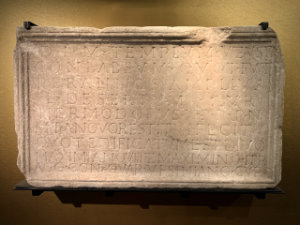
Inscription of the praeses Aurelius Hermodorus
This marble gives some details of the reconstruction of the Virunum Mithraeum.
CIMRM 1431
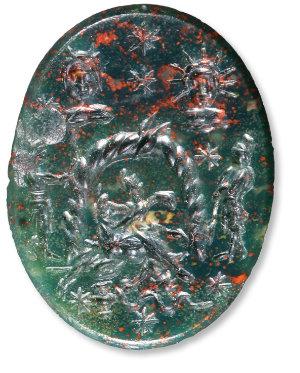
Intaglio with Tauroctony from Munich
This heliotrope gem, depicting Mithras slaying the bull, dates from the 2nd-3rd century, but was reused as an amulet in the 13th century.
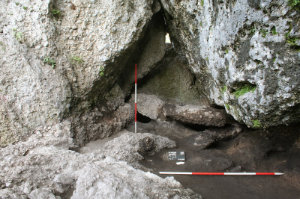
Mithraeum of St. Egyden
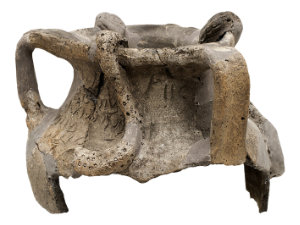
The 'Mithraic cave' in the Gradische/Gradišče massif near St. Egidio contained vessels decorated with snakes and the remains of chicken bones and other animals that were consumed during Mithraic ceremonies.
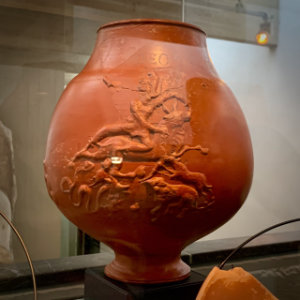
Mithraic vase of Mühltal
The Mühltal Mithraic crater was discovered among the artefacts of a mithraeum found in Pfaffenhoffen am Inn, Bavaria.
Cult vessel with snake representations of St. Egyden
Upon first examination, archaeologists interpreted the inscription on the cult vessel from Gradishje as referencing Mithras, though it has since been re-evaluated.
Plaque of Milan by Ulbius Gaianus
This monument dedicated to 'Invicto Patrio' was found in Milan in 1869.
CIMRM 709
Slab of S. Urban by Ursinus
Marble plaque with inscription by a certain Ursinus found in Virunum in 1838.
CIMRM 1443
Altar of Secundinus from Bad Ischl
A certain Secundinus, steward of the emperor, dedicated this altar to Mithras in Noricum, today Austria.
CIMRM 1407
Circular tauroctony relief from Linz
Small circular marble tauroctony relief from the Mithraeum at Linz, ancient Lentia, depicting Mithras killing the bull with dog, serpent, and scorpion, flanked by cross-legged torchbearers with a lion behind Cautopates; the lower section is divided into three subsidiary scenes.
CIMRM 1415
Brothers attested in Noricum
Places in Noricum
Bedaium
Bedaium occupied a position near the Chiemsee lake region within the northern Alpine frontier zone.
Esca
The Bad Ischl area has been inhabited since the time of the prehistoric Hallstatt culture. Documentary evidence of the settlement dates back to 1262, when it was referred to as Iselen.
Iuvavum-Ovilava
Iuvavum and Ovilava formed two important urban centres connected by the Norican road network.
Moosham
The Moosham area lies within the Alpine territory historically connected with Roman Noricum.
Inscriptions from Noricum
Plaque with the list of worshippers of Virunum
et Aeliano coln/s[ulibus] VI k[alendas] lulias.
[There follows, in four columns, a list of 98 names, all masculine, with the first 34 in the same hand.]
Tiberius Claudius Quintilianus ob dedicationem templi tabulam / aeream donum dedit et camaram picturis exornavit.
Inscription of the praeses Aurelius Hermodorus
Mithraic vase of Mühltal
Cult vessel with snake representations of St. Egyden
Plaque of Milan by Ulbius Gaianus
Slab of S. Urban by Ursinus
Altar of Secundinus from Bad Ischl
References
- Gernot Piccottini (1994) Mithrastempel in Virunum
- Jaime Alvar Ezquerra (2021) The Mystery of Mithras. Exploring the heart of a Roman cult
- Lisa R. Brody; Gail L. Horffman (eds.) (2001) Dura Europos. Crossroads to Antiquity