Your search Bu Njem gave 1183 results.
This intaglio depicting Mithras killing the bull is preserved at the Bibliothèque national de France.
This ancient carnelian intaglio mounted in gold depicts Mithras slaying the bull surrounded by his companions Cautes and Cautopates.
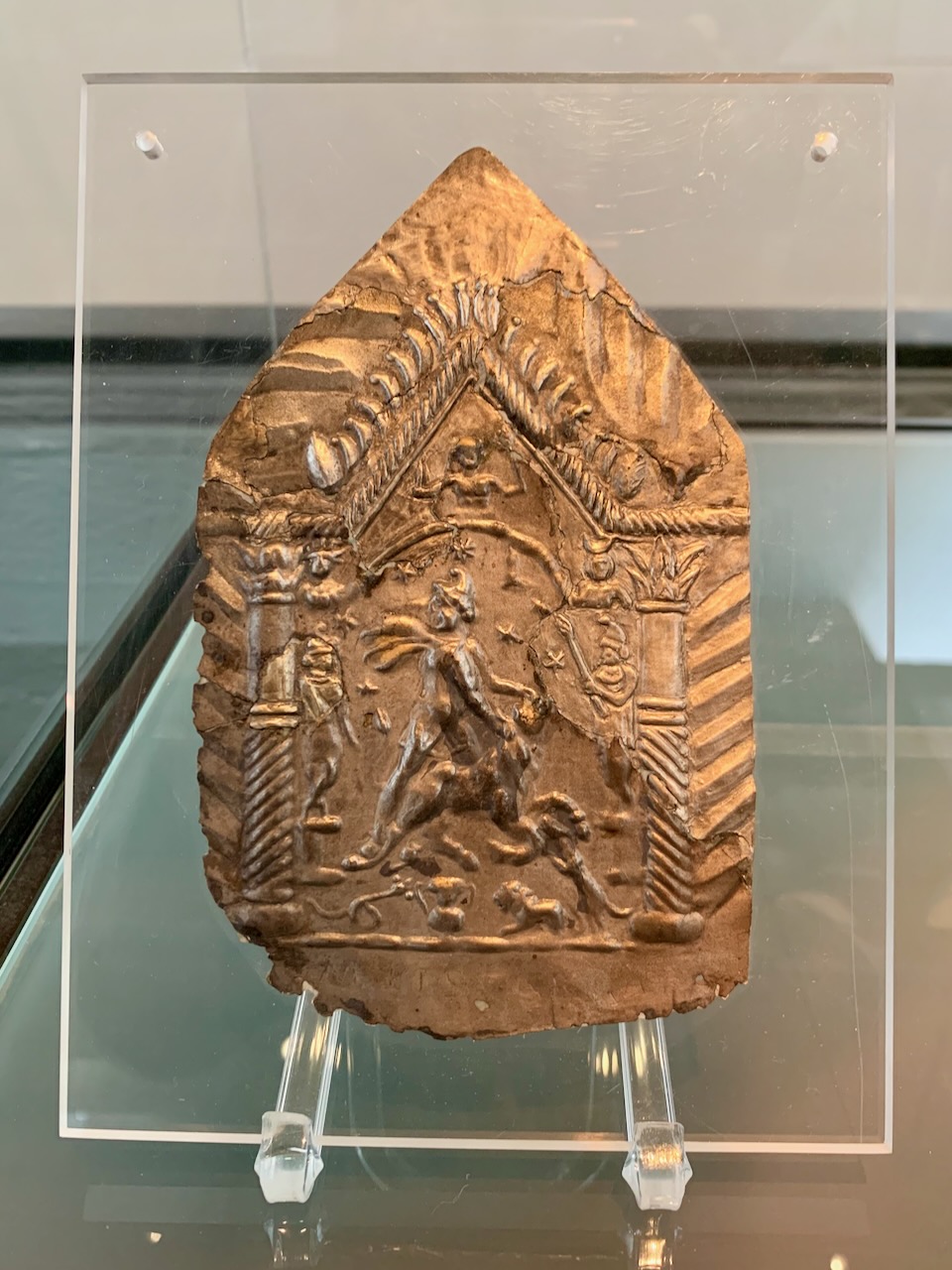
Mithras Tauroctony on bronze exposed at the Metropolitan Museum of New York.
The limestone altar at Klechovtse in North Macedonia bears an inscription to the invincible Mithras.
Marble group of Dionysus accompanied by a Silenus on a donkey, a satyr and a menead.
This sculpture of Mithras killing the bull may come from Rome, probably found in 1919.
In the tauroctonic relief on display at the Cincinnati Art Museum, Mithras slaughters the bull over a rocky background.
The Mithras's head of Walbrook probable belonged to a life-size scene of the god scarifying the bull.
The Mithraeum of Inveresk, south of Musselburgh, East Lothian, is the first found in Scotland, and the earliest securely dated example from Britain.
The Mackwiller Mithraeum was built in the middle of the 2nd century, during the reign of Antoninus the Pious, on the site of a spring already worshipped by the natives.
The Mithraeum was found in one of the rooms of the Horrea built in the years 120 - 125 AD. The installation of the shrine may have taken place in the first half of the third century.
The Mithraeum of Lucretius Menander was installed in the early 3rd century in an alley to the east of a Hadrianic building named after the solar god temple.
A bronze plaque records the existence of a mithraeum at Virunum that collapsed and was rebuilt by members of the community.
This marble gives some details of the reconstruction of the Virunum Mithraeum.
Mithras rock-born from Villa Giustiniani was holding a bunch of grapes in its raised right hand instead of a torch, probably due to a restoration.
The Mithraeum of Caernarfon, in Walles, was built in three phases during the 3rd century, and destroyed at the end of the 4th.
The Tauroctony of Patras was found years before the temple over which the relief of Mithras sacrificing the bull was supposed to preside.
The Cautopates with scorpion found in 1882 in Sarmizegetusa includes an inscription of a certain slave known as Synethus.
The Mithraeum of Sarrebourg was discovered during operatoins for military buldings.
The House of the Mithraeum of the Painted Walls was built in the second half of the 2nd century BC (opus incertum) and modified during the Augustan period.