Your search Bu Njem gave 1882 results.
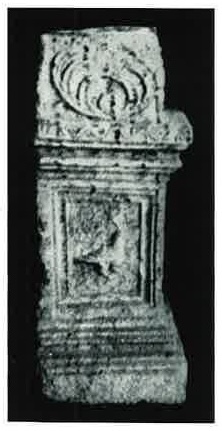
Inscription from Aquincum, Pannonia Inferior, dedicated to Deo invicto Mithrae by Caelius Anicetus with his son.

Four uninscribed altars and fragments of torchbearer statues from Mithraeum III at Aquincum, Pannonia Inferior.
Sandstone statue from near Mithraeum III at Aquincum, Pannonia Inferior, depicting a lion to the right with an open frontal mouth, holding an ox head between its forefeet with a red-painted tongue.
Sandstone statue from near Mithraeum III at Aquincum, Pannonia Inferior, probably depicting Mithras's rock-birth.
Limestone altar from Mithraeum III at Aquincum, Pannonia Inferior, dedicated to Invicto deo sacrum for the welfare of Caius Iulius Victorinus, decurio of the Colonia Aquincensium, by Caius Iulius Primus, his libertus.
Third Mithraic sanctuary at Aquincum, Pannonia Inferior, between the Amphitheatre and the Krempelmühle, attested by five altars and a decorated mosaic; the building itself is not fully known.
Second Mithraic sanctuary discovered at Altofen in 1888, Pannonia Inferior; rectangular (15.03 × 7.06 m) and raised two metres above ground, with benches and a cult niche; one of the most fully excavated Mithraea from the Danubian region.
Altar from Aquincum, Pannonia Inferior, dedicated to Soli deo by Callistus ex voto, decorated with akroteria bearing palmettes.
Altar from Mithraeum I at Aquincum, Pannonia Inferior, dedicated by a decurio of the municipium Aquincum who held the rank of duumvir iure dicundo and praefectus collegii fabrum.
Altar from Mithraeum I at Aquincum, Pannonia Inferior, dedicated to Leoni, suggesting a dedication to the Mithraic grade leo or to the lion as a cult animal.
Sculpted ram’s head discovered among the finds from the supposed Mithraic sanctuary.
Small inscribed plaque invoking Mithras and Mercury attached to a sandstone column inside the sanctuary.
Assemblage of lamps, serpent-vases and painted ritual pottery from the sanctuary complex.
Decorative bronze candlestick discovered near the entrance of the supposed Mithraic sanctuary.
Sandstone basin from the pronaos of the sanctuary originally mounted on a short column.
Cult statue base discovered with a hooked ritual sword in front of the sanctuary niche.
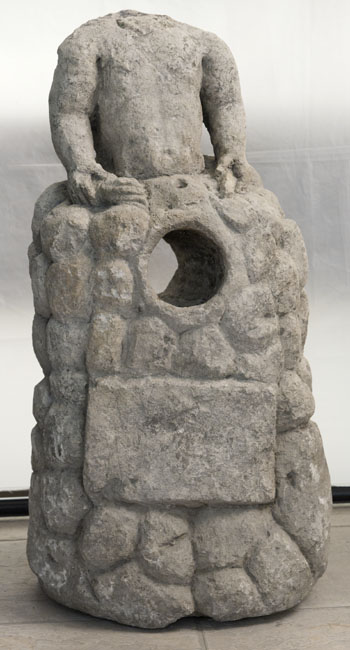
This sculpture from Dobrosloveni, Romania, depicts the petrogenesis of Mithras, with a hole through the generative rock from which water flowed.
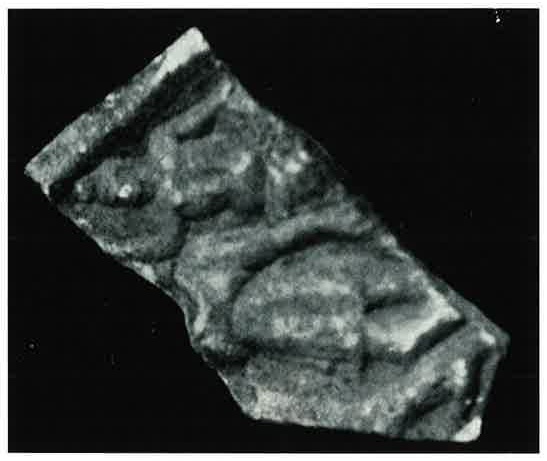
Tauroctony relief fragment with torchbearer and scene of Mithras’ rockbirth from Romula, Romania.

Relief of Mithras killing the bull with an inscription from a certain Aurelius Macer who dedicates it to Sol Invictus Mithras.
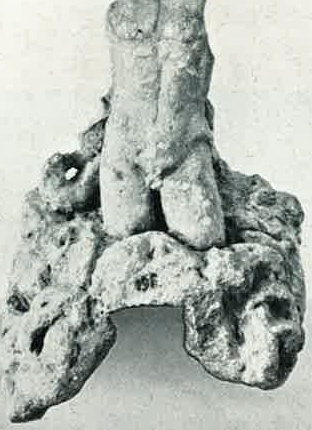
Sandstone petrogenesis from Petronell-Carnuntum (Lower Austria), depicting Mithras emerging from the rock, preserved from the knees upwards.
