Your search Frankfurt am Main gave 1503 results.
Hermadio's inscriptions have been found in Dacian Tibiscum and Sarmizegetusa, as well as in Rome.
Praeses of the Noric Mediterranean province, of equestrian rank, restaured the Mithraeum of Virunum in 311.
Syndexios in Ostia, his name Marsus suggests that he was a snake-charmer.
Libertus from the Arrii-family to which also belonged the Emperor Antonius Pius.
Centurion who dedicated the first known Latin inscription to the invincible Mithras.
Callimorphus was a cashier (arkarius) of the estates of Chresimus, steward of emperors.
He travelled to Juliomagus and engraved vases to the undefeated Sun Mithras for his brothers.
Pater Patrum of Ostia, he officiated at the Mitreo Aldobrandini where he is mentioned in a couple of inscriptions.
He dedicated to the Emperor, for the worshipers of the god Mithras a sculpture in Stabiae.
Slave of the imperial family and dispensator who repaired an image of Mithras in Tibur, near Rome.
The Rusicade Mithraeum is notable for the absence of a tauroctony relief, instead yielding multiple altars and unusual installations including conduit pipes and a pine-cone shaped stone.
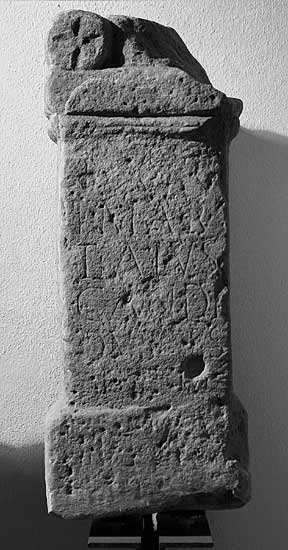
This altar dedicated to Sol Invictus Mithras by a certain Septimius Zosimus was found in the Basilica of San Martino ai Monti in Rome.
The Hekataion of Sidon, which depicts Hekate in her trimorphic form surrounded by three dancing girls, is the only example found to date in connection with the Mithraic cult.
The site was destroyed in the 5th century but some elements, including the benches, can still been seen.
The votive fresco from the Mithraeum Barberini displays several scenes from Mithras’s myth.
Limestone tauroctony relief from Carnuntum with traces of polychromy and a graffito on the bull’s neck. The inscribed base was carved separately.
A limestone lion holding a flowing urn, discovered at the entrance of the Mithraeum of Les Bolards, reflects the ritual significance of water within the cult of Mithras.