Your search From Rome, Mithreum of Castra Peregrinorum under Santo Stefano Rotondo. gave 548 results.

Tivoli is a town and comune in Lazio, central Italy, 30 kilometres north-east of Rome, at the falls of the Aniene river where it issues from the Sabine hills.
Tibiscum was a Dacian town mentioned by Ptolemy, later a Roman castra and municipium.
Pons Aelius, or Newcastle Roman Fort, was an auxiliary castra and small Roman settlement on Hadrian's Wall in the Roman province of Britannia Inferior, situated on the north bank of the River Tyne close to the centre of present-day Newcastle upon Tyn
Ostia may have been Rome's first colony. According to legend, Ancus Marcius, the fourth king of Rome, destroyed the area and founded the colony. An inscription seems to confirm the foundation of the ancient castrum of Ostia in the 7th century BC.
Pescorocchiano is a comune in the Province of Rieti in the Italian region of Latium, located about 60 kilometres northeast of Rome and about 30 kilometres southeast of Rieti. Pescorocchiano borders the following municipalities: Borgorose, Carsoli
Caetobriga, now Setúbal of Proto-Celtic *Caetobrix, became a Turdetani settlement which passed under Roman rule. In the time of Al-Andalus the city was known as Shaṭūbar.
Caere is the Latin name given by the Romans to one of the larger cities of southern Etruria, modern Cerveteri, some 50-60 kilometres north-west of Rome.

This marble tablet found at Portus Ostiae mentions a pater, a lion donor and a series of male names, probably from a Mithraic community.
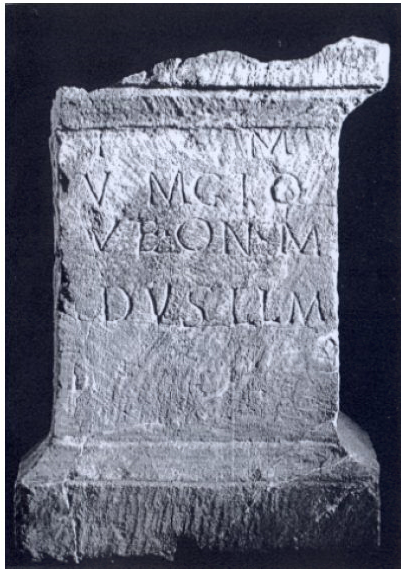
This fragmented monument bears an inscription of a certain veteran named Valerius Magio.
Armenia occupied a frontier crossroads between the Roman world, Anatolia and the Iranian cultural sphere.
Umbria formed part of the central Italian heartland through which religious practices circulated between Rome and the northern provinces.
Picenum connected the Adriatic coast of central Italy to inland communication routes and the wider networks of the Roman Peninsula.
Samnium occupied a mountainous region of central Italy linked to Rome through military movement and regional urban networks.
Lucania connected inland southern Italy to the Tyrrhenian and Ionian maritime worlds through regional communication networks.
Latium formed the political and religious centre of the Roman world where some of the most important Mithraic communities developed.
Corsica et Sardinia occupied an important insular position within the maritime networks of the western Mediterranean.
Mesopotamia formed part of the eastern frontier zone where Roman military expansion encountered long-established Mesopotamian traditions.
Syria-Palestina occupied a complex religious landscape shaped by imperial administration, pilgrimage and eastern Mediterranean mobility.
Chersonesus occupied a northern Black Sea position where Greek, Roman and frontier cultures intersected at the edges of the Mithraic world.
The high mountain routes of Alpes Graiae formed part of the Alpine corridors connecting Italy, Gaul and the northwestern provinces.
