Your search Martin Luther King gave 158 results.

Fragments of a marble relief preserving only the lower part, with Mithras slaying the bull, dog and serpent licking blood, a large scorpion, and Cautopates behind the bull pointing his torch downwards, from the Mithraeum of S. Lorenzo in Damaso.
Great royal inscription of Antiochus I of Commagene carved on the thrones at Nemrud Dağı, invoking Apollo-Mithras-Helios among the guardian deities of the kingdom, 69–34 B.C.
Gold coin of the Scythian king Hooerkes, reverse showing Mithras (MIIPO) in tunic with lance and sword, north-west India, c. 87–129 A.D.
Gold coin of the Scythian king Hooerkes, reverse showing Mithras (MOPO) standing with wreath and staff, north-west India, c. 87–129 A.D.
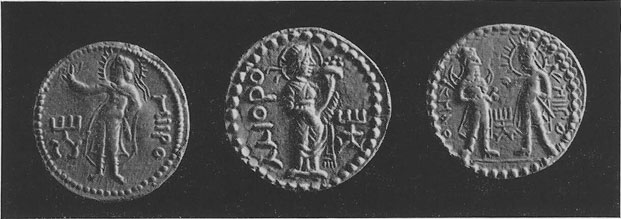
Gold coin of the Scythian king Hooerkes, reverse showing MIOPO (Mithras) as a goddess with cornucopia, north-west India, c. 87–129 A.D.
Red sandstone relief from Mithraeum I at Stockstadt showing a male figure stooping and walking to the right with outstretched hands, head veiled
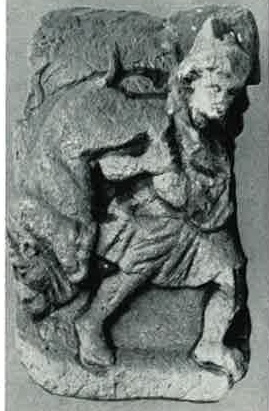
Grey sandstone relief from Mithraeum I at Stockstadt showing Mithras in Oriental dress walking to the right while carrying a bull on his shoulders
Sandstone altar from Romula, Dacia, dedicated to Deo invicto Mithrae by Aurelius Rufus ex voto, with the busts of Sol and Luna flanking the text.
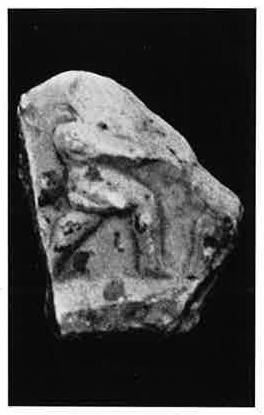
White marble relief fragment from the Mithraeum at Sarmizegetusa, Dacia, probably belonging to the preceding piece, depicting a man walking to the right stretching his hand towards a rock.
Marble statue from Intercisa, Pannonia Inferior, depicting Cautopates in Oriental dress and a high Phrygian cap, walking.
Marble tauroctony relief from Aquincum, Pannonia Inferior, found at Budapest III, Fötér, depicting Mithras as bull-slayer with both torchbearers flanking the central group.
Large sandstone altar from Mithraeum I at Carnuntum, Pannonia Superior, with Cautopates cross-legged carved on the left side and Cautes walking on the right, both holding their torches with two hands; the front bears an inscription.
Small altar found at Töltschach in 1817, Noricum, decorated with the traces of two ram heads flanking foot-prints; the relief is no longer visible and only the inscription survives.
White marble slab from the Zollfeld at Virunum, Noricum, dedicated to Deo invicto Mithrae by Diadumenus, arcar(ius) of the imperial dispensator Nicolaus for the kingdom of Noricum.
Sandstone statue of a seated lion in attacking posture, from Mithraeum I at Heddernheim, ancient Nida, with its hindmost part lost
Small inscribed plaque invoking Mithras and Mercury attached to a sandstone column inside the sanctuary.
Complex military inscription invoking Apollo, Sol and Luna under Severus Alexander.
Altar inscription from Sahin invoking the most high heavenly god and Mithras in the Alawite Mountains.
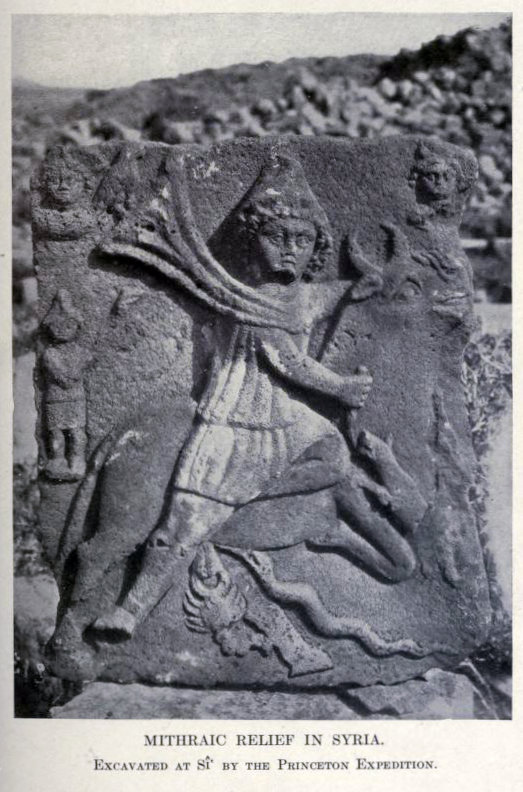
In the tauroctony of Jabal al-Druze in Syria, the snake appears to be licking the head of the bull's penis.

Ancient region of the Crimean Peninsula associated with the Greek colonies and Roman presence in Taurica.
