Your search Roma gave 961 results.

Venetia connected northern Italy to the Adriatic and Danubian worlds through trade, mobility and imperial communication routes.
Etruria formed part of the cultural and religious heartland of central Italy closely connected to Rome and the Tyrrhenian world.
Samnium occupied a mountainous region of central Italy linked to Rome through military movement and regional urban networks.
Latium formed the political and religious centre of the Roman world where some of the most important Mithraic communities developed.
Sicilia connected Italy, North Africa and the eastern Mediterranean through some of the busiest maritime routes of the Roman world.
Corsica et Sardinia occupied an important insular position within the maritime networks of the western Mediterranean.
At the western edge of the Roman world, Mauretania Tingitana linked North Africa to Hispania through military and maritime exchange.
Mauretania Caesariensis connected western North Africa to Mediterranean trade routes and the provincial networks of the Roman empire.
Syria-Palestina occupied a complex religious landscape shaped by imperial administration, pilgrimage and eastern Mediterranean mobility.
Cilicia occupied a key position between Anatolia, Syria and the eastern Mediterranean maritime routes.
Cappadocia formed a major frontier and military region linking central Anatolia to the eastern limits of the Roman empire.
Asia formed one of the most urbanised and interconnected provinces of the eastern Roman world where Mithraic cults circulated widely.
Bithynia et Pontus connected northwestern Anatolia to the Black Sea through major maritime, urban and provincial networks.
Moesia superior preserves frontier evidence shaped by the military infrastructure and circulation networks of the middle Danube.
Along the lower sectors of the middle Danube, Pannonia inferior became a major centre of Mithraic activity in the frontier provinces.
Pannonia superior preserves one of the richest frontier corpora of Mithraic evidence along the middle Danube.
Rhaetia occupied a strategic frontier position between the Alps, the upper Danube and northern Italy where Mithraic cults circulated through military networks.
Narbonensis connected Roman Gaul to the Mediterranean world through some of the oldest urban and maritime networks of the western empire.
Belgica occupied a strategic position between Roman Gaul, the Rhine frontier and the northern provinces where Mithraic cults circulated widely.
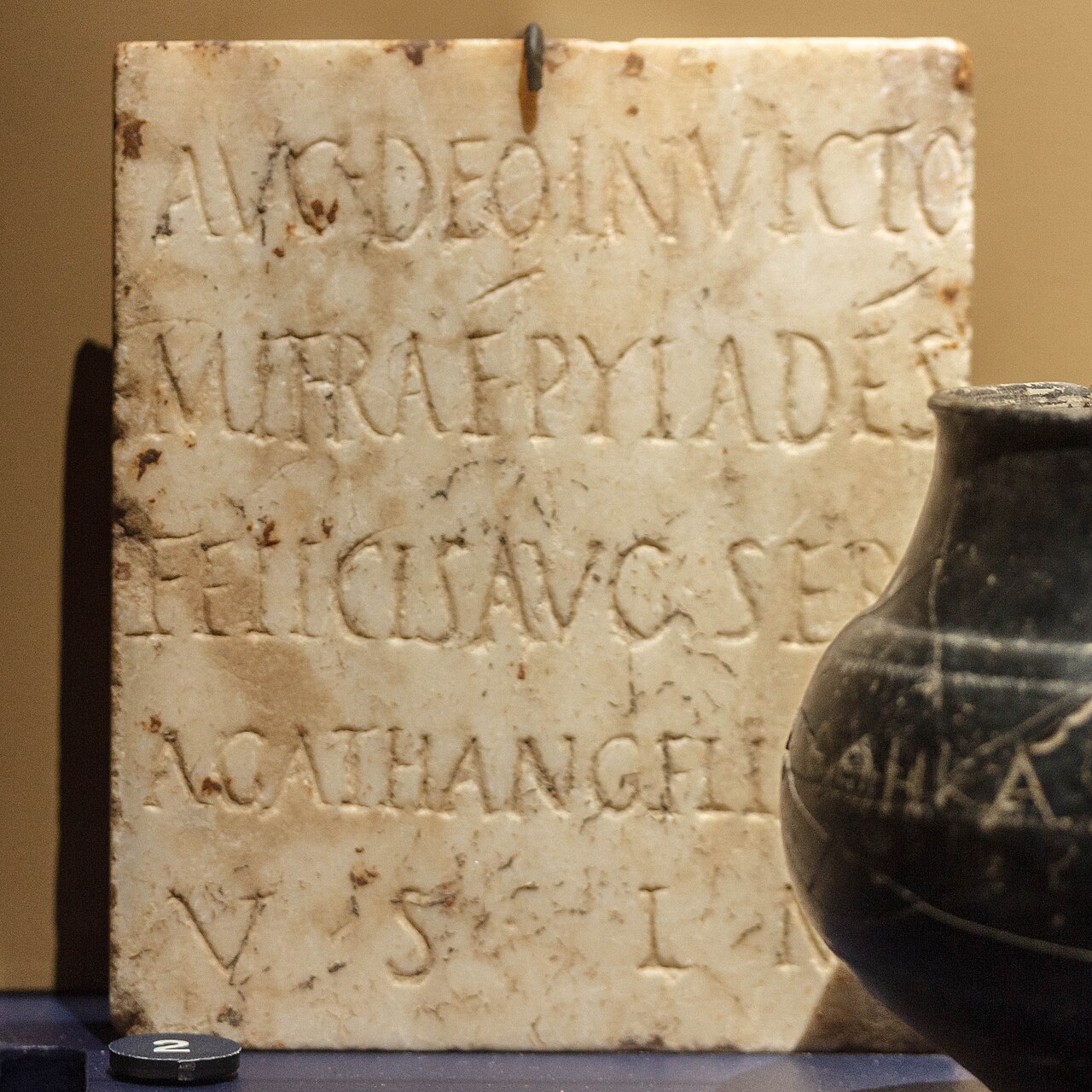
This marble plaque from Iuliomagus, Roman Angers, bears a rare dedication to Mithras by Pylades, a slave of an imperial slave connected to the Roman administration in Gaul.
