Your search San Gemini gave 585 results.

Square sandstone fire-basin from the Mithraeum at Königshoffen, found with remnants of pitch still adhering to its interior, dedicated to Deo invicto Mithrae by Marcus Bellius.
Rectangular sandstone water-basin from the Mithraeum at Königshoffen, placed near the great tauroctony relief; only the bottom, front, and part of the left side survive, and the front inscription records the flow of water as a votive act.
Large sandstone altar from the Mithraeum at Königshoffen, hollowed out at the back with a circular opening in the top, which stood before the great tauroctony relief; the front bears a dedication to Deo invicto Mithrae.
Miscellaneous sandstone altar fragments from the Mithraeum at Königshoffen, including uninscribed pieces and one bearing a solar disc with two heart-shaped figures on the upper front face.
Red sandstone altar fragments from the Mithraeum at Königshoffen, reused as a step or threshold in the sanctuary's third building phase, preserving only the opening of a dedication to Deo invicto Mithrae.
Upper portion of a sandstone altar from the Mithraeum at Königshoffen, later reused as building material, bearing a dedication by Ianussa on both the front and reverse faces.
Grey sandstone slab from the Mithraeum at Königshoffen, a companion piece to the preceding, recording the same act of repainting a cult image by Caius Celsinius Matutinus, veteran of Legio VIII Augusta Alexandriana.
Grey sandstone tauroctony relief from the Mithraeum at Königshoffen, heavily restored, depicting Mithras killing the bull with Cautes and Cautopates and the busts of Sol and Luna; only the lower part of Cautopates and the crossed legs are original.
Upper left corner of a sandstone altar from the Mithraeum at Königshoffen, preserving the beginning of a dedication to Deo invicto by Caius Iulius; the rest is lost.
Sandstone altar from the Mithraeum at Königshoffen, dedicated to Deo invicto by a dedicant whose name begins Primu[s]; the remainder of the text is fragmentary.
Dark red sandstone altar fragment from the Mithraeum at Königshoffen whose upper section, reconstructed from additional fragments, is shown to have supported a shell-shaped basin; dedicated to Soli invicto.
Fragment of a dark red sandstone altar from the Mithraeum at Königshoffen preserving a dedication to Deo Soli invicto Augusto; found in the eastern part of the sanctuary.
Yellow sandstone altar from the Mithraeum at Königshoffen decorated with volutes enclosing small globes and a patera holding two iron rings; traces of fire or smoke are visible on the surface.
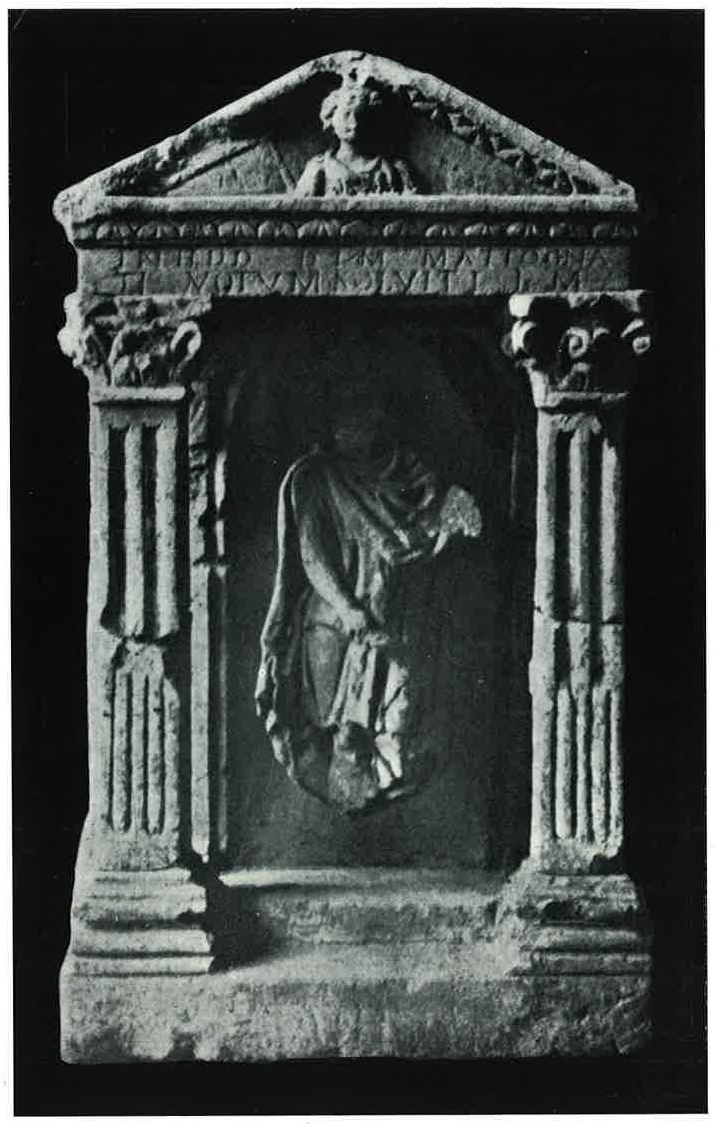
Sandstone monument in the form of a temple façade from the Mithraeum at Königshoffen, accessible by a step and framed by two Corinthian columns; the pediment is decorated with the bust of Luna, and the architrave carries an inscription.
Dark red sandstone fragment from the Mithraeum at Königshoffen preserving part of a rock base with a serpent's tail; the white-painted front suggests a rock-birth composition.
Small sandstone relief fragment from the Mithraeum at Königshoffen preserving a naked male figure from the thighs to the head, possibly part of a rock-birth scene.
Left portion of a brown sandstone statue from the Mithraeum at Königshoffen depicting the lower part of a rock encircled by a serpent, forming the base of a rock-birth group; the base preserves remnants of an inscription.
Grey sandstone hand holding a globe from the Mithraeum at Königshoffen, with a lead bar indicating attachment to a larger statue; a second globe with a partial hand was found at the same spot.
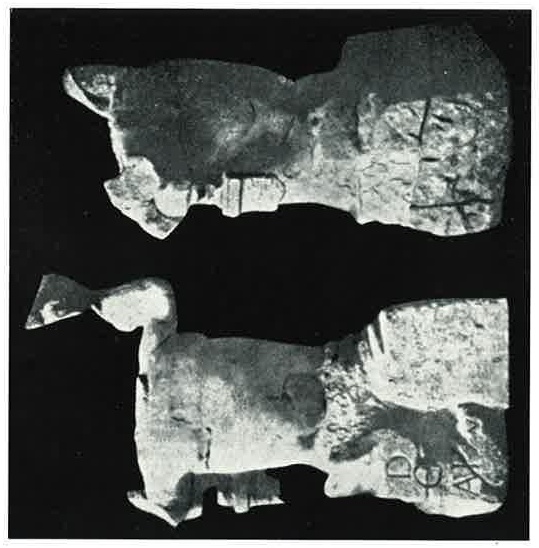
Sandstone statue from the entrance area of the Mithraeum at Königshoffen depicting the youthful naked Mithras emerging from the rock, with the sheath of a dagger still visible at his hip; head, right arm, and left hand are lost.
Upper corner of a sandstone base from the Mithraeum at Königshoffen bearing a fragmentary inscription in which the word Leo is legible, suggesting a Mithraic grade dedication.
