
White marble head in Phrygian cap with a sorrowful expression from Ghighen, ancient Oescus in Moesia Inferior, probably the head of Mithras as bull-slayer.
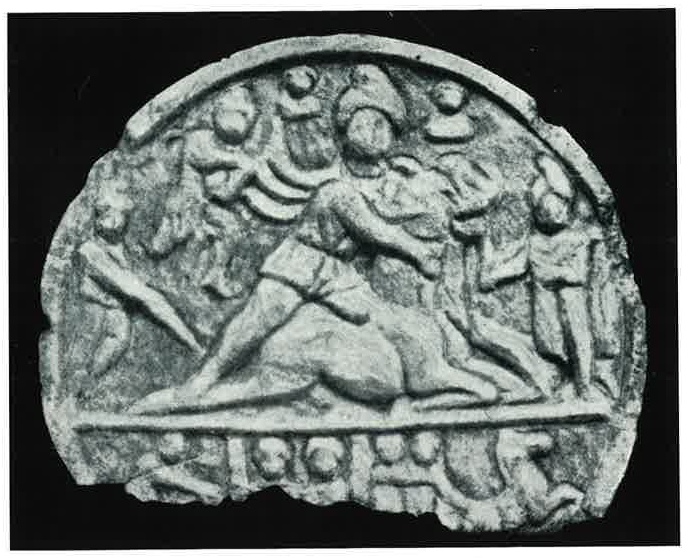
Small circular marble tauroctony relief from Kadine-Most in the Küstendil district, Moesia Superior, divided into two parts by a horizontal rim, with the bull-slaying in the upper and a figure or inscription in the lower.
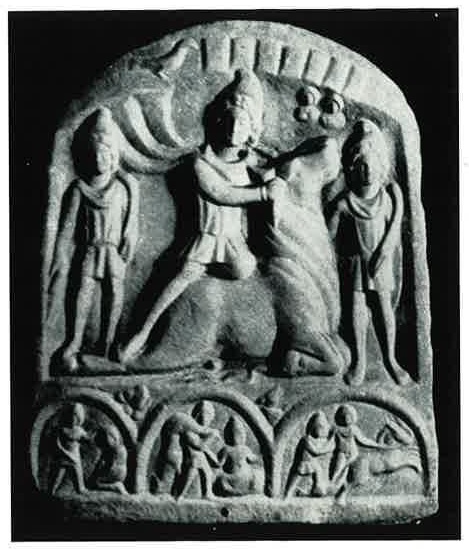
White marble tauroctony relief from the ruins of the Roman castle near Koniovo, Moesia Superior, depicting the standard bull-slaying scene.
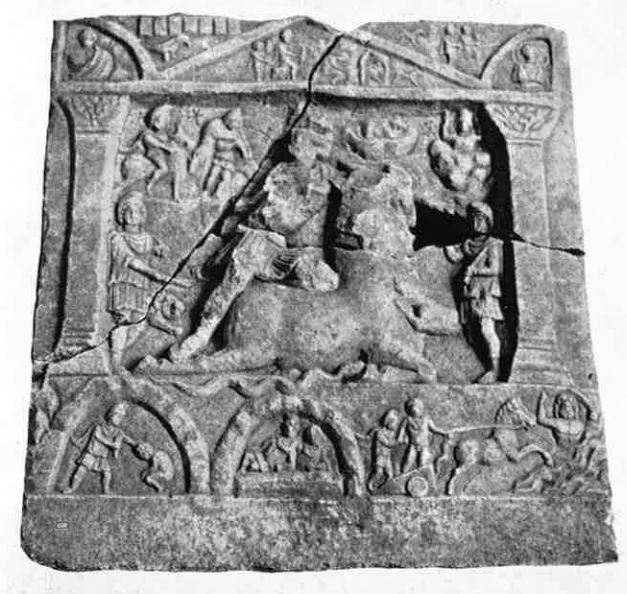
Large marble tauroctony relief from near Tavalicavo, Moesia Superior, with the shape of a temple façade: two columns supporting a pediment, the capital decorated with a head of Medusa, and the tauroctony in the central field.
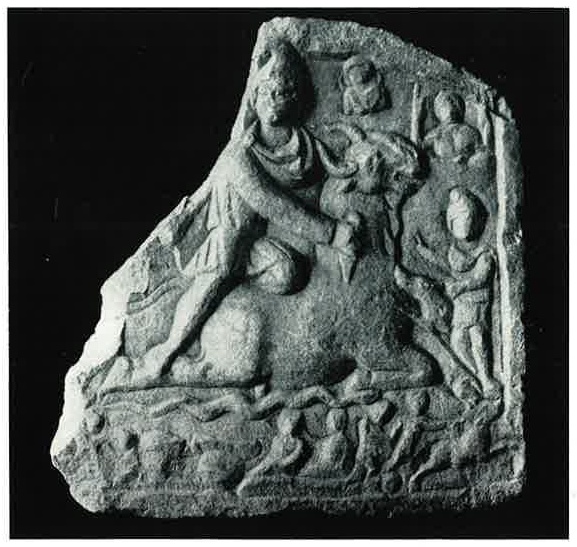
White marble tauroctony relief from Radeša near Pirot, Moesia Superior, depicting the standard bull-slaying scene.
Marble tauroctony relief from the surroundings of Küstendil, ancient Pautalia in Moesia Superior, depicting the bull-slaying with torchbearers and Sol and Luna busts in the upper corners.
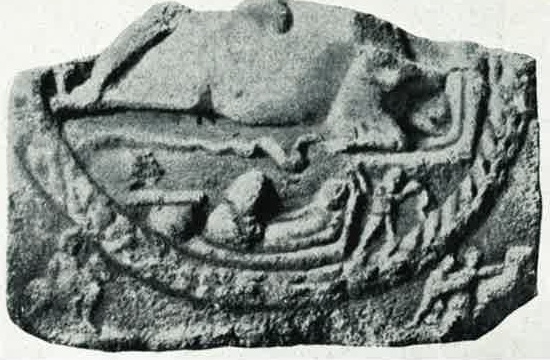
Lower part of a marble tauroctony relief from Küstendil, ancient Pautalia in Moesia Superior, preserving only the lower half of the bull-slaying scene with partially visible legs of the torchbearers.
Monument from Almus, Moesia Superior, with a tauroctony representation and a dedication to Deo invicto above it; no further details are available.
Upper portion of a limestone altar from Kule-Mahata, ancient Almus in Moesia Superior, dedicated to the invictus — possibly but not certainly Mithras — by Caius Plotius Maro for himself and his family.
Inscription from Civitas Montanensium, Moesia Superior, dedicated to Deo sancto invicto by Lucaius ex voto.
White marble tauroctony relief from Golema Kutlovica, ancient Civitas Montanensium in Moesia Superior, depicting the standard bull-slaying scene.
Limestone altar from Stojnik, Moesia Superior, found at a house at Guberevci, dedicated to Deo Mithrae Soli for the welfare of Emperor Severus Alexander.
Inscription from Drmno, Moesia Superior, dedicated to Deo invicto Mithrae by a naucleros — a ship-owner or navigator — who arranged the erection of the monument.
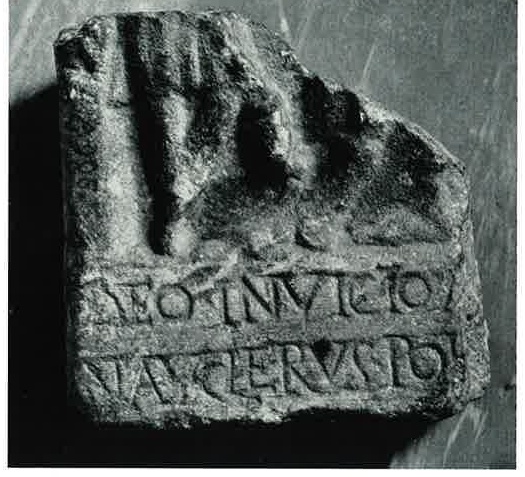
White marble tauroctony relief fragment from Drmno, Moesia Superior, found in 1892 and now in Brussels, depicting the standard bull-slaying scene.
Fragment of a relief from Jassen, Moesia Superior, with three scenes: Mithras and kneeling Sol, the sacred repast, and Mithras ascending Sol's chariot; known from a personal communication.
Fragment of a Mithraic relief in a crown from Ratiaria, Moesia Superior, mentioned in a personal communication from Radnóti; no further details.
Marble tauroctony fragment from Ratiaria, Moesia Superior, preserving the lower part of Mithras's body with his right leg, the hindmost part of the bull, and the serpent below.
Fragmentary inscription from Ratiaria, Moesia Superior, preserving only scattered letters.
Marble relief fragment from Artschar, ancient Ratiaria in Moesia Superior, preserving a scene of Mithras in Phrygian cap and Sol reclining behind a tripod — part of the sacred banquet.
Fragment of a marble tauroctony statuette from Artschar, ancient Ratiaria in Moesia Superior, preserving Mithras's head, cloak, right foot, the bull's head, and feet.
