Biography
of Tamesius Augentius Olympius
- Tamesius Augentius Olympius, a senator, is attested as a Pater, holding the office of Pater patrum at the Mitreo di San Silvestro in Capite.
- Also recorded as Vir clarissimus.
- Attested in the 4th century.
- Attested at Roma, Latium, Italia in 4th century (TNMM 447).
- Attested at Roma, Latium, Italia (TNMM 990).
TNMP 30
Aurelius Victor Augentius was a late fourth-century Roman senator (vir clarissimus) and one of the best documented Mithraic priests of Late Antiquity. Together with Nonius Victor Olympius, he belonged to an aristocratic circle responsible for maintaining a Mithraic community traditionally associated with the area of San Silvestro in Capite in Rome, although the precise location of its mithraeum remains uncertain (Gallo 1979; Griffith 1993; Bjørnebye 2007; Canciani 2022; Chalupa 2023).
The earliest inscriptions, dated AD 357–362, present Augentius as a pater working alongside Nonius Victor Olympius, who held the supreme Mithraic office of pater patrum. These inscriptions record a series of initiatory ceremonies in which the two priests admitted new initiates into successive grades of the Mithraic hierarchy, including leo, Perses, Heliodromus and Pater, while another inscription refers to the presentation of cryfii, probably catechumens awaiting initiation into the mysteries (Blomart 1992; Griffith 1993; Chalupa 2023).
By AD 376, following the disappearance of Nonius Victor Olympius from the epigraphic record, Augentius himself had become pater patrum. In that capacity he initiated his own son, Aemilianus Corfonius Olympius, into the grade of hierocorax, providing rare evidence for the transmission of Mithraic religious authority across successive generations of a senatorial family (Gallo 1979; Griffith 1993; Canciani 2022; Chalupa 2023).
The family’s continued involvement in the cult is further demonstrated by a metrical inscription commissioned by Tamesius Augentius Olympius, probably Augentius’ grandson, sometime between AD 371 and 400. The inscription commemorates the achievements of his ancestors and declares that he himself “built the cave” (antra facit), almost certainly referring to the construction or refurbishment of a mithraeum. Whether this inscription refers to the same sanctuary attested by the earlier inscriptions, however, remains a matter of scholarly debate (Gallo 1979; Bjørnebye 2007; Chalupa 2023).
Although no archaeological remains of the sanctuary have yet been securely identified, the inscriptions associated with Aurelius Victor Augentius constitute one of the richest bodies of evidence for the persistence of Mithraism among the Roman senatorial aristocracy during the final decades before the suppression of the traditional pagan cults. They also document one of the clearest examples of hereditary continuity within a Mithraic community, extending across at least three generations of the same family.
References
Attestations
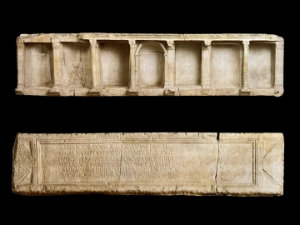
Inscription of Olympus to his grandfather
TNMM 447
This monument is the only one still available from the disappeared Mithraeum in Piazza S. Silvestro in Capite.
Olim Victor avus, caelo devotus et astris
Regali sumptu Phoebeia templa locavit.
Hunc superat pietate nepos, cui nomen avitum est:
Antra facit, sumptusque tuos nec Roma requirit
Damna piis meliora lucro: quis ditior illo est
Qui cum caelicolis parcus bona dividit heres?.

Mitreo di San Silvestro in Capite
TNMM 446
This Mithraic temple, also known as the Mithraeum of the Olympii, dates to the 3rd century and was rediscovered in 15th-century Rome, but it has not been preserved.

Slab with dedicatory poem from near S. Silvestro, Rome
TNMM 990
Large marble slab found in 1648 near S. Silvestro in Capite, inscribed with a Latin dedicatory poem forming a cypher-acrostic for TAMESIUS and AUGENTIUS, with records of leontica and chrysos initiations, dated to 362 A.D.
Mamertino et Nebitta co[ns(ulibus)] / Nonius Victor Olympius v(ir) c(larissimus) [p(ater) p(atrum)] / et Aur(elius) Victor Augentius v(ir) [c(larissimus) p(ater)] / tradiderunt leontica kal(endis) apr(ilibus) felic(iter). / Al[i]a tradiderunt con[s(ulibus)] s(upra) s(criptis) VI idu(s) apr(iles) felic(iter). / Cons(ulibus) s(upra) s(criptis) tradiderunt chryfios (sic!) VI idu(s) apr(iles) felic(iter).
Under the consulship of Mamertinus and Nevitta, Nonius Victor Olympius, vir clarissimus [and Pater Patrum], together with Aurelius Victor Augentius, vir clarissimus [and Pater], conferred the grade of Leo on the Kalends of April, successfully. They conferred other grades under the aforementioned consuls on the sixth day before the Ides of April, successfully. Under the same consuls, they conferred the status of cryfii on the sixth day before the Ides of April, successfully.