Your search Boulogne-sur-Mer gave 706 results.
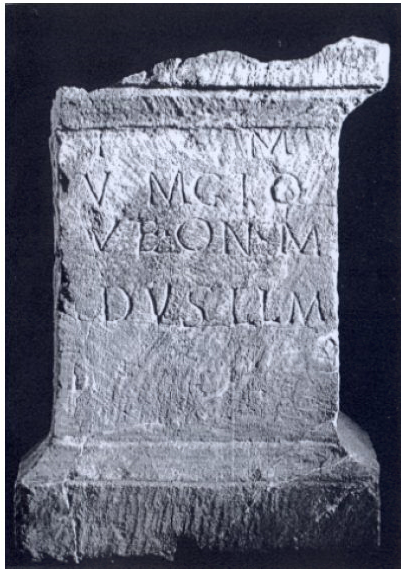
This fragmented monument bears an inscription of a certain veteran named Valerius Magio.
Aemilia connected northern and central Italy through prosperous urban centres and major communication routes of the Roman Peninsula.
Aegyptus occupied a unique position within the Roman world where Mediterranean trade, Nile networks and ancient religious traditions intersected.
Apulia connected southern Italy to the Adriatic and eastern Mediterranean through maritime trade and regional urban networks.
Campania preserved a vibrant urban and maritime environment closely connected to the commercial life of Roman Italy.
Latium formed the political and religious centre of the Roman world where some of the most important Mithraic communities developed.
Syria-Coele formed one of the principal urban and cultural centres of the Roman Near East where diverse religious traditions coexisted.
Asia formed one of the most urbanised and interconnected provinces of the eastern Roman world where Mithraic cults circulated widely.
Bithynia et Pontus connected northwestern Anatolia to the Black Sea through major maritime, urban and provincial networks.
Chersonesus occupied a northern Black Sea position where Greek, Roman and frontier cultures intersected at the edges of the Mithraic world.
Along the lower sectors of the middle Danube, Pannonia inferior became a major centre of Mithraic activity in the frontier provinces.
Belgica occupied a strategic position between Roman Gaul, the Rhine frontier and the northern provinces where Mithraic cults circulated widely.
Lugdunensis formed part of the urban and administrative core of Roman Gaul, where Mithraic cults circulated through major civic centres.

One of the most eminent representatives of late antique pagan religiosity, combining high civic authority with deep initiation into multiple mystery traditions, including the cult of Mithras.
Roman Sicilia preserves Mithraic evidence shaped by Mediterranean mobility and the island’s strategic position between east and west.
The evidence from Roman Africa reflects the implantation of Mithraic cults within prosperous urban centres of the western Mediterranean.
Roman Syria preserves a major eastern corpus of Mithraic evidence within one of the empire’s most interconnected regions.
Pannonia preserves one of the most important frontier corpora of Mithraic evidence in the Roman world.
Roman Asia preserves a rich and diverse body of Mithraic evidence connected to the major cities of western Anatolia.
Bithynia and Pontus preserve important evidence for the diffusion of Mithraic cults across the Black Sea and northwestern Anatolia.
