Your search Bu Njem gave 1078 results.

Fragmentary limestone relief from Thun-Allmendingen of the same dimensions as the bull relief, depicting a swine; both may have formed part of the sanctuary's ritual décor.
Site excavated by C. F. L. Lohner in 1824–25 at the Renzenbühl near Thun-Allmendingen, Germania Superior, where the outline of five rooms was identified, one or more of which may have served as a Mithraic sanctuary.
Red sandstone altar fragments from the Mithraeum at Königshoffen, reused as a step or threshold in the sanctuary's third building phase, preserving only the opening of a dedication to Deo invicto Mithrae.
Upper portion of a sandstone altar from the Mithraeum at Königshoffen, later reused as building material, bearing a dedication by Ianussa on both the front and reverse faces.
Grey sandstone tauroctony relief from the Mithraeum at Königshoffen, heavily restored, depicting Mithras killing the bull with Cautes and Cautopates and the busts of Sol and Luna; only the lower part of Cautopates and the crossed legs are original.
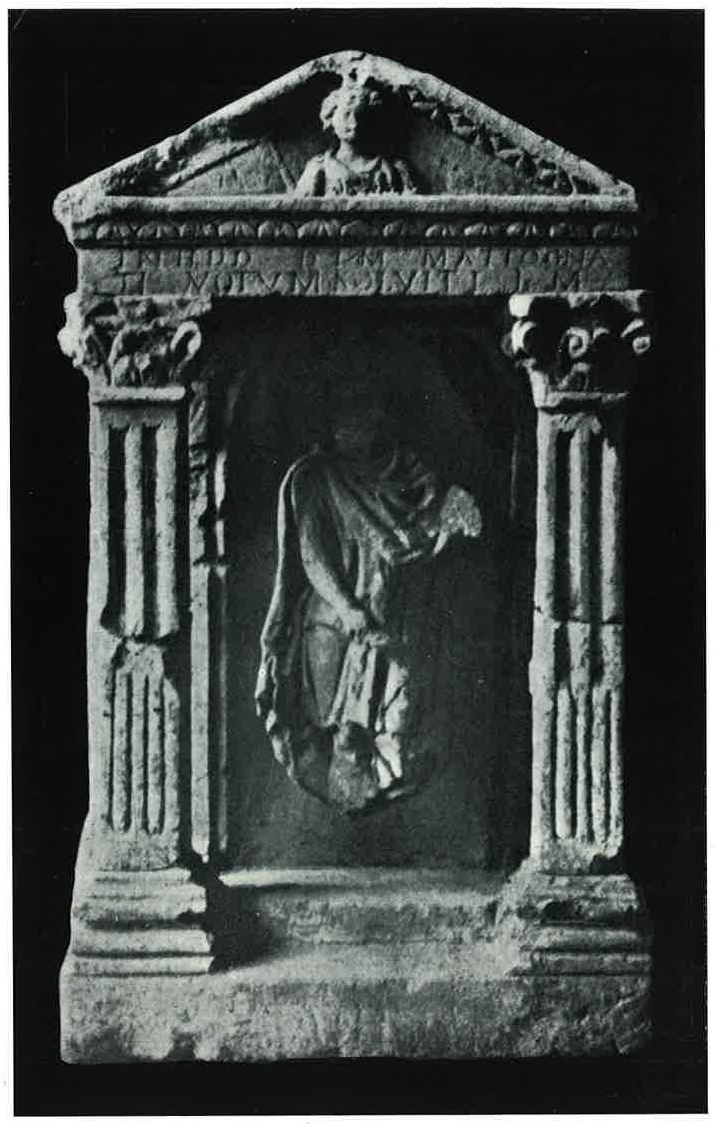
Sandstone monument in the form of a temple façade from the Mithraeum at Königshoffen, accessible by a step and framed by two Corinthian columns; the pediment is decorated with the bust of Luna, and the architrave carries an inscription.
Stone fragment from the Mithraeum at Königshoffen preserving a human thigh against which a hand holds a bunch of grapes; probably part of a larger sculptural group.
Stone torso of a naked winged figure from the Mithraeum at Königshoffen, identified as Aion; the head is lost, but remnants of a wing survive at the right shoulder, and the statue likely stood on a preserved base with traces of two feet.
Reconstructed tauroctony relief from the Mithraeum at Mackwiller, assembled from multiple stone fragments and preserving Mithras's head, shoulders, dagger hand, flying cloak, and parts of the bull and torchbearers.
Second sandstone lion from Brumath, ancient Brocomagus, of uncertain Mithraic attribution; larger than the inscribed companion piece.

Large grey sandstone tauroctony relief from Fellbach near Cannstatt, depicting the bull-slaying in a vaulted grotto with torchbearers, Sol, Luna, and subsidiary Mithraic scenes along the border.
Large votive altar from Murrhardt, dedicated to Soli invicto Mithrae by Sextus Iulius Florus Victorinus, tribune of Cohors XXIV Voluntariorum civium Romanorum, recording the full restoration of a Mithraic temple from its foundations.
Small bronze statuette recovered from the river Saale near Burg Giebichenstein in 1900, depicting Mithras as bull-slayer without a Phrygian cap; the left leg is lost.
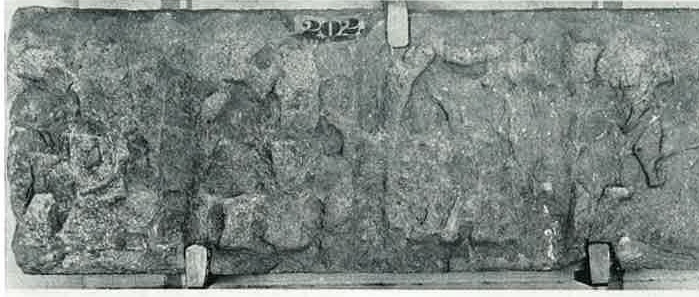
Badly damaged red sandstone relief from Hölzern, Germania Superior, depicting the standard bull-slaying scene; possibly forming part of the border zone of a larger composition.
Inscribed altar from Lengfeld near Aschaffenburg dedicated to Numini augusto deo invicto by Caius Atulius Maior ex voto
Large inscribed altar from Lengfeld near Aschaffenburg dedicated to Numini augusto Soli deo invicto by Lucius Trougillus ex voto
Grey limestone relief fragment from Rockenhausen found at the Pfingstborn spring, preserving part of the bull-slaying scene
Marble stele relief with bull-slaying scene and subsidiary Mithraic episodes including the sacred banquet.
Structure in the Tarn region initially reported as a Mithraeum but later identified as an ordinary silo.
Terracotta matrix used to produce vessels decorated with the bull-killing scene of Mithras.
