Your search Tal hal Hariri / Es-Sâlihiyeh / As Salhiyah gave 3725 results.

Two terracotta lamps formerly in the Coll. Passeri and now probably in the Museo Olivieri at Pesaro: the first showing Mithras as a bullkiller, the second in the shape of a bull's head inscribed Μέθρα ἱερός on the horns, both regarded as probably forged…
Altar and a relief of a figure tearing a lion to pieces, found along the Otočac–Gospić road near the mountains Veliki and Mali Vitalj, Dalmatia; the tauroctony interpretation of the lion-tearing relief was subsequently disputed.
A marble cippus from Rome bearing two inscriptions: the upper dedicated to Deus Sol Invictus Mithras and Cautopates, the lower by Flavius and companions.
Marble cippus from the Villa Giustiniani near Porta Flaminia with a dedication to Sol Invictus Mithras by M. Aurelius Euprepes, erected after a vision through the presidents Bictorinus pater and Ianuarius, dated to 184 A.D.
Marble inscription from the Villa Giustiniani near Porta Flaminia, dedicated by M. Aurelius Euprepes, freedman of the three Emperors, to Sol Invictus Mithras through the priests Calpurnius and Ianuarius, dated to 194 A.D.
Large marble altar found near S. Giovanni in Laterano, dedicated by Sextilius Agesilaus Aedesius, pater patrum of Sol Invictus Mithras, to the Great Mother and Attis following his taurobolium and criobolium, dated to 376 A.D.
Marble base from the S. Prisca Mithraeum composed of two vases stacked on top of each other, which probably supported a statue.
Pieces of roughly worked stone from the Caracalla Mithraeum which may represent Mithras' rock-birth.
Marble statue of Cautopates in Eastern attire, cross-legged, leaning against a trunk and rocky stone with a cock beside his left foot, from the Mithraeum of S. Lorenzo in Damaso; the greater part of his arms and torch are lost.
Relief in plaster, fixed on the wall beside the Mithraic wall-painting (No. 386) in the house of the Nummi Albani on the Quirinal, with traces pointing to a representation of Mithras slaying the bull.
Fragment of a marble vase found near Portus by Prince Torlonia, showing a bearded head in radiate crown (Sol) and Cautes with upraised torch, with a Mithras representation now lost, now itself lost.
Altar inscription dedicated to Kautopates by Eutyces, a freedman serving the two emperors, found at Mascula (modern Khenchela).
Marble inscription discovered near the Via Cupa mentioning an offering to the invincible Mithras by Apollonius Tetes Syras of Marcianopolis.
Limestone altar from Mureș Port near Apulum, Dacia, dedicated to Invicto Mithrae; the dedicant is identified only as Augustalis (coloniae?).
Barbara-stone pedestal from Mithraeum III at Ptuj, ancient Poetovio, with a hollow and three attachment holes in the top indicating that a votive object was originally fixed to it.

Patras is Greece's third-largest city and the regional capital and largest city of Western Greece, in the northern Peloponnese, 215 km west of Athens.
Astorga is a municipality and city of Spain located in the central area of the province of León, in the autonomous community of Castilla y León, 43 kilometres southwest of the provincial capital.
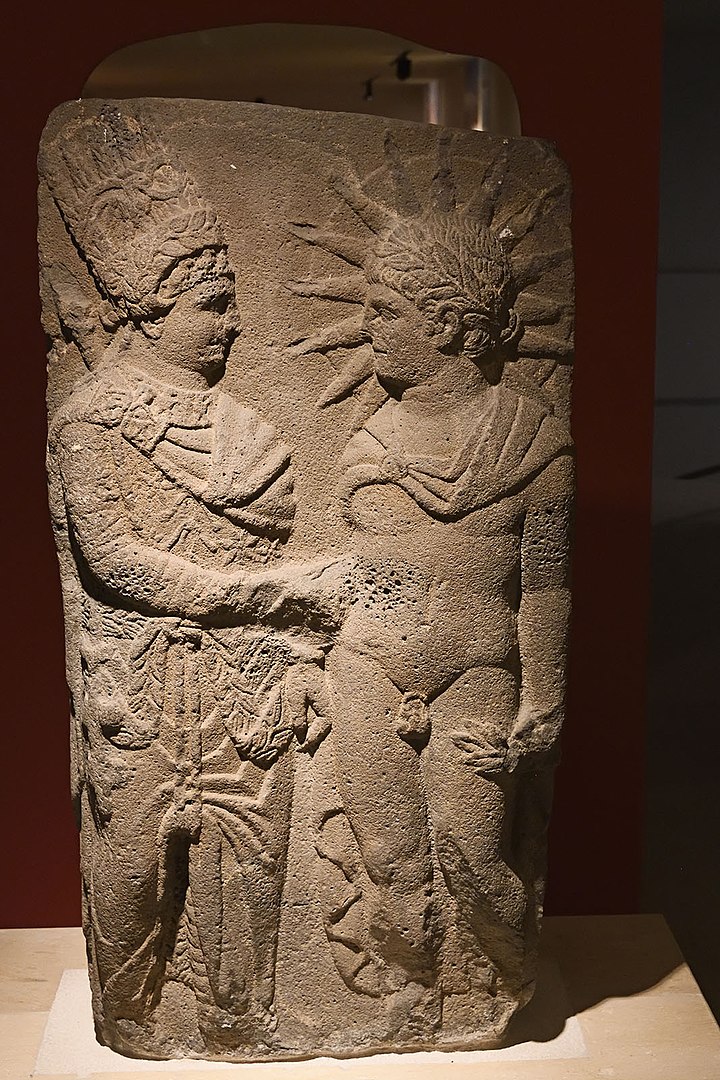
Stele representing Apollo-Mithras-Helios in a Hellenistic nude fashion, shaking hands with Antiochus I.

Fresco of Mithras found in an arched niche above the right bench of the Baths of Caracalla’s Mithraeum in Rome.
Sandstone base from Vetera (Xanten), Germania Inferior, with a relief of Cautes in Oriental dress holding a long burning torch.
