

Biography
of Marcus Aemilius Chrysanthus
- Marcus Aemilius Chrysanthus, a freedman, is attested as a member of a Mithraic community (syndexios), with a recorded role as magister anni primi.
- Attested in the 2nd – 3rd century.
- Attested at Roma, Latium, Italia in 171 – 230 (TNMM 785).
- Attested at Roma, Latium, Italia in 2nd – 3rd century (TNMM 479 and TNMM 463).
TNMP 95
Marcus Aemilius Chrysanthus was a freedman (M(arcorum duorum) l(ibertus), ‘freedman of two Marci’) and magister anni primi known from three marble altars found in central Rome. His connection with the cult of Mithras is securely established by an altar dedicated Deo Invicto Mithrae by Gaius Lucretius Mnester and Marcus Aemilius Philetus, who describe themselves as summagistri anni primi M. Aemili Chrysanti (TNMM 785; CIMRM 517; CIL VI 734).
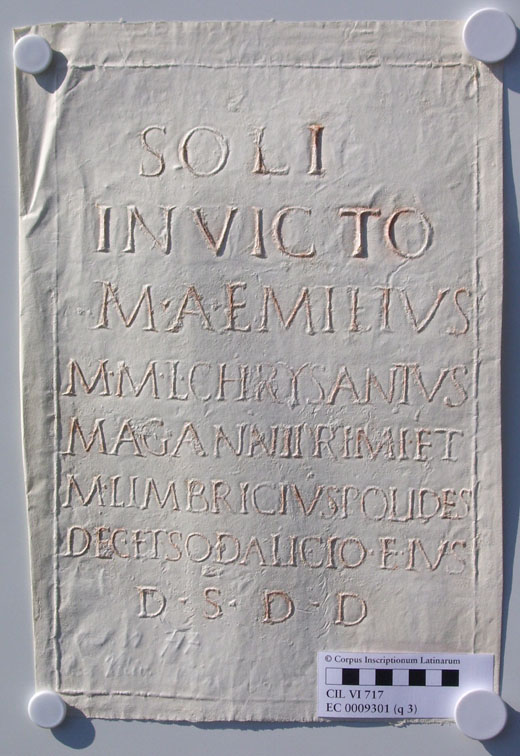
Chrysanthus himself dedicated another altar to Sol Invictus together with Marcus Limbricius Polides, a decurio. On this monument he explicitly records his freedman status and again bears the title magister anni primi (TNMM 479; CIMRM 519; CIL VI 717). A third altar, dedicated Orienti by the slave Fructus and his son Myro, was erected sub M. Aemilio Chrysantho magistro anni primi, apparently under Chrysanthus’ authority or supervision (TNMM 463; CIMRM 518; CIL VI 556). Clauss (1992) suggested that Oriens here might refer to Cautes, although this identification remains uncertain.
The precise meaning of magister anni primi is likewise unclear. Earlier scholarship interpreted the title as an office concerned with the instruction of new members, but Clauss (1992) stressed that neither its function nor even its specifically Mithraic character can be established independently. The inscriptions therefore show that Chrysanthus occupied a position of authority within the group associated with these dedications, but they do not allow his responsibilities to be defined more precisely.
The three altars have traditionally been associated with a supposed Mithraeum near Santa Maria in Monticelli because of their findspots and the recurring presence of Chrysanthus. No architectural remains of such a sanctuary are known, however. Chalupa (2023) consequently regards only the altar explicitly dedicated to Mithras as certainly Mithraic, while treating the altars to Sol Invictus and Oriens as probable Mithraic finds on the basis of their association with Chrysanthus.
References
- Alfred Shenington Geden. Altar of Fructus and Myro in EDCS.
- Epigraphik-Datenbank Clauss / Slaby. Altar from Rome by Mnester and Philetus in EDCS.
- Evelyn Schraudolph (1993) Römische Götterweihungen mit Reliefschmuck aus Italien. Altäre, Basen und Reliefs.
Attestations
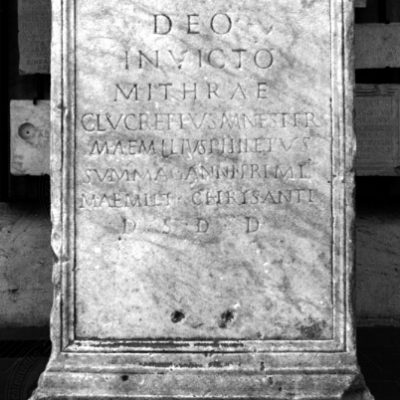
Altar from Rome by Mnester and Philetus
TNMM 785
This marble altar was found ’in the street called di Branco’, behind the palace of the Cardinal of Bologna, in Rome.
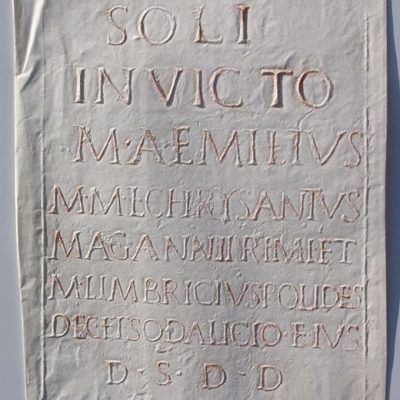
Altar of Aemilius Chrysanthus to the Invincible Sol
TNMM 479
Aemilius Chrysanthus shares the expenses of this monument with a decurio named Limbricius Polides.

Altar of Fructus and Myro
TNMM 463
This marble monument was dedicated in Rome by the slave Fructus and his son Myro.
