Your selection gave 351 results.

Two marble tauroctony fragments from near the station at Constanța, ancient Tomis in Moesia Inferior, depicting the bull-slaying with Sol visible above; lost during the war.
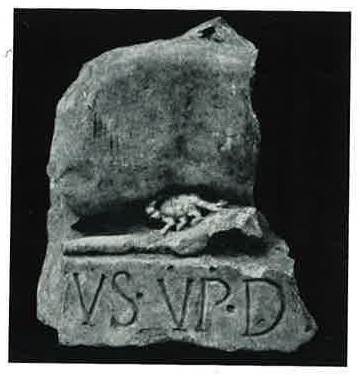
Fragmentary inscription from Tomis, Moesia Inferior, preserving only the garbled closing formula votum pusuit (for posuit).
Marble tauroctony fragment from Constanța, ancient Tomis in Moesia Inferior, depicting the bull-slaying with dog, serpent, and scorpion; Cautes holds both an upraised torch and a pedum.
White marble trapezium-shaped tauroctony relief probably from Constanța, ancient Tomis in Moesia Inferior, divided into three horizontal registers with the central tauroctony and subsidiary scenes.
Marble stele from Histria, Moesia Inferior, found reused in a late wall in the southern quarter of the city, bearing a Mithraic dedication or scene.
Limestone altar from the Territorium Troesmense, Moesia Inferior, dedicated to Invicto Mithrae sacrum by Lucius Valerius Fuscus, centurion of a legion.
Rough limestone tauroctony relief probably from Troesmis, Moesia Inferior, depicting the standard bull-slaying with the greater part of the bull's head lost.
Right upper corner of a tauroctony relief from Troesmis, Moesia Inferior, now in Paris, preserving part of the bull-slaying scene.
Fragmentary inscription from Troesmis, Moesia Inferior, dedicating to Soli and a deity or epithet beginning Zo-.
Head in a radiate crown — probably Sol — from Troesmis, Moesia Inferior, with a partly legible inscription below.
Limestone tauroctony relief from Iglița, ancient Troesmis in Moesia Inferior, found in 1882, depicting the standard bull-slaying with serpent, scorpion, and a partial dog; the raven is lost.
Inscription from Axiopolis, Moesia Inferior, recording a dedication by a vir perfectissimus dux limitis provinciae Scythiae.
Marble tauroctony fragment from Axiopolis, Moesia Inferior, preserving only a small part of Mithras's knee, the hind part of the bull, and the scorpion.
Fragment of the border of a marble vase from Axiopolis, Moesia Inferior, bearing an inscription dedicated to Deo Soli invicto Mithrae.
Limestone altar fragment from the apsidal construction at Ulmetum, Moesia Inferior, bearing a partially preserved inscription mentioning fonte dei — the spring of the god; the Mithraic attribution is uncertain.
Inscription from Ulmetum, Moesia Inferior, preserving only the opening of a dedication to Deo bono invicto.
Marble tauroctony relief fragment from the Byzantine camp at Pontelimonul de sus, ancient Ulmetum in Moesia Inferior, found reused in the masonry; the subject is partly identifiable.
Fragmentary inscription from Transdierna, Moesia Superior, preserving only the opening of a dedication to Deo invicto Mithrae.
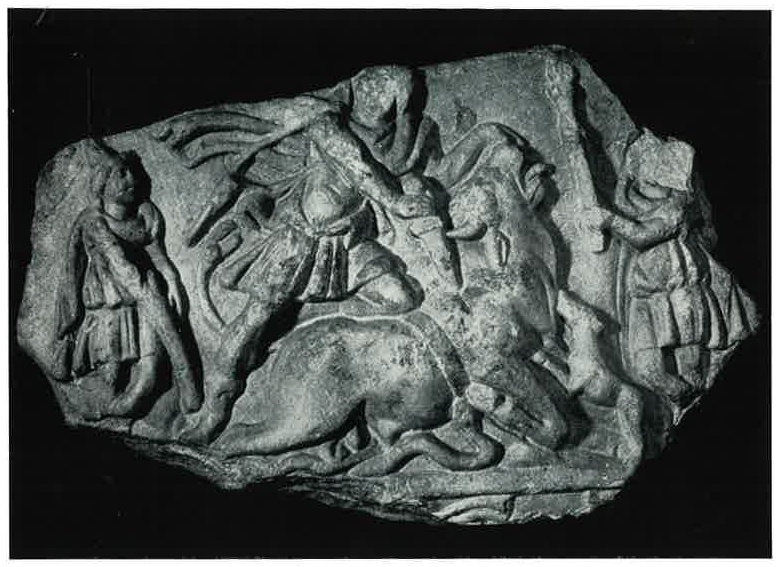
Marble tauroctony relief fragment from Tekija in east Serbia, ancient Transdierna in Moesia Superior, depicting the standard bull-slaying scene.
Inscription from Celei, ancient Sucidava in Dacia, dedicated to the sanctum of Solis invicti Mithrae.
