Your search Mit Rahina gave 2643 results.

Neapolitan senator who dedicated a tauroctonic relief to Mithras tauroctonus to the Almighty God Mithras.

A Mithraic initiate attested in Pannonia Superior during the late 2nd or early 3rd century CE.

Member of the Mithraic community of Les Bolards and dedicator of a statue of Cautes.

Tribune of the First Cohort of Vardulli, he erected a mithraeum at Bremenium together with his consacranei.

This marble tablet found at Portus Ostiae mentions a pater, a lion donor and a series of male names, probably from a Mithraic community.
This heavily damaged relief from Narbo preserves the figure of a cross-legged Mithraic torchbearer carved in low relief near the church of Saint-Sébastien in Narbonne.
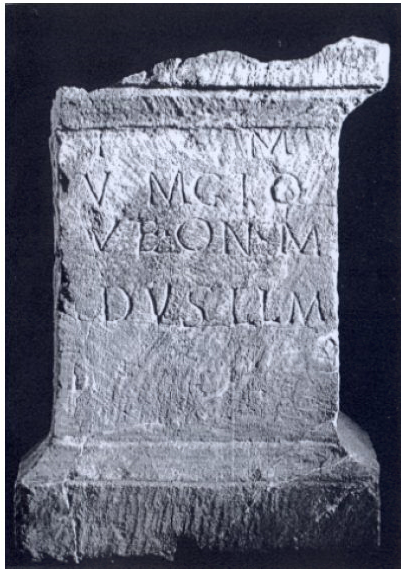
This fragmented monument bears an inscription of a certain veteran named Valerius Magio.

This relief of Mithras slaying the bull incorporates the scene of the god carrying the bull and its birth from a rock.

Histria connected the northern Adriatic to the Balkan and Danubian worlds through maritime and regional communication networks.
Transpadana occupied the northern plains of Italy where major communication routes connected the peninsula to the Alpine and Danubian worlds.
Cyrene linked North Africa to the Greek East through long-standing urban traditions and eastern Mediterranean maritime exchange.
Aemilia connected northern and central Italy through prosperous urban centres and major communication routes of the Roman Peninsula.
Along the northern frontier of Roman Britain, Britannia inferior preserves important evidence linked to military and frontier communities.
Armenia occupied a frontier crossroads between the Roman world, Anatolia and the Iranian cultural sphere.
Aegyptus occupied a unique position within the Roman world where Mediterranean trade, Nile networks and ancient religious traditions intersected.
Liguria linked northern Italy to southern Gaul and the western Mediterranean through coastal and Alpine communication routes.
Venetia connected northern Italy to the Adriatic and Danubian worlds through trade, mobility and imperial communication routes.
Etruria formed part of the cultural and religious heartland of central Italy closely connected to Rome and the Tyrrhenian world.
Umbria formed part of the central Italian heartland through which religious practices circulated between Rome and the northern provinces.
Picenum connected the Adriatic coast of central Italy to inland communication routes and the wider networks of the Roman Peninsula.
