Your search San Gemini gave 586 results.

Yellow sandstone votive altar from Wiesbaden, ancient Aquae Mattiacae, published by Ritterling and preserved in the Städtisches Museum
Two sandstone altar fragments from Mainz, ancient Mogontiacum, with a partially preserved dedication to Deo invicto Mithrae

Fragment of a white sandstone tauroctony relief from Mainz, ancient Mogontiacum, found reused in the wall of a house in 1864
Fragmentary sandstone altar from Mainz, ancient Mogontiacum, dedicated to Deo invicto Mithrae by Marcus A., a duplicarius of an ala
Yellow sandstone altar from Mainz, ancient Mogontiacum, dedicated to Deo invicto Mithrae on behalf of the salus of soldiers of Cohors I Ituraeorum
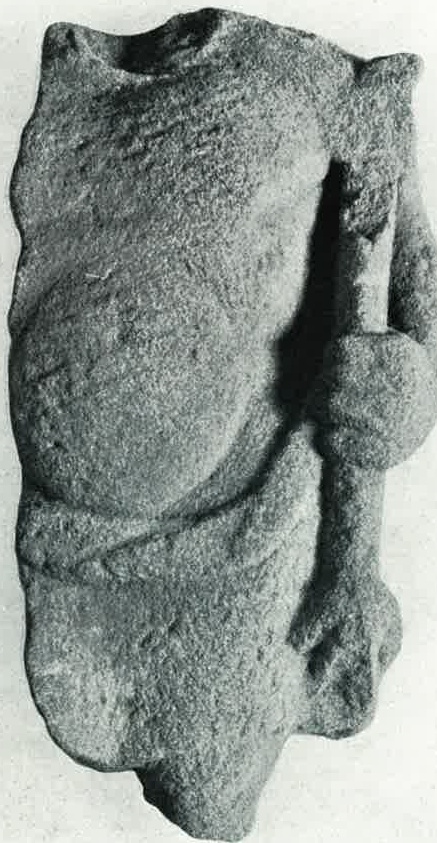
Group of sandstone relief fragments from Rückingen depicting multiple deities including a male head identified as Hercules
Two sandstone relief fragments from Rückingen, each preserving a woman's head looking to the left
Sandstone relief fragment from Rückingen showing the upper part of an undressed male figure in a niche, head and left arm lost
Sandstone relief fragment from Rückingen with an indistinct standing figure, probably a woman, in an arched niche
Lower part of a sandstone relief fragment from Rückingen preserving only the lower body of a walking figure, legs lost
Small sandstone relief fragment from Rückingen preserving only the upper part of a head wearing a Phrygian cap
Sandstone Mithras relief discovered in 1950 near Rückingen, proving the existence of a Mithraeum there from the late second to early third century AD

Fragment of a statuette on a sandstone base found in Mithraeum III at Heddernheim, ancient Nida, formerly in the Häberlin collection
Two basalt blocks walled into the podium of Mithraeum III at Heddernheim, ancient Nida, which supported decorative sandstone bases
Two sandstone altars with voluted tops from Mithraeum III at Heddernheim, ancient Nida, possibly used to support a partition bar across the cult niche
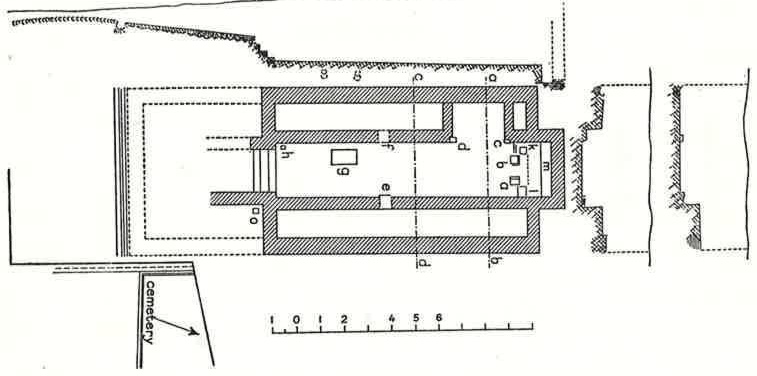
Third Mithraic sanctuary found north-west of the cemetery at Heddernheim, ancient Nida, in 1887 and fully excavated by G. Wolff in 1890
Two sandstone reliefs from Vibbel, found in a pit at Heddernheim, ancient Nida, in 1884, probably lost during the Second World War
Damaged red sandstone altar from Mithraeum II at Heddernheim, ancient Nida, with the representation of an axe on its front face
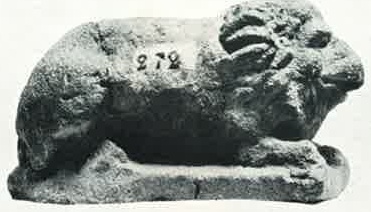
Red sandstone statue of a lying lion with a hollow channel running through its body, from Mithraeum II at Heddernheim, ancient Nida
Sandstone altar from Mithraeum I at Heddernheim, ancient Nida, inscribed with a dedication to Cautes by Lucius Domitius Agilis (?)
