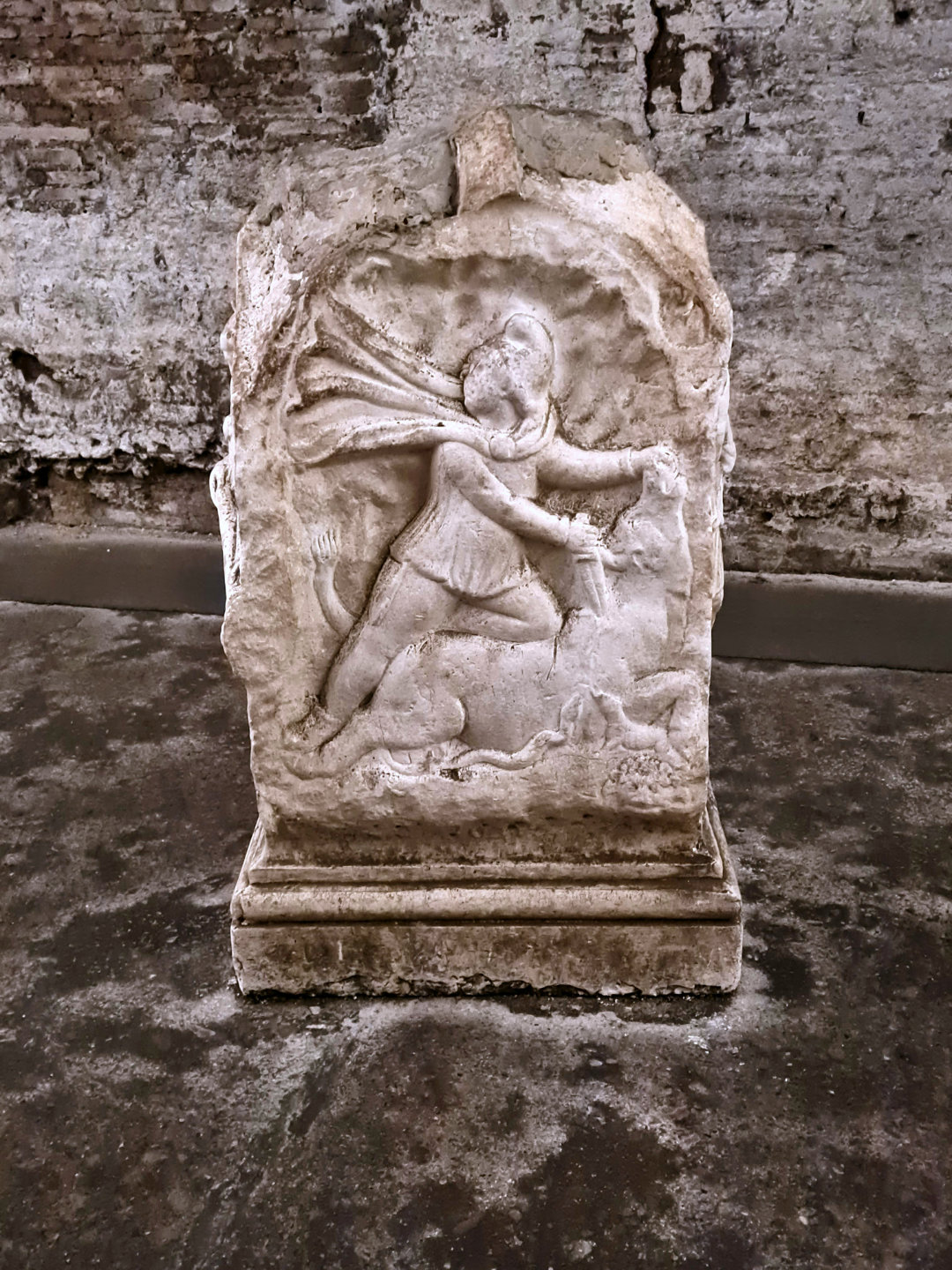
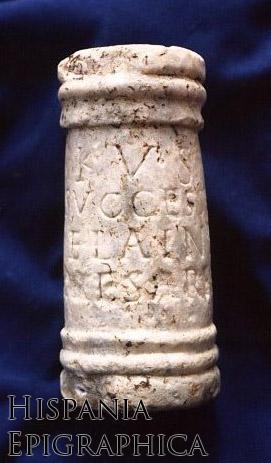
Richard Gordon suggests the object on the Miles step is a bull’s hindquarter.
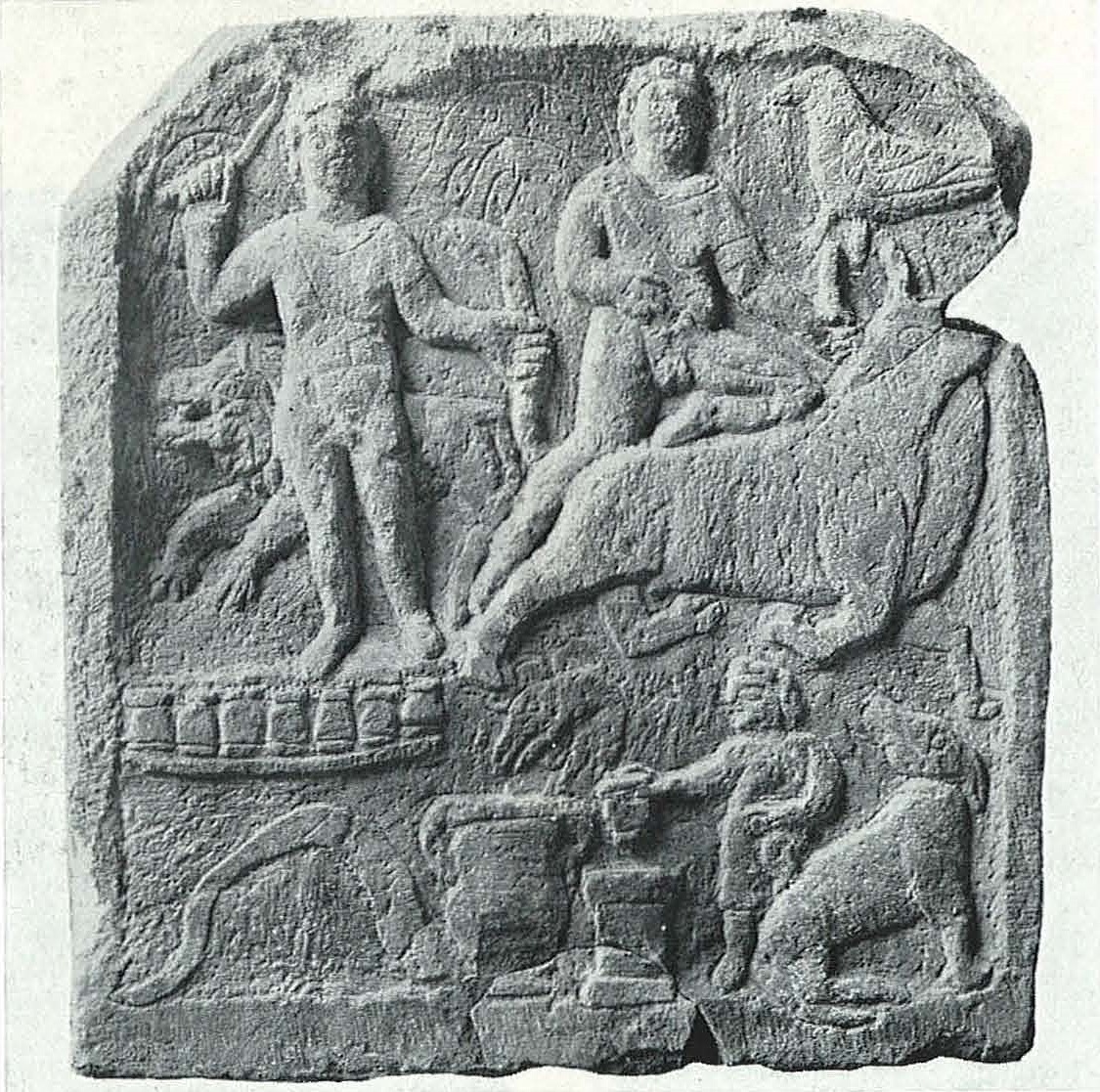
“In the light of the sacrificial scene on the altar of Flavius Aper (Poetovio), the interpretation as a bull’s hind-quarter rather than shoulder is to be preferred. The scene at Ostia is perfectly in keeping with other evidence suggest- ing that (junior) Mithraic grades fulfilled specific manual tasks within the cult, in the case of Miles, butchery of sacrificial animals.”
See:
Gordon, R. 2013c. “The Miles-frame in the Mitreo di Felicissimo and the practicalities of sacrifice.” Religio: Revue Pro Religionistiku 21, no.1: 33–38.
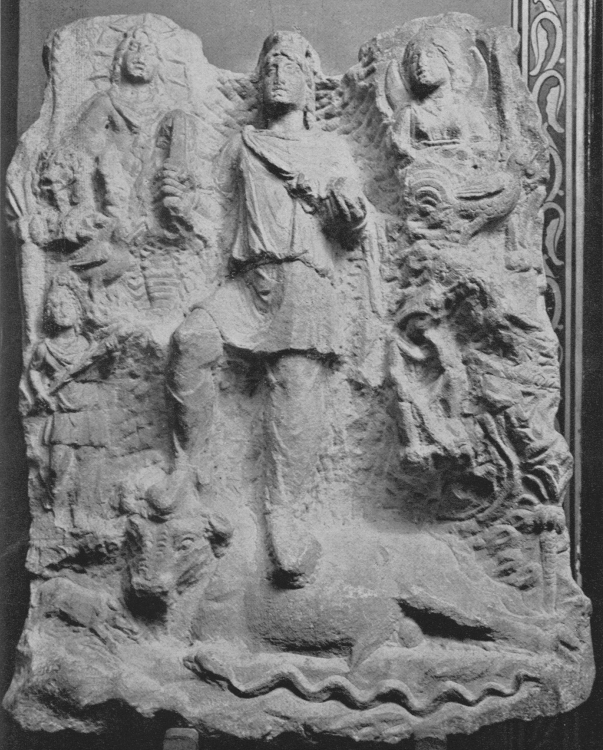
The most detailed publication on this monument seems to be Diamandis Triandaphyllos. „Nouveau relief rupestre de Mithra Tauroctone dans la région de Xanthi“, in: Pulpudeva. Semaines philippopolitaines de l’histoire et de la culture Thrace, (Supplementum 6), Sofia: St. Kliment Ohridski University Press 2008, pp. 159‒171. There is information about the "rediscovery" or rather reclassification of this monument (previously described as "the image of a warrior") in 1973, but no information about Bogdan Filov´s discovery. What is the source of this information?
Thank you for your reply. My comment was in no way meant to be critical, I found the same information on the web. Personally, I have little doubt that Bogdan Filov (a fascinating figure, a leading Bulgarian archaeologist who became Prime Minister of the Fascist government during the Second World War and was executed by the People´s Court in February 1945 and buried in a mass grave) really did discover this monument, the problem is that I cannot find any published source for this information. Triandaphyllos is silent on the subject, but this is not surprising given that the tauroctony of Thermes is located in the disputed region once controlled by Bulgaria and now belonging to Greece, and he has no detailed knowledge of Bulgarian literature on the subject. Anyway, let´s hope that the information is there and that someone will be able to find it in the future.
Please be critical! As you can see, this article was written a long time ago and only quotes an article from https://www.balkantravellers.com, which was deleted shortly after. Any additional information you can provide, including Triandaphyllos’s article if it is publicly available, would be most welcome.
I recently had the opportunity to visit the remains of this mithraeum. It is located in Altafulla, in a pleasant seaside village on the Catalan coast. In situ, not much is preserved apart from the foundations, but it's worth a detour if you're passing through the area to visit the site and, if the weather is good, take a dip in the beach!
“In the light of the sacrificial scene on the altar of Flavius Aper (Poetovio), the interpretation as a bull’s hind-quarter rather than shoulder is to be preferred. The scene at Ostia is perfectly in keeping with other evidence suggest- ing that (junior) Mithraic grades fulfilled specific manual tasks within the cult, in the case of Miles, butchery of sacrificial animals.”
See:
Gordon, R. 2013c. “The Miles-frame in the Mitreo di Felicissimo and the practicalities of sacrifice.” Religio: Revue Pro Religionistiku 21, no.1: 33–38.