This site uses cookies to offer you a better browsing experience.
Find out more on how we use cookies in our privacy policy.

 
Region

Mithras in Germania

Germania preserves some of the densest concentrations of Mithraic evidence in the Roman frontier provinces.

The Mithraic material documented in Germania is closely associated with the Rhine frontier and the military infrastructure of the Roman Empire. Mithraea, reliefs and inscriptions are particularly concentrated around forts, legionary bases and urban settlements such as Mogontiacum, Nida, Bonna and Colonia Agrippinensis, reflecting the important role of soldiers, officials and merchants in the spread of the cult across the northwestern provinces.

Mithraic monuments of Germania


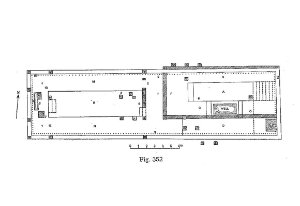
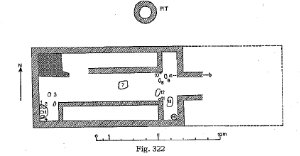
Mithraea of Heddernheim

Since 1826, four mithraea have been found at Nida-Heddernheim.


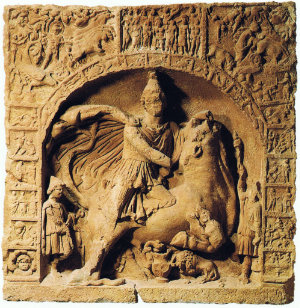
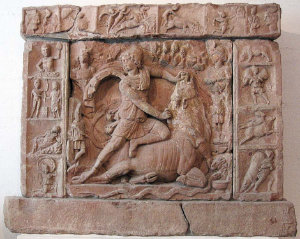
Tauroctony from Osterburken

Franz Cumont considers the bas relief of Osterburken ’the most remarkable of all the monuments of the cult of Mithras found up to now’.

CIMRM 1292


Mithréum of Strasbourg

Lors de la construction de l’église Saint-Paul en 1911, un mithraeum a été mis au jour à Königshoffen, vicus gallo-romain situé aux abords du camp légionnaire de Strasbourg-Argentorate.

CIMRM 1335


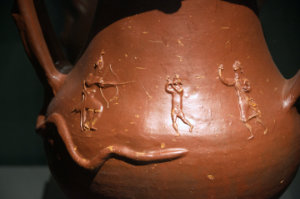
Cultic mithraic vase of Zeughausstraße

The Mithraic vase from Colonia Claudia Ara Agrippinensium in Germany includes Sol-Mithras between Cautes and Cautopates, as well as a serpent, a lion and seven stars.


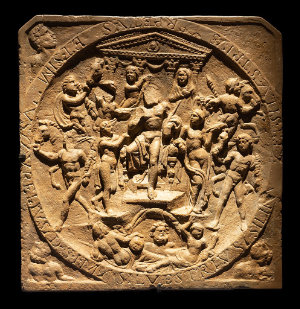
Two-sided relief of Dieburg

The relief of Dieburg shows Mithras riding a horse as main figure, surrounded by several scenes of the myth.

CIMRM 1247


Tauroctony from the Mithräum von Heddernheim

This relief is so well-known that it has been reproduced in nearly every handbook of archaeology and of history of religions.

CIMRM 1083


Tauroctony from Neuenheim

The Tauroctony relief of Neuenheim, Heidelberg, includes several scenes from the deeds of Mithras and other gods.

CIMRM 1283


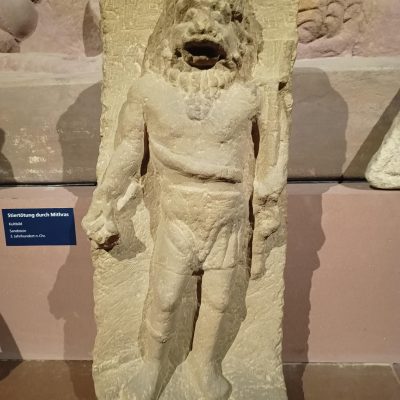
Cautes and Cautopates from Mithraeum III of Heddernheim

The two companions of Mithras carry a torch and a shepherd's staff at the third Mithraeum in Frankfurt-Heddernheim, formerly Nida.

CIMRM 1119


Mithraic vessel of Mainz

The Mithraic vase from Ballplatz in Mainz depicts seven figures arranged in two narrative sequences, commonly interpreted in relation to initiation rites.


Mithräum von Dieburg

There are references to two places of worship from Dieburg, whereby the Mithraeum, discovered in 1926.

CIMRM 1246


Mithräum von Neuenheim

Only a small part of the Neuenheim Mithraeum has been excavated.

CIMRM 1282


Mithräum von Saalburg

In the 1900s a model Mithraeum was built in Saalburg in the mistaken belief that there was an original temple of Mithras in an ancient Roman building.

See all Mithraicmonuments in Germania

Places in Germania


[Neuenheim]

Neuenheim lies in an area occupied since at least the Iron Age, with a Celtic hilltop refuge and cult site on the nearby Heiligenberg from the 5th century BC. From around 40 - 45 CE, the site developed into a Roman vicus associated with a castellum.


Aquae Mattiacae

Wiesbaden is the capital of the German state of Hesse, and the second-largest Hessian city after Frankfurt am Main.


Argentoratum

Argentoratum or Argentorate was the ancient name of Strasbourg. Its name was first mentioned in 12 BC, when it was a Roman military outpost established by Nero Claudius Drusus. The Legio VIII Augusta was stationed there from 90 AD.


Bingium

The Celts are the first known to have settled in this place, which they called Binge, meaning rift. Roman troops stationed here in the first century AD rendered the local name as Bingium in Latin.


Bodobrica

Vicus Baudobriga was a Roman settlement on the left bank of the Rhine, founded during the conquest of Gaul. Its development reflects the Rhine’s shifting role as frontier, trade route, and fortified border before Roman withdrawal.


Burginatium

Kalkar is a municipality in the district of Kleve, in North Rhine-Westphalia, Germany.


Centum Prata

Centum Prata is the name of a Roman vicus, whose remains are located on the eastern Zürichsee lakeshore in Kempraten, a locality of the municipality Rapperswil-Jona in the canton of St.


Colonia Agrippina

Colonia Claudia Ara Agrippinensium, usually just called Colonia, was the Roman settlement in the Rhineland that became the modern city of Cologne, now in Germany. It was the capital of Germania Inferior and the military headquarters of the region.


Durnomagus

Founded in 50 AD, Durnomagus is now part of the German town of Dormagen.


Gimmeldingen

Gimmeldingen is a village, part of the town of Neustadt an der Weinstraße, Germany. Its origins, along with the village of Lobloch (which used to be connected), can be traced back to Roman settlements in 325 AD.


Groß-Gerau

Groß-Gerau is the district seat of the Groß-Gerau district, lying in the southern Frankfurt Rhein-Main Region in Hesse, Germany, and serving as a hub for the surrounding area.


Güglingen

Güglingen is a town in the district of Heilbronn in Baden-Württemberg in southern Germany.

See all Mithraic sites in Germania

Inscriptions from Germania

Tauroctony from Osterburken

D[eo] S[oli] I[nvicto] M[ithrae] M[er?]catorius Castrensis in suo cons[ituit].
To the unconquerable sun god Mithras, Mercatorius Castrensis erected [this monument] on his property.

Two-sided relief of Dieburg

[Side A:] D[eo] i[nvicto] M[ithrae] / Silves/trius / Silvi/nius et Silvestrius Pe[rpetus et A]urelius nepos / v[otum] s[olverunt] l[ibentes] l[aeti] m[erito]. /
Perpetus fra/te[r] artis sutor[iae]. / Silvinus ar/tis quadratari/ae Aureli[us ---] d[ono] d[ederunt].

[Side B:] D[eo] S[oli] i[nvicto] M[ithrae] Silvestrius Sil[v]inu[s] et Silvestrius Perpetus et Silvinius Aurelius.
[Side A:] To the invincible god Mithras, Silvestrius Silvinus, Silvestrius Perpetus and Silvinius Aurelius.
[Side B:] To the invincible god Mithras, Silvestrius Silvinus, Silvestrius Perpetus and [Silvinus?] Aurelius, their nephew, fulfilled their vow willingly, gladly and deservedly. Perpetus, brother, a cobbler by trade, and Silvinus, a sculptor by trade, Aurelius [---] gave this as a gift.

Tauroctony from Strasbourg

[In h[onorem]] d[omus] d[ivinae] d[eo] i[nvicto] M[ithrae] / ... us M.P.D ... / ... us typu[m] ... / ... solo v ...
In honor of the Imperial house, to the unconquered god Mithras … sculptural model … soil [/only] ...

Altar with Mithras rock-birth of Nida

D[eo] inv[icto] Mit[hrae] / Senilius Car/antinus / c[ivis] Medio/m[atricus]
V[otum] s[olvit] l[ibens] l[aetus] m[erito] / Sive Cracissiu[s]. // P[etram] genetricem.
To the invincible god Mithras, Senilius Carantinus, also named Cracissius, citizen of Mediomatricus, dedicated willingly, gladly and deservedly following a vow these images of Cautes, of the generative rock, of Cautopates, and of the Heaven and Ocean.

Mithräum von Dormagen

Deo Soli i[nvicto] M[ithrae] p[ro] s[alute] i[mperatoris] Suran l[ibertus] dupl[icarius] ale Noricorum ci[vis] Trax v[otum] s[olvit] l[ibens] m[erito].
To the god Sol Invictus Mithras, for the well-being of the emperor, Suran, freedman, duplicarius of the Ala Noricorum, a Thracian citizen, willingly and deservedly fulfilled his vow.

Dedication inscription from Koenigshoffen Mithraeum

In h[onorem] d[omus] d[ivinae] deo Invic/to M[ithrae] C[aius] Celsinius / Matutinus veter[anus] / leg[ionis] VIII Aug[ustae] Alexan/drianae typum / de suo repinx[it]
In honour of the divine house, to the invincible god Mithras. Caius Celsinius Matutinus, veteran of legio VIII Augusta [Alexandriana], repainted this relief at his own expense.

Cautes and Cautopates of Stockstadt

In honorem domus divinae Cauti et Cautopati Florius Florentius et Ancarinius Severus nepos votum solverunt libentes laeti merito Faustino et Rufino consulibus.
In honour of the divine house, at Cautes and Cautopates, Florius Florentius and Ancarinius Severus, his nephew, willingly, joyfully and justly fulfilled their vow, [Manius Acilius] Faus[tinus and [Aulus Triarius] Rufinus being consuls.

Votive plaque of Stockstadt

[D[eo]] i[nvicto] M[ithrae] et S[oli] s[ocio] Argata / v[otum] s[olvit] l[ibens] l[aetus] m[erito].
To the invincible god Mithras and his ally Sol, Argata has fulfilled his vow willingly, gladly and deservedly.

Altar to Mithras and Mars from Mainz

D[eo] I[nvicto] M[ithrae] / et Marti / Secundini/us Amantius / cornicu[larius] / praef[ecti] leg[ionis] / XXII permi/ttente Pri/mulo patre / ex voto pos/uit l[ibens] l[aetus] m[erito].
To the Unconquered Sun God Mithras and Mars. Secundinius Amantius, cornicularius to the prefect of the 22nd Legion, with the permission of Primulus the Pater, dedicates this willingly in fulfilment of a vow.

Inscription to Mithras by Claudius Romanius from Köln

D[eo] I[nvicto] M[ithrae] S[oli] s[ocio] / Tiberius Cl[audius] / Romaniu[s] / veteranu[s] / l[ibens] m[erito].
To the invincible sun god Mithras, ally of sol, Tiberius Claudius Romanius, veteran, willingly and deservedly.

Inscription of Corax Materninius Faustinus from Gimmeldingen

In h[onorem] d[omus] d[ivinae] / deo inviht[o] [sic] Midre [sic] / Maternin[i]us Faustinu[s] / carax [sic] fan[um] cum solo inviht[o] / in suo fecit c[ onsac]ratus XI k[alendis] Feb[ruariis].
Fanus [sic] consacrat[us] / per Potentianum / patrem co[n]s[ulibus] / Paulino et Iuliano /l[ibens] l[aetus] m[erito].
In honour of the divine house, to the invincible god Mithras, Materninius Faustinus, Crow, consecrated a shrine with [a statue of] the invincible Sol, on his property [in suo], on the tenth day before the calendars of February. Sanctuary [fanum] consecrated by Potentianus, Father, the consuls being [Sextus Anicius Faustus] Paulinus and [Ionis] Iulianus, willingly, joyfully and justly.

Tauroctony from Dormagen

D[eo] S[oli] i[nvicto] imp[erio] C. Amandinius / Verus buc[inator] v[otum] l[ibens] l[aetus] m[erito].
Under the command of the Unconquered Sun God, C. Amandinius Verus, the trumpeter, willingly, gladly, and deservedly fulfils his vow.

See all Mithraicinscriptions from Germania

References

Back to Top