This site uses cookies to offer you a better browsing experience.
Find out more on how we use cookies in our privacy policy.

 
Region

Mithras in Moesia

Moesia preserves a strongly militarised body of Mithraic evidence along the Danubian frontier of the empire.

The Mithraic material documented in Moesia is closely associated with frontier garrisons, military communities and the strategic infrastructure of the middle and lower Danube. The province preserves important evidence for understanding the diffusion of Mithraism within the defensive and administrative systems of the Roman frontier.
Mithraic monuments of Moesia


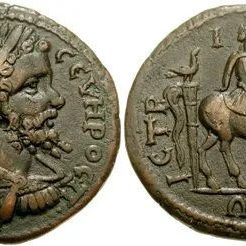
Coin of Septimius Severus and god on horseback

Coin of Istrus, Moesia Inferior, showing Caracalla on one side and a god on horseback (Mithras ?) on the other.


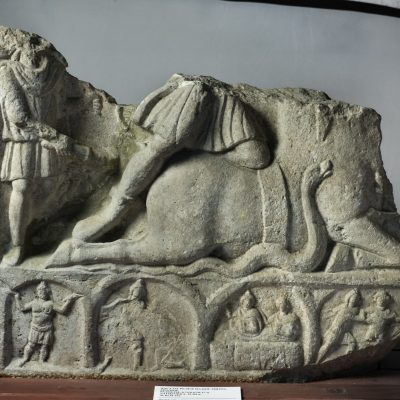
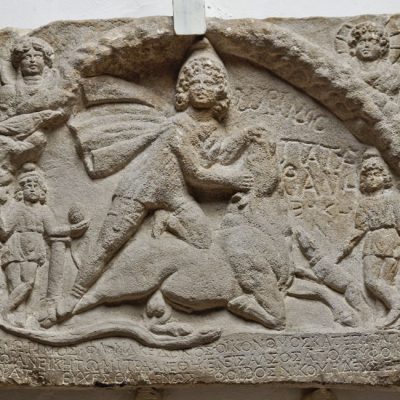
Tauroctony from Târgușor

This limestone relief of Mithras killing the bull bears an inscription by a certain Flavius Horimos, consecrated in a ’secret forest’ in Moesia.

CIMRM 2306


Altar of Klechovtse

The limestone altar at Klechovtse in North Macedonia bears an inscription to the invincible Mithras.

CIMRM 2209


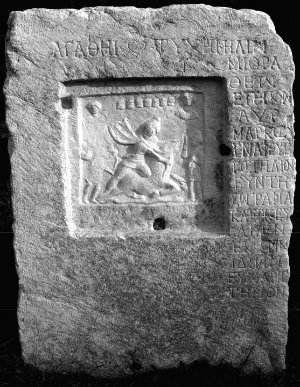
Tauroctony stele from Nicopolis ad Istrum

The Tauroctony of Nicopolis ad Istrum is unique as it is the only Mithraic stele befitting a Greek donor.

CIMRM 2264


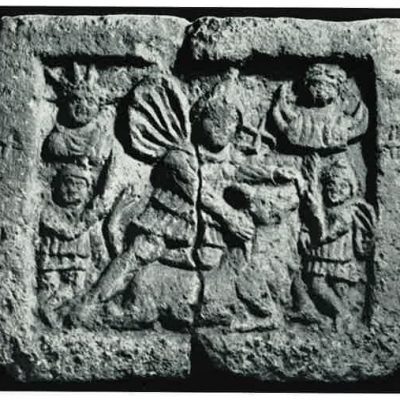
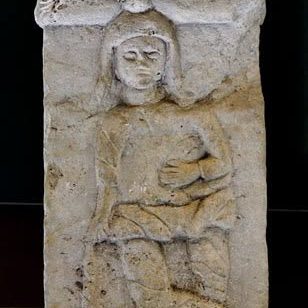
Inscription with Cautes and Cautopates of Steklen

An unusual feature of this very ancient relief is that Cautopates carries a cockerel upside down, while Cautes carries it right-side up.

CIMRM 2268


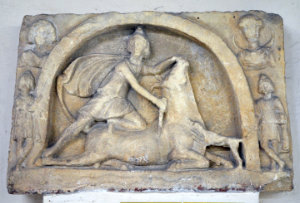
Tauroctony from Pleven

This relief of Mithras killing the bull in a vaulted grotto lacks the usual scorpion pinching the bull's testicles.

CIMRM 2257


Inscription of Ision from Guberevac

In this monument, the imperial slave Ision claims the completion of a new temple to Mithras in Moesia.

CIMRM 2235


Altar of Tettius Plotus from Oescus

In the altar that Titus Tettius Plotus dedicated to the invincible God, he called himself pater sacrorum.

CIMRM 2252


Autel of Straton from Kreta

Straton, son of Straton, consecrated an altar to Helios Mithras in Kreta, Moesia inferior.

CIMRM 2260


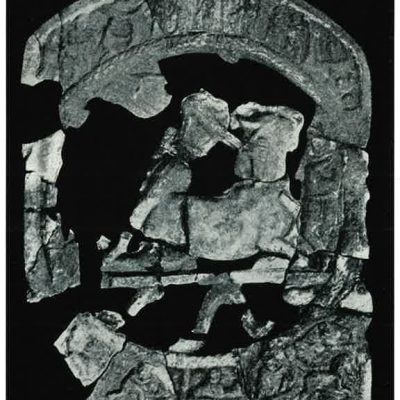
Fragmentary tauroctony from Kostolac

This weathered marble fragment from Viminacium preserves part of a tauroctony with Luna, Cautopates, the serpent, and the dog.

Places in Moesia


Guberevac

Guberevac is a village in the municipality of Sopot, Serbia.


Istros

Under Roman rule from the 1st century CE, Histria was incorporated into the province of Moesia. The city is noted on the Tabula Peutingeriana, which places it 11 miles from Tomis and 9 miles from Ad Stoma.


Nicopolis ad Istrum

Nicopolis ad Istrum or Nicopolis ad Iatrum was a Roman and Early Byzantine town. Its ruins are located at the village of Nikyup, 20 km north of Veliko Tarnovo in northern Bulgaria. The site was placed on the Tentative List for consideration as a Wo


Novae

Novae was initially one of the few great Roman legionary fortresses along the empire’s border, forming part of the defences along the Danube in northern Bulgaria. It lies about 4 km east of the modern town of Svishtov.


Statio Vizianum

Klečevce is a village in the municipality of Kumanovo, North Macedonia.


Storgosia

Storgosia was a Roman road station and later a fortress, located in the modern Kaylaka Park in the vicinity of modern Pleven (North-central Bulgaria). Pleven is today the seventh most populous city in Bulgaria.


Târgușor

Târgușor is a commune in Constanța County, Northern Dobruja, Romania.


Ulpia Oescus

Oescus, Palatiolon or Palatiolum was an important ancient city on the Danube river in Roman Moesia.


Viminacium

Viminacium was a major city, military camp, and the capital of the Roman province of Moesia.

Inscriptions from Moesia

Tauroctony from Târgușor

Ὣριμος / πατὴ/ρ ἀνέ/θηκε/ν.
Φλ[άουιος] Ὣριμος Φλ[αουίου] Μακέδονος οἰκονόμος κατ᾽ ἐπιταγήν / θεῷ ἀνεικήτῳ Μίτρᾳ ἀνέθηκεν εἰς ἄλσος ἀπόκρυφον. / Ε᾽θφράτῃ εὔχεσθαι ἁγνῶς. Φοῖβος Νικομηδεὺς ἐποίει.
Horimos, Father, consecrated.
Flavius Horimos, steward of Flavius Macedo, by order, to the invincible god Mithras, consecrated, in a secret forest. Adore the Euphrates with piety. Phoibos of Nicomedia made [this monument].

Horimos, the ‘Father’, dedicated this.
Flavius Horimos, the supervisor of the estate of Flavius Makedon, dedicated this to the invincible god Mithras, upon [divine] command, for a secret grove. May you pray to Euphrates in a pure manner. Phoibos of Nikomedeia made this.

Altar of Klechovtse

[D[eo] i[nvicto]] M[ithrae] / fano mag[no] / pro sal[ute] Aug[g[ustorum]] n[ostrorum] / Apollonides / eorund[em] vect[igalis] Il/lyr[ici] ser[vus] [contra]sc[riptor] st[ationis] / Lamud[---] quam vove/rat [contra]sc[riptor] sta[tionis] Vizi[ani] // A[pollo]n[ides]s Viz[iani] // Gentia/no et / Basso [co[n]s[ulibus]].
To the invincible god Mithras, a great temple, for the safety of our Agustus Apollonides, the servant of Illyricum, the contrascriptor of the garrison of those tributaries, Lamud--- which he had vowed, the contrary of the station of Viziani.

Tauroctony stele from Nicopolis ad Istrum

Ἀγαθῆι τύχηι. Ἡλίῳ | Μίθρᾳ | θεῷ | ἐπηκόῳ || Αὐρ[ήλιος] | Μᾶρκος | γναφεὺς | τὸ συήλιον | σὺν τῇ || ζωγραφίᾳ | κατεσκεύ|ασεν | ἐκ τῶν |ἰδίων || εὐχαρισ|τήριον.
To the lord Mithras, as an ex-voto, Galerios, son of Proteos, assistant stone cutter. To good fortune. To Helios Mithras, the listening god, Aurelios Markos, stone cutter, had the stele erected with the painting, at his own expense, as a mark of gratitude.

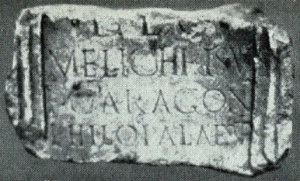
Inscription with Cautes and Cautopates of Steklen

Deo / Melichrisus / P. Caragoni / Philopalaestri
Melichrisus [slave of] P. Caragonius Philopalaestrus [in charge of the customs office of the sout shore of Danube] [dedicated] to the god [...].

Inscription of Ision from Guberevac

Invicto deo / Ision Caes[aris] n[ostri] ser[vus] / vil[icus] vectigal[is] Il/lyr[ici] templ[um] omn[i] / re instruct[um] a / solo p[ecunia] s[ua] f[aciendum] c[uravit].
To the invincible god, Ision, a slave of our emperor and steward of the taxes of Illyricum, saw to it that the temple, complete with all its furnishings, was built from the ground up at his own expense.

Altar of Tettius Plotus from Oescus

T[itus] Tettiu[s] / Plotu{u}[s] / vet[eranus] leg[ionis] II[II] / F[laviae] F[elix] p[ater] s[acrorum] d[ei] / Invicti [s[olvit]] / l[ibens] m[erito].
Titus Tettius Plotus, veteran of Legion IV Flavia Felix, father of the rites [pater sacrorum] of the invincible God, willingly and justly fulfilled his vow.

Autel of Straton from Kreta

Στράτω/ν Στράρω/νος άνέθη[κεν] / τὸ[ν] βωμὸν / Ἡλίῳ Μίθρᾳ
Straton, son of Straton, consecrated the altar to Helios Mithras.

References

Back to Top