The Mithraic evidence documented in Moesia inferior reflects the province’s strategic role within the frontier system of the lower Danube and the western Black Sea. Military mobility, urban settlements and riverine communication networks contributed to the diffusion of the cult throughout the region.

People attested in Moesia inferior






Places in Moesia inferior
Acbunar
The locality of Acbunar is associated with archaeological remains from the lower Danubian frontier zone.
Callatis
Callatis developed as an important Black Sea port on the western coast of the Pontus Euxinus.
Histria
Histria was one of the earliest Greek colonies established on the western shores of the Black Sea.
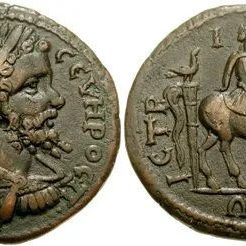
Istros
Under Roman rule from the 1st century CE, Histria was incorporated into the province of Moesia. The city is noted on the Tabula Peutingeriana, which places it 11 miles from Tomis and 9 miles from Ad Stoma.
Kreta
Small settlement on the lower Vit River in northern Bulgaria, within the territory of Roman Moesia Inferior.
Nicopolis ad Istrum
Nicopolis ad Istrum or Nicopolis ad Iatrum was a Roman and Early Byzantine town. Its ruins are located at the village of Nikyup, 20 km north of Veliko Tarnovo in northern Bulgaria. The site was placed on the Tentative List for consideration as a Wo
Novae
Novae was initially one of the few great Roman legionary fortresses along the empire’s border, forming part of the defences along the Danube in northern Bulgaria. It lies about 4 km east of the modern town of Svishtov.
Inscriptions from Moesia inferior
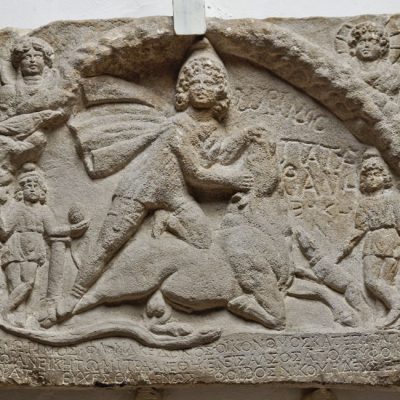
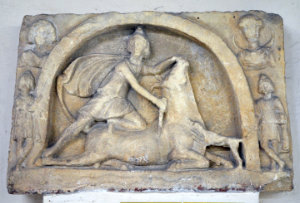
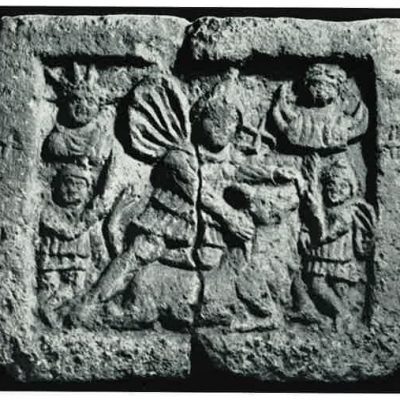
Tauroctony from Târgușor
Φλ[άουιος] Ὣριμος Φλ[αουίου] Μακέδονος οἰκονόμος κατ᾽ ἐπιταγήν / θεῷ ἀνεικήτῳ Μίτρᾳ ἀνέθηκεν εἰς ἄλσος ἀπόκρυφον. / Ε᾽θφράτῃ εὔχεσθαι ἁγνῶς. Φοῖβος Νικομηδεὺς ἐποίει.
Flavius Horimos, steward of Flavius Macedo, by order, to the invincible god Mithras, consecrated, in a secret forest. Adore the Euphrates with piety. Phoibos of Nicomedia made [this monument].
Horimos, the ‘Father’, dedicated this.
Flavius Horimos, the supervisor of the estate of Flavius Makedon, dedicated this to the invincible god Mithras, upon [divine] command, for a secret grove. May you pray to Euphrates in a pure manner. Phoibos of Nikomedeia made this.
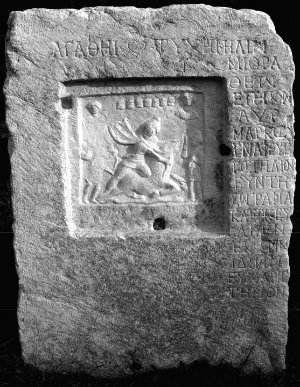
Tauroctony from Nicopolis ad Istrum
Ἀγαθῇ τύχῃ Ἡλίῳ / Μίθρᾳ / θεῷ / ἐπηκόῳ / Αὐρ(ήλιος) Μάρκος / γναφεὺς / τὸ στήλιον / σὺν τῇ ζωγραφίᾳ / κατεσκεύ/ασεν / ἐκ τῶν / ἰδίων / εὐχαρισ/τήριον.
To Good Fortune. To Helios Mithras, the god who hears prayers, Aurelius Marcus, fuller, had the stele made together with the painting, at his own expense, as a thank-offering.
