Your search Latium gave 470 results.
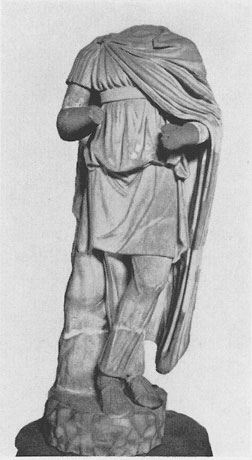
Penthelic marble statue of a standing torchbearer in Eastern attire, cross-legged, with head and torch arm broken off, probably 2nd century A.D., found at Antium (modern Anzio).

Marble relief showing Mithras slaying the bull inside a vaulted cave accompanied by Sol, Luna and the torchbearers.
A statue found along the Via Cassia about six kilometres from Rome, tentatively identified as an Aion entwined by a serpent but possibly representing Atargatis according to Vermaseren, now in the Museo Nazionale delle Terme.
A white marble relief fragment found with its companion piece near Nomento on the Via Nomentana, showing only the lower body of a cross-legged torchbearer in a short tunic, now in the storerooms of the Museo Nazionale in Rome.
A white marble tauroctony relief fragment found at the hill known as Carnale near Nomento on the Via Nomentana, about twenty kilometres from Rome, now in the storerooms of the Museo Nazionale in Rome, dated to the third century AD.
A marble cippus from Rome bearing two inscriptions: the upper dedicated to Deus Sol Invictus Mithras and Cautopates, the lower by Flavius and companions.
A badly damaged marble torso from Rome, carved from Luna marble, possibly representing a Mithraic torchbearer dressed in tunic, long cloak and anaxyrides.
A marble relief depicting Cautopates as a standing cross-legged torchbearer in Eastern attire with his burning torch pointing downwards, found in Rome near the Via Appia and now in the Museo Nazionale delle Terme, the head and much of the torch lost.
A marble relief depicting Cautes as a standing cross-legged torchbearer in a short tunic and Phrygian cap with torch upraised and left hand lost, found in Rome near the Via Appia and now in the Museo Nazionale delle Terme.
A cippus found in a vineyard near the Via Salaria by the Coemeterium Priscillae outside Rome, inscribed by Q. Hostilius Euplastus, a leo of the Mithraic mysteries, dedicating a gift to the god.
A white marble tauroctony statue found in 1925 at the ancient site of Lorium near the eleventh milestone on the Via Aurelia outside Rome, showing Mithras slaying the bull with dog, serpent and scorpion, accompanied by Cautes and Cautopates; now in the Palazzo Doria…
A lost Mithraic relief acquired near Rome and formerly held by the Lyceum Hosianum of Braunsberg in East Prussia, known only through a 1910 communication to Cumont; possibly identical with the relief from Macerata.
A marble plinth inscription formerly in the Vigna Guidii outside the walls of Rome, recording L. Valerius Megistus as pater and sacerdos of the Invincible Mithras.
Two lost Mithraic monuments from Rome: one documented in a 1738 catalogue of the Palazzo Barberini as a tauroctony group with scorpion, snake and dog, and another mentioned by Pirro Ligorio as a Mithras panel in the Palazzo del Duca di Sanseverino.
A small tauroctony group once in the collection of the sculptor Antonio d'Este in Rome, depicting Mithras as a bullkiller with the two torchbearers, the entire composition carved from a single piece of stone.
Two tauroctony statues formerly at the Villa del Grande near the Porta Maggiore in Rome, both lacking the upper part of Mithras and the bull's head.
A bluish marble tauroctony relief once in the Villa Ludovisi in Rome, showing Mithras slaying the bull with the raven perched on his cloak holding a heart-shaped fruit, the bull's tail ending in ears of grain, and the dressed busts of Sol and Luna in the upper corners…
A white marble tauroctony relief fragment, in the seventeenth century at the Palazzo Caesiani near the Vatican and later in the Villa Ludovisi in Rome, showing Mithras slaying the bull with dog, serpent and raven, with a cross-legged torchbearer on a base; now lost…
A white marble tauroctony group in the round found near the Forum in Rome in 1919, showing Mithras slaying the bull with dog, serpent and scorpion, the bull's tail ending in three ears of grain; possibly identical with No. 605.
A stone statue probably found in Rome, depicting a naked Mithras emerging from the rock with his index finger raised to his lips and his right arm broken off, described by Cumont as an unfinished work never completed.
