Your search Latium gave 470 results.

Small marble arula found near the church of SS. Apostoli in Rome, bearing a brief Greek dedication to Helios Mithras Invictus.
Greek inscription dedicated to Sol Invictus Mithras by Balbillus, saved from the waters, in the presence of Bassus the priest, belonging to the Mithraic grade of Leo.
Bronze lamella probably from Rome, found in 1729, bearing a dedication to Sol Sanctissimus by C. Veratius Faustinus, a soldier of the third praetorian cohort.
Marble head in the Museo Baracco, Rome, generally described as an Alexander but very probably representing Mithras with his eyes lifted towards heaven; the back of the head is finished obliquely with a small hole for fastening a Phrygian cap.
Fragment of a relief from the Villa Wolkonsky showing the usual representation of Mithras slaying the bull, with the dog, serpent and scorpion; the bull's head, Mithras' head and right foot are lost.
Marble relief formerly in the Palazzo Alberoni and then the Palazzo Vaccari on Via del Tritone, showing Mithras slaying the bull with the raven on the god's cloak, the serpent, dog and scorpion, and the busts of Sol and Luna in the upper corners.
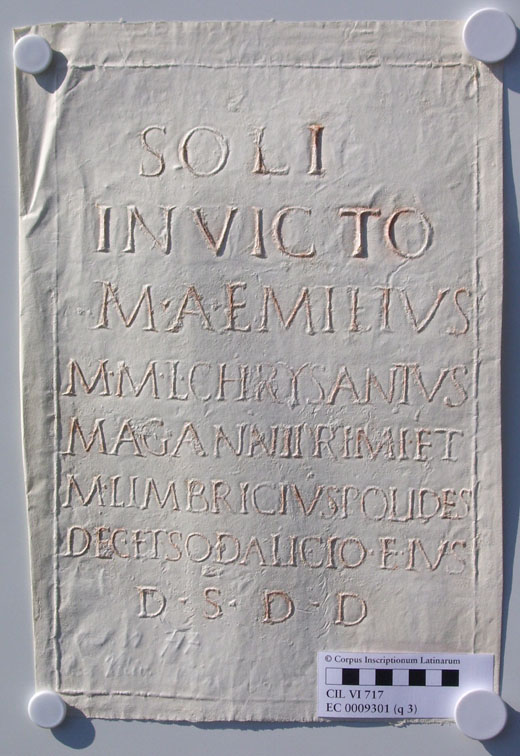
Aemilius Chrysanthus shares the expenses of this monument with a decurio named Limbricius Polides.
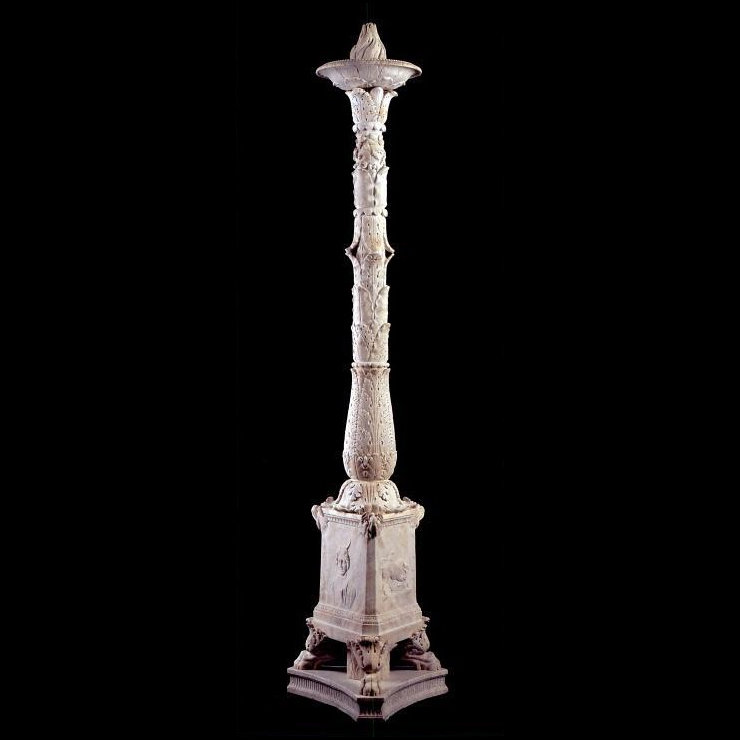
This magnificent candelabrum was found in Rome in 1803, in the Syrian Temple of Janicule.
Large limestone jar from room Z of the S. Prisca Mithraeum, fitted with a small cylindrical vase and a lid bearing the graffito "Te cauterio i Saturne i Ata[r i] Opi".
Mithraic object or evidence from Rome reported as no longer preserved.
Preliminary readings of the painted Mithraic texts later revised after additional research and restoration.
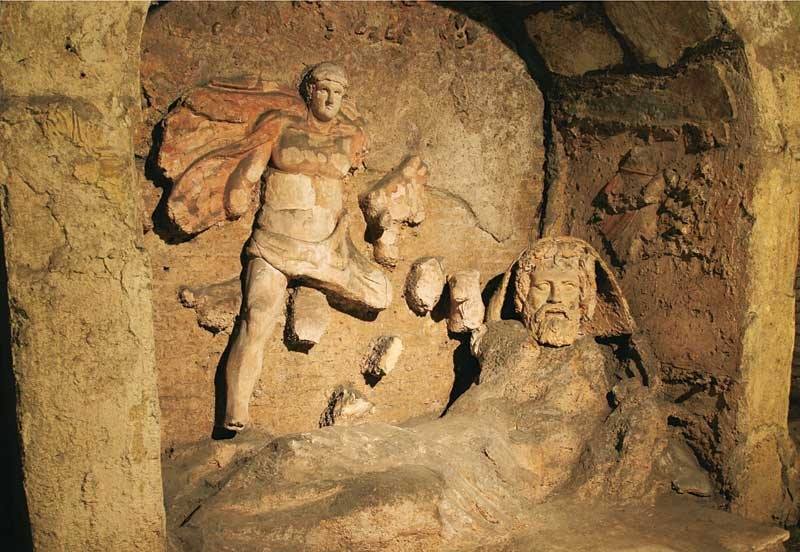
Even if only a few fragments remain, it is very likely that the main niche of the Mitreo di Santa Prisca contained the usual representation of Mithras killing the bull.
The fragmented tauroctony of the Mitreo di Santa Prisca rests on the naked figure of a bearded man, probably Ocean or Saturn.
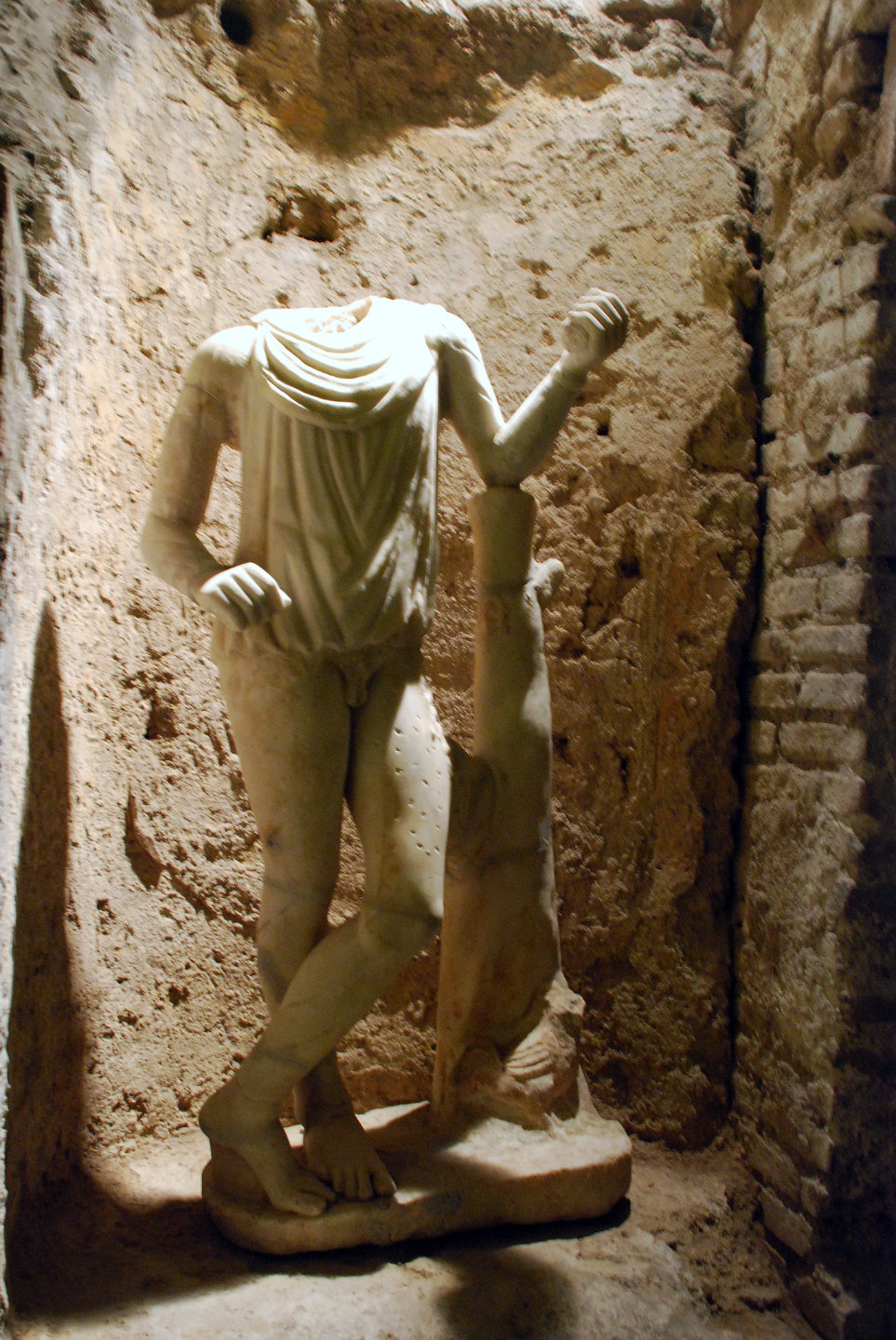
The marble statue of Cautes, found in the Mithraeum of Santa Prisca, was originally a Mercury.
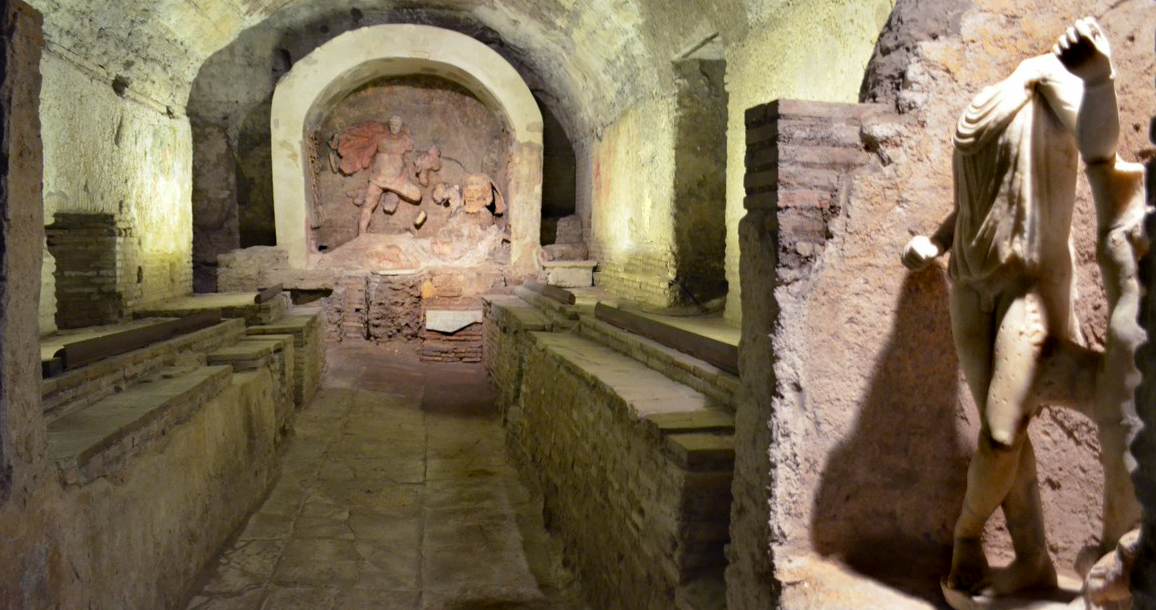
The Mithraeum of Santa Prisca houses remarkable frescoes showing the initiates in procession.
Marble base found in 1764 on the Aventine with a dedication to Sol by C. Rufus Volusianus, vir clarissimus, who held the offices of pater, hierophant, prophet of Isis and pontifex of the Sun, dated to the 4th century A.D.

Roman building on the Aventine between the eastern side of S. Saba and Via Salvator, probably used as a Mithraeum at the end of the 4th century, with a long corridor bearing three semicircular niches and a large external basin.
This small cippus to Zeus, Helios and Serapis includes Mithras as one of the main gods, although some authors argue that it could be the name of the donor.
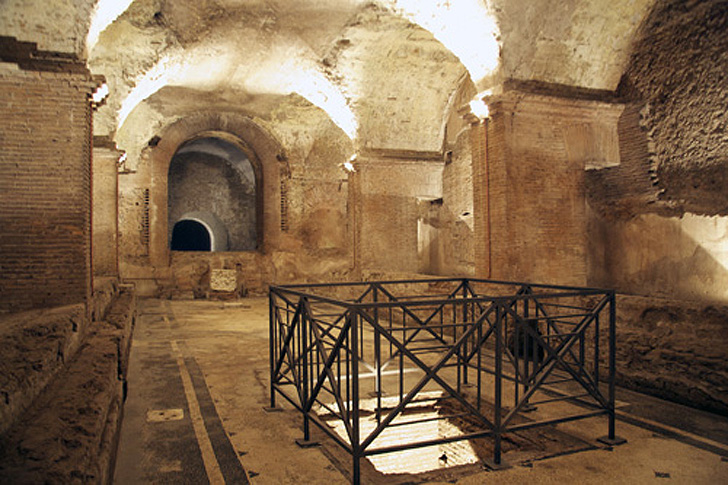
The Mitreo delle terme di Caracalla is one of the largest temples dedicated to Mithras ever found in Rome.
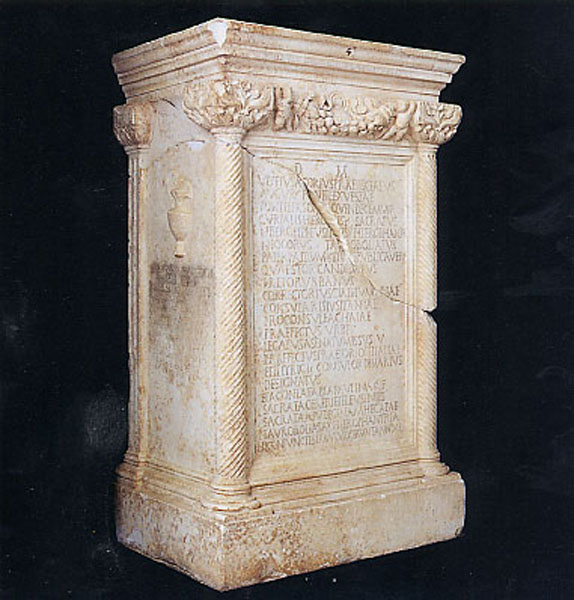
The marble altar mentions Vettius Agrorius Praetextatus as Pater Sacrorum and Patrum and his wife Aconia Fabia Paulina.
